Climate change is no longer a distant threat; it disrupts the lives of millions of children across India. Floodwaters submerge villages, heatwaves scorch towns, and cyclones ravage areas far beyond the coast, severely impacting education. These aren't just weather events—they create barriers to learning, growth, and future opportunities.
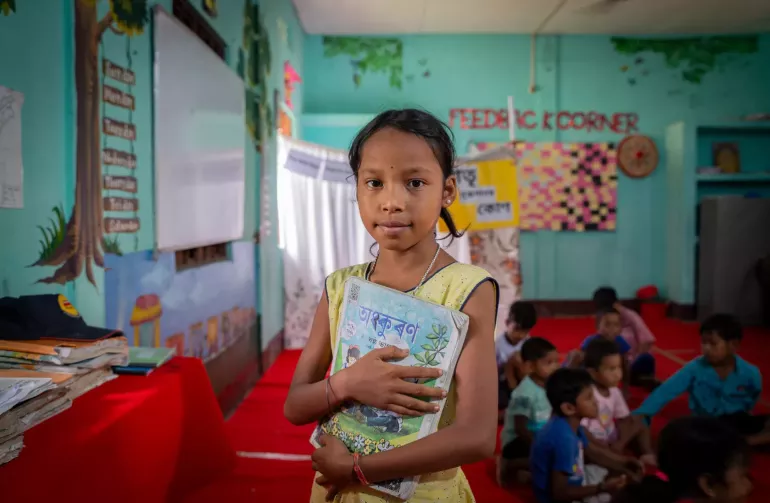
Our heart goes out to children like 10-year-old Korobi Medhi in Assam. She dreams of becoming a teacher, and school is her haven. But rising floodwaters engulfed her school, leaving it impossible for her to continue. Her books were destroyed, her classroom submerged, and her dreams put on hold. Korobi’s story is shared by millions of children in India, where climate shocks continually disrupt education. This isn't just about missed lessons—it’s about losing stability, social interaction, and safe spaces.
Such interruptions worsen inequalities for marginalized children, especially girls. Repeated, short periods of missed schooling widen learning gaps and increase the risk of dropping out. Children often must take on household responsibilities when they are at home, and they face cultural barriers to return to school.
India ranks 26th out of 163 countries on UNICEF's Children’s Climate Risk Index, emphasizing its vulnerability to climate change. This crisis, fundamentally a child rights issue, calls for urgent action to ensure learning continues despite extreme weather events.
But what if learning could continue, no matter what? What if a flood, cyclone, or heatwave didn't mean the end of a child’s education?
This vision drives UNICEF India's commitment to uninterrupted learning.
The COVID-19 pandemic showed us the potential of low-tech, no-tech, and high-tech options for learning continuity, provided there is adequate access to resources. Radio, TV, community learning hubs, online platforms, educational videos, and interactive apps enable children to access lessons anytime, anywhere.
In Bihar, digital tools are used in the ‘Safe Saturday’ programme, reaching over 8.4 million children to teach disaster preparedness while keeping them on track academically. Climate change and disaster management are part of the curriculum in Kerala, with digital content reaching remote areas. Gujarat’s self-paced school safety course has been adopted by tens of thousands of schools.
UNICEF India supports the government to train teachers to effectively use digital tools for engaging lessons, focusing on low-cost, low-tech solutions for inclusive education. India’s National Education Policy 2020 prioritizes environmental education, integrating sustainability and climate action into curricula. UNICEF and others have worked with the government to embed these elements into the National Curriculum Framework (NCF), aligning with India’s Mission LiFE to promote climate literacy and sustainable practices.
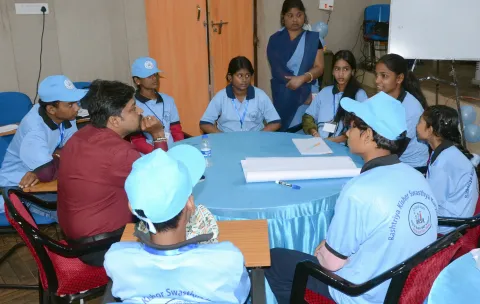
Globally, children and adolescents have been at the forefront of demanding climate action. While we strengthen knowledge and skills through the curriculum, co-curricular and extracurricular activities are critical to empower students to act. Eco clubs in schools engage students in activities like tree planting, waste management, and energy conservation, practices often extending to families and communities. In Bihar, UNICEF’s partnership with the Bihar Education Project Council on eco clubs impacted over 75,000 schools. Uttar Pradesh hosted a children’s convention on climate change, inspiring statewide campaigns through adolescent platforms in schools. And in Maharashtra, the Youth for Climate Actions (MYCA) program has integrated climate lessons into school curricula, mobilizing hundreds of thousands of young advocates.
As the frequency and severity of climate events increase, we must do more. From developing early warning systems, to shoring up school infrastructure through climate-smart builds and adaptation, to building the resilience of children and schools to disasters and growing the country's human capital to drive the green economy, we can prevent and mitigate the impact of climate change.
As I think about Korobi and the millions of children like her, I am reminded of the scale and urgency of our mission. These children are not just statistics—they represent strength and resilience, refusing to let the devastating impacts of climate change define their futures.
Safeguarding children from climate-related disruptions requires a collective effort from governments, development partners, civil society, parents, teachers, and students. At UNICEF India, we are committed to partnering and building systemic and community resilience.
We count on your support and action.
Education is not just about knowledge; it is about hope. And hope must never be disrupted.