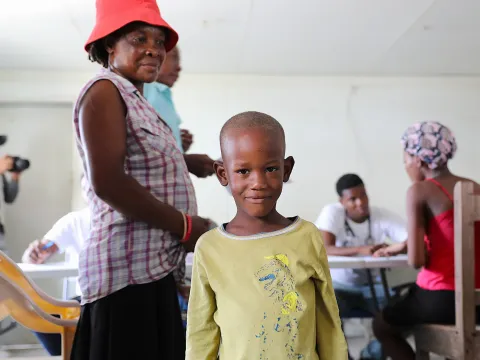
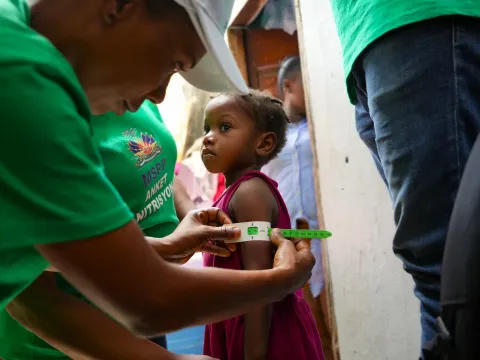
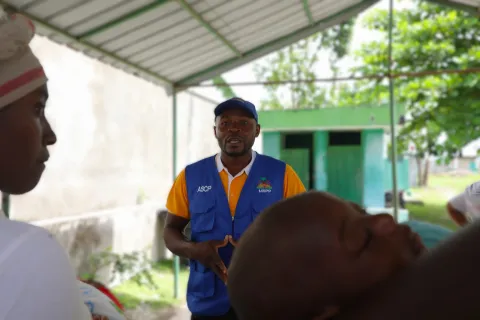
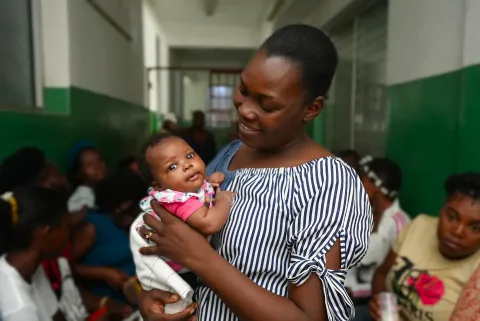
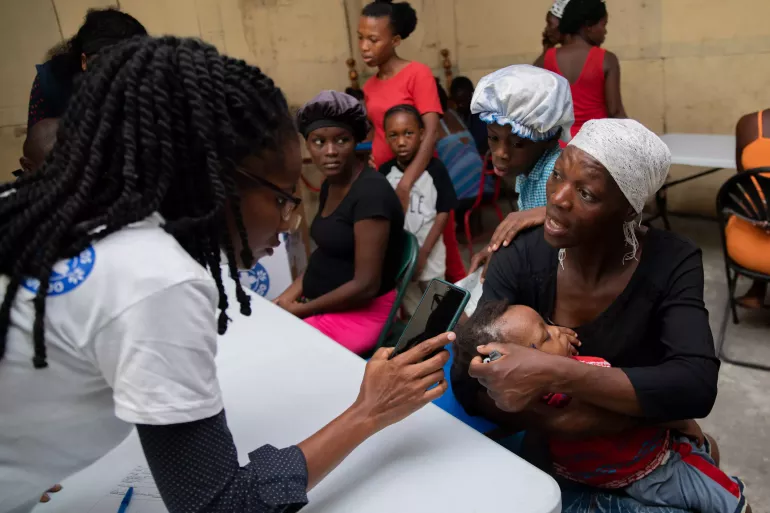
More than 50,000 displaced children and family members received medical care through integrated mobile clinics in Port-au-Prince.
- Français
- English
PORT-AU-PRINCE, 10 May 2024 – Since the coordinated attacks operated by armed groups in late February, UNICEF and its partners have rapidly scaled up their efforts, reaching over 50,000 displaced children and families impacted by the resurgence of violence in various parts of the city through integrated mobile clinic interventions.
The situation in displacement sites remains critical, with overcrowded conditions and limited access to healthcare and vaccinations exacerbating health risks such as cholera, malaria, and malnutrition. UNICEF, WHO, and partners including Médecins du Monde and the Ministry of Health ensured continuity of care delivery to internally displaced persons (IDPs) and affected communities.
"We offer an integrated package of services to children and their families, including consultations and treatment for children, pregnant women, mothers, adolescents, and families, identifying and treating cases of malnutrition, and administering vaccinations to children and pregnant women," says Jean-Bosco Hulute, UNICEF Head of Health Programme. "In March alone, more than 51,000 individuals, predominantly women and children, received vital healthcare services through mobile clinics."
Since January, the deteriorating security situation in Haiti has continued to worsen the humanitarian crisis, with UNICEF expressing grave concerns over the impact of violence on children’s access to an already crumbling healthcare system. The situation has deteriorated, with only 38% and 20% of hospitals still fully functional in the metropolitan area of Port-au-Prince and Artibonite respectively, exacerbated by challenges in maintaining electricity, fuel for generators, and ambulances.
Three out of four women and children do not have access to basic public health and nutrition interventions in the Metropolitan area of Port-au-Prince. Hospitals have been vandalized and forced to close due to safety concerns. With UNICEF support, partners have established a referral plan to ensure the care of children requiring hospitalization, including pregnant women among internally displaced persons. Two healthcare facilities, The Peace University Hospital and Eliazar Germain Hospital, have been assigned to facilitate referrals.
Maternal, newborn, and child health commodities are scarce, including shortage of quality resources and functional health facilities. Neonatal, pediatric, and nutritional units are overwhelmed. The few health facilities remaining open to women and children in areas controlled by armed groups lack adequate human resources, equipment, and medicines to provide essential health and nutrition services.
"UNICEF is exploring ways to help these facilities by providing essential supplies and strengthening supply chains and management to create a more sustainable system for the future," concluded Dr. Hulute.
Additionally, UNICEF has prioritized support in medical supplies to 67 health institutions across the departments of West, Artibonite, North, and North-East, ensuring continuity of care for children and women. In response to the collapsing health system in the Artibonite and South departments, UNICEF has deployed approximately 115 healthcare professionals to assist in case management at these departments.
For cholera management, UNICEF has provided support in medical supplies, including antibiotics for the treatment of cholera cases in children, to 10 cholera treatment centers across Artibonite, West, and South departments. The Integrated Mobile Clinic interventions have successfully traced suspected cases of cholera, with 10 confirmed cases identified in IDP sites.
"We remain committed to delivering aid despite the ever-changing realities on the ground, even in hard-to-reach and the most challenging areas. However, additional support is needed to help us protect more children and communities in need today and to move towards building more resilient systems to better protect children in the months ahead," emphasizes Dr. Hulute.
In 2024, UNICEF's plan for Haiti is to continue scaling up the humanitarian response by increasing access to basic services and helping to sustain those services. UNICEF aims to reach at least 650,000 children and women accessing primary healthcare services.
Media contacts
Additional resources