Rafeef’s Resilience: Finding Hope Through Art
From Sudan to Egypt, a girl’s quest to unleash her potential.
- English
- العربية
In a small corner in the village of Wadi Karkar, near the city of Aswan in Egypt, an 11-year-old girl named Rafeef carries the weight of a world she did not choose. A refugee from Sudan, Rafeef’s life has been marked by loss and displacement, her journey etched with the trauma of losing her father. The tragedy left her unmoored, struggling to find her place in an unfamiliar land.
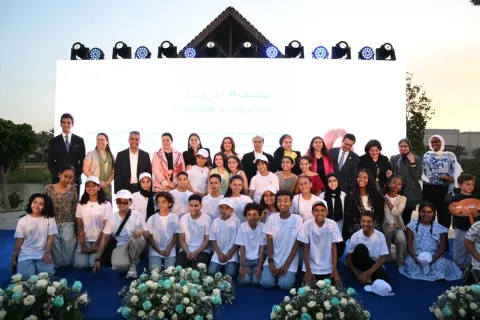
Yet amid hardships and darkness, a spark of light found its way to Rafeef through the "Art Narty" festival. Encouraged by her aunt—the unwavering source of strength in her life—Rafeef decided to attend. When asked who supports and encourages her the most, Rafeef confidently said, “My aunt is the source of solid ground for me.” With a mix of apprehension and an unspoken yearning, she entered the festival, searching for something she could not yet define.
“My aunt is the source of solid ground for me.”

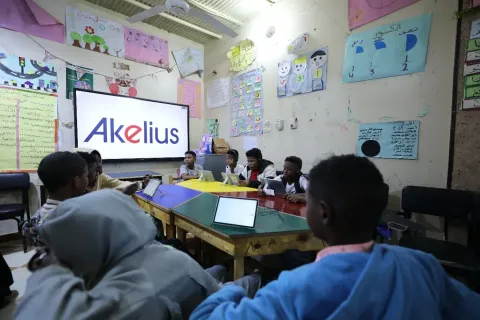
Through the UNICEF-supported Learning Space that Rafeef frequented, she was introduced to the activities of Dawwie, the National Girl’s Empowerment Initiative. Of the many Dawwie activities, one in particular caught Rafeef’s attention: a film screening that featured a documentary titled "It Takes a Village." The documentary vividly portrayed the lives of 3 girls and their families’ stories who, like Rafeef, faced overwhelming challenges. Yet, they did more than just survive; they found ways to truly thrive.
The film stirred something deep within Rafeef. As she watched, she saw reflections of her own life, but she also saw something she had not felt in a long time—hope. The characters’ resilience, their perseverance and determination to stand up for themselves and model positive change resonated deeply with her. And in that moment, Rafeef wondered to herself “Why can't I do the same?”
The next day, Rafeef attended a drawing workshop at the Art Narty festival. With her aunt by her side and the 3 girls from the documentary in her mind, she picked up a pencil and began to draw. Drawing quickly became a safe space for Rafeef, a way to channel her feelings and make sense of her world.
Through drawing, Rafeef discovered a new part of herself—an artist with the power to create beauty from pain. The more she drew, the more she healed.

“Why can't I do the same?”
When Rafeef’s artwork was displayed at the festival, it was clear that her talent was something special. The announcement that she had won first place was met with cheers, but for Rafeef, it was more than just a victory. It was a moment of self-realization, a recognition of her own strength and potential, an ignition for her confidence and pride.
Rafeef’s story is one of resilience and the power of creative expression. It is a reminder that even in the darkest times, there is always a way to find light. Through the support of her aunt and the opportunities provided by initiatives like Dawwie and the Learning Spaces, Rafeef found a path to healing and hope.
In the face of unimaginable challenges, Rafeef has discovered the strength to rise, the courage to dream, and the creativity to build a new future—one brushstroke stroke at a time.
Dawwie-the National Girls’ Empowerment Initiative-is a multi-stakeholder’s initiative to advocate for girls’ empowerment through enhanced access to quality services, skills development, and opportunities to participate and be heard. Dawwie was placed under the auspices of H.E. First Lady, Intissar El-Sisi within the framework of the National Egyptian Family Development Project and is led by National Council for Childhood and Motherhood (NCCM) and the National Council for Women (NCW) supported by UNICEF and in partnership with the Ministry of Education and Technical Education MoETE), Ministry of Social Solidarity (MoSS), Ministry of Health and Population (MoHP), Ministry of Youth and Sports (MoYS) and Ministry of Culture (MoC), Ministry of Information and Communication Technology (MoICT), National Council for Persons with Disability (NCPD) and the National Population Council (NPC), in addition to civil society organizations and international organizations.