Teaching Beyond the Textbook: Inside the Akelius Language Learning Approach in Egypt
How a five-day teachers’ training and blended digital learning programmes are expanding inclusive education for vulnerable children across Egypt

- English
- العربية
In learning spaces across Aswan, Egypt, the “Akelius Language Learning Programme” is strengthening both classroom practice and student engagement. Through a two-year partnership between Egypt’s Ministry of Education and Technical Education, UNICEF, and the Akelius Foundation, the programme is expanding inclusive digital learning opportunities for marginalized children across Egypt.
Through a partnership with Om Habiba Foundation, the programme is being implemented in Aswan, integrating interactive English learning into remedial education for Sudanese children on the move.
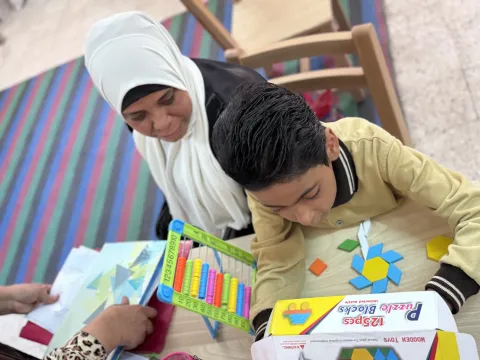
Before introducing tablets in the classroom, teachers completed a five-day intensive training on how to integrate digital learning into their lessons. The training focused on practical classroom methods, helping teachers combine self-paced learning on tablets with guided instruction using digital tools, ensuring that technology complements, rather than replaces, instruction.
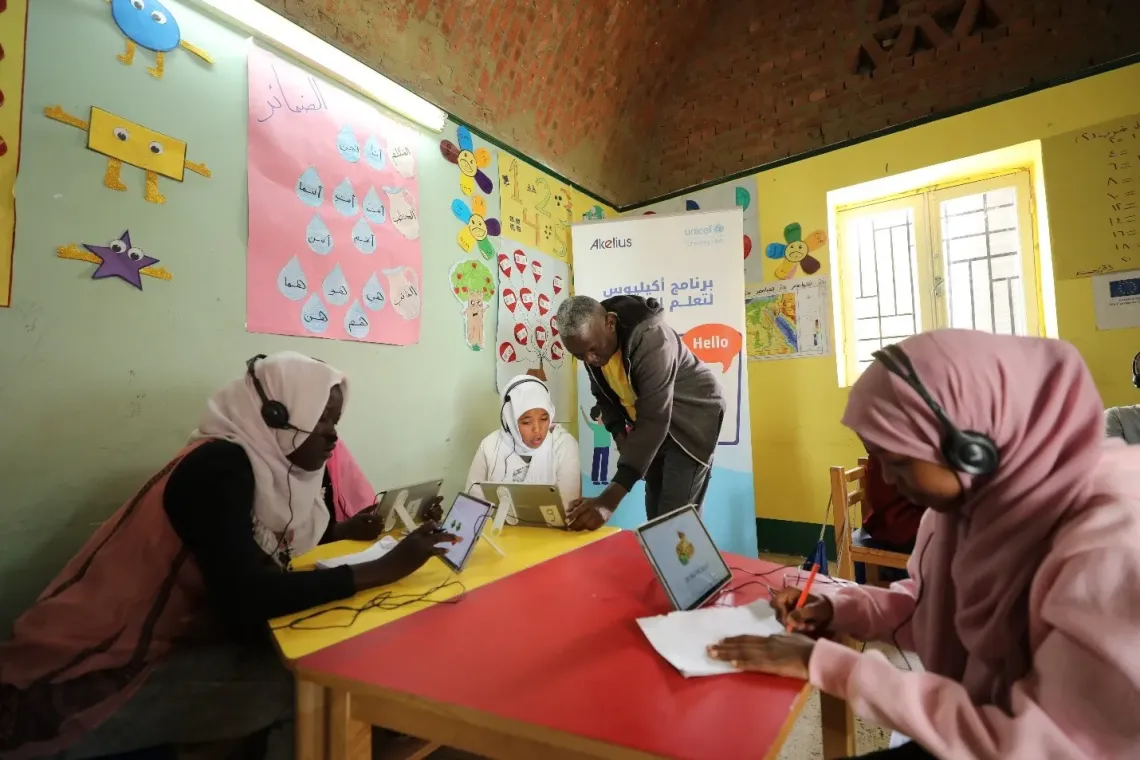
When the programme was first introduced, teacher Moataz Osman, originally a physicist and expert in solar energy from Khartoum, admitted he was skeptical.
“I was worried about children handling the devices, that they might break the tablets, and I was unsure how the system would work with weak internet connections for energetic students who get bored very quickly,” he recalls.
But once implemented, his concerns quickly faded. The children began treating the tablets as precious possessions, and as soon as the lessons started, the classroom grew noticeably quieter as each student became immersed in the visual, audio, and interactive activities. “I found how easily children used it and do not get bored. My fears didn’t materialize; on the contrary, students stay focused on their tablets even after the class is over. Now I’m asking for more tablets to accommodate larger numbers of students in the learning space.”
Moataz explains that the offline feature, permitting the class to use the Akelius application without internet connectivity, was his major concern during training days and is now one of the programme’s greatest strengths. It allows students to access language lessons and interactive exercises even without their tablets being connected to the internet. Using their own tablets, teachers can monitor students’ progress in real time and quickly identify learning gaps. “In the beginning, it was unclear – did it connect? Did it not? Get the barcode, leave the barcode, etc. But we got used to it, and it became easy for students to connect to the local network.” He continued: “The network is weak in the area, so it was difficult to work online as there was no connection; this is the value of the offline mode. After I provide a general overview of the lesson, it helps me monitor each and every student, where they work and how far they have gone. Instead of counting on traditional methods or one-size-fits-all tests, the application helps me identify gaps and provide targeted support based on their level.”
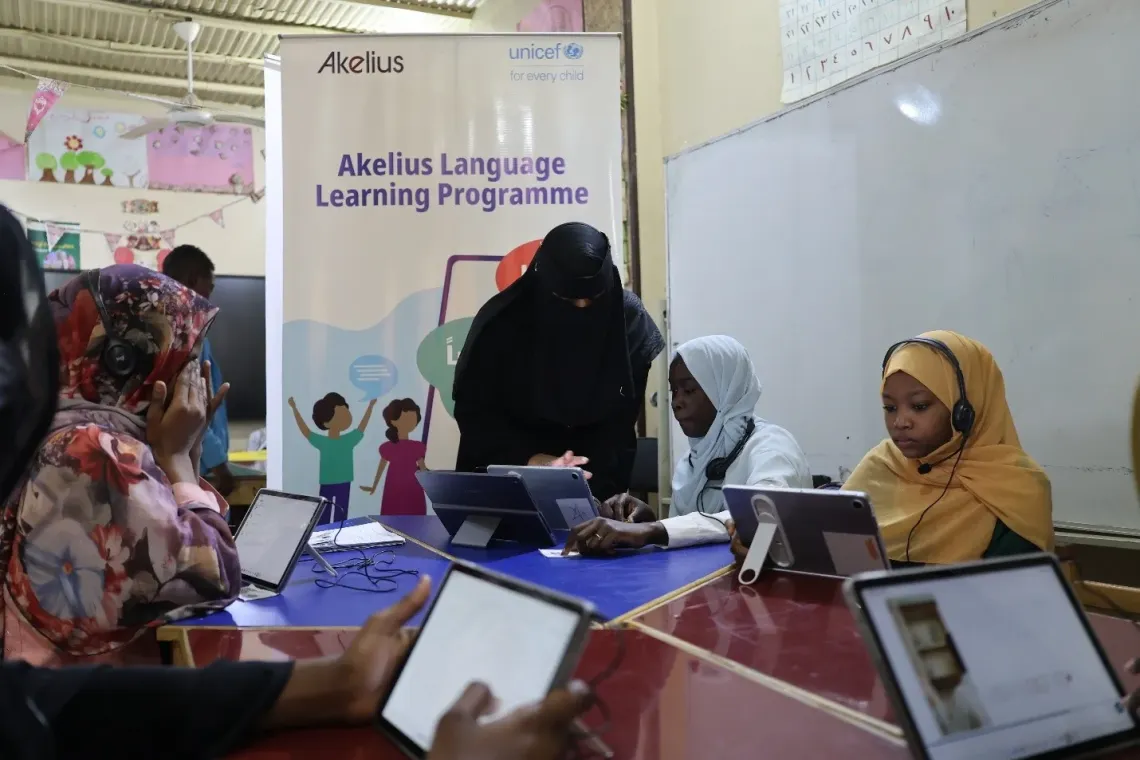
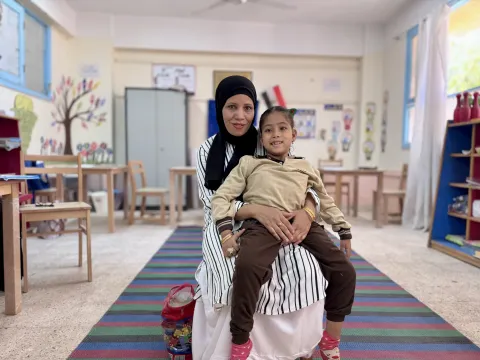
Across town, another Akelius Champion, Ms. Roqaya Farouq, is witnessing broader outcomes from the use of tablets and the Akelius application within the Al-Fadl Learning Space. Many of the children she works with arrived after long interruptions to their education. “Some of our students have been out of learning for nearly two years,” she explains. “They came with very little foundational knowledge, and many of them were not ready to learn. They were focused on returning home to Sudan, and that frustration sometimes showed in the classroom through conflict or damaged furniture.”
Since introducing the tablets and the Akelius application, Roqaya has observed a noticeable shift in the classroom environment. “Now the students feel that the devices belong to them and to the learning space,” she says. “They protect the tablets and take care of them.” The interactive design of the application has also increased motivation. “They love earning coins when they answer correctly,” she adds with a smile. “It motivates them to continue so they can customize their avatars.”
Beyond learning outcomes, Roqaya highlights an important psychological shift. The students’ behavior and attendance have gradually improved as they develop a stronger sense of belonging to the learning space. “They feel that this place is theirs,” she explains. “When they come to class now, they come with a purpose and with curiosity.” For Roqaya, one of the most important benefits is the opportunity for personalized learning. “Each student uses their own tablet during their time slot, which means they can start from their own level and move at their own pace,” she says. “With the headphones, they can practice privately without feeling embarrassed if they make mistakes. It gives them confidence, and they are much more eager to learn.”

Within two years, the initiative equips classrooms with tablets and the Akelius application, trains 450 educators, and directly supports around 7,500 children, while also reaching thousands of family members indirectly. At the community level in Aswan, implementation is carried out in cooperation with the Om Habiba Foundation, ensuring the programme responds to the needs of refugee children and the realities of local learning spaces.
What began as hesitation for some teachers has become strong advocacy among them. As Moataz puts it: “Anyone who can use Akelius should have it at home. Unlike textbooks and other methods that can be exhausting for teachers and difficult for students to absorb, this is very simple. After using it two or three times, the information becomes firmly established in your mind.”