A Message Through the Brush... Louder Than a Thousand Words
The Story of Maha Gamil: Turning Art into a Voice

- English
- العربية
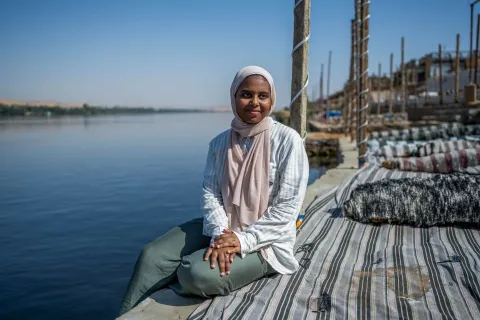
Maha Gamil, a 32-year-old artist from Aswan, never viewed painting as just a hobby or "scribbles" on walls. Maha decided to paint murals not just to beautify the streets, but to turn art into a tool for positive change—using it to amplify people’s voices.
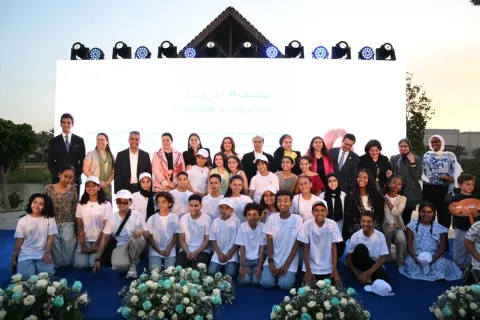
Maha has been an ambassador of "Dawwie", the National Girls’ Empowerment Initiative under the auspices of Mrs. Entissar El Sisi and implemented as part of the "Tamkeen Programme" for Empowering Egyptian Women, supported by the European Union.
She began using her murals to inspire countless girls and boys. Her goal was clear: to prove that girls can succeed in any field, and that art can give confidence to anyone who feels unheard.

The Smile That Made a Huge Difference
At a "Dawwie" camp in a Nubian village, a grandmother asked Maha to paint her 5-year-old granddaughter Rasma, who has autism. The girl didn’t interact with anyone at all, but the moment she saw her painted portrait, she smiled. "In that moment, I felt that the painting was the key to a heart that had been closed for years."
Maha never stopped painting, and behind every mural was a story:

Mohamed: A deaf child who suffered from bullying. When Maha painted him among his friends, he felt "seen" and accepted for the first time. Her art shed light on his power and gave him a sense of belonging.

Heidi: The brave girl who advocated for "Dawwie" activities in her school. Maha celebrated her leadership in a massive mural to tell every girl: "You don't have to be famous to make an impact... change starts with a word."
Streets of Aswan: Maha transformed four buildings into a museum that tells the stories of workers, children, and grandmothers. "I wanted everyone walking in the street to feel like the hero of the story."

Maha’s Greatest Challenge
Maha's most difficult moment was painting the "Symbol of the Nile" on a giant water tank. The scorching sun, terrifying heights, and heavy winds made the work difficult, but the dream was stronger. "Every brushstroke was saying: Nothing is impossible."
Throughout all of this, there was one person standing behind Maha—her husband, Ali. Ali was the support system that reassured her whenever she felt unsure. "Ali would carry away my fear before he carried the equipment. When I felt weak, his voice would tell me: Keep going, we are doing something great."
Maha’s Message to Every Girl
Maha’s story shows how art can become a powerful tool for inclusion, confidence, and social change. More than that, through her murals and community engagement, she is not only transforming public spaces in Aswan, but also helping children and young people feel seen, heard, and valued. Her journey reflects the spirit of the Dawwie initiative: empowering girls and communities to express themselves, challenge stereotypes, and inspire positive change through creativity and participation.
After being honoured by numerous Egyptian institutions in recognition of her work, Maha shares a simple, direct message:
"Don’t wait until you have everything to start. Start where you are, with what you have in your hands and what you carry in your heart. Society can change with a single painting, a single idea, or a sincere story... and I chose to tell our stories on the walls."
About Dawwie:
Dawwie-the National Girls’ Empowerment Initiative, under the auspices of H.E. Ms. Entissar El Sisi, and within the National Investment Framework for Girls in Egypt, is a multi-stakeholder initiative that advocates for girls’ empowerment through enhanced access to quality services, skills development, and opportunities to participate and be heard.
Dawwie is led by National Council for Childhood and Motherhood (NCCM) and the National Council for Women (NCW) supported by UNICEF and in partnership with the Ministry of Education and Technical Education (MoETE), Ministry of Social Solidarity (MoSS), Ministry of Health and Population (MoHP), Ministry of Youth and Sports (MoYS) and Ministry of Culture (MoC), Ministry of Information and Communication Technology (MoICT), National Council for Persons with Disability (NCPD) and the National Population Council (NPC), in addition to civil society organizations and international organizations.