It Runs in the Family
From One Generation to the Next: A Story of Strength, Empowerment, and Change

- English
- العربية
At first glance, Mariam and her mother Nadia appear to be a typical Cairo-based mother-daughter duo, but their story proves otherwise. Mariam and Nadia’s individual and intertwined stories are stories of resilience and perseverance; they are stories of struggles for dreams, of the impact of girls’ empowerment and the difference it makes on the individual lives as well as the immediate community and the community at large; they are stories of the transformation of societal norms across generations. Mariam, a 15-year-old aspiring football player, is breaking barriers in a male-dominated sport, while her mother, Nadia, a therapist, and advocate for mental health, reflects on the obstacles she faced at the same age and the strides the younger generation is making.
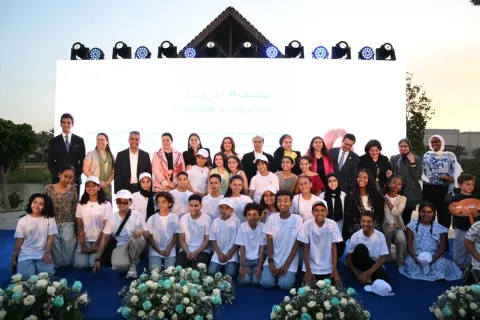
Mariam’s journey began with a spark of inspiration from the Digital Literacy Package followed by the Storytelling Circles as part of the journey of Dawwie, the National Girl’s Empowerment Initiative. The storytelling circle’s topic was on the rights of girl children and it was aimed at empowering girls to first understand their rights and then speak up and advocate for their rights. At just 13, Mariam participated in sessions on self-expression and solidarity, which gave her the courage to pursue her passion for football. Today, she leads a football team of 11 girls, defying societal norms and inspiring her peers to do the same.
“I want to play football, and I’ll do everything I can to play football,” she declares with unwavering determination.
Mariam, what do you think, or feel are the challenges that 15-year-old girls face today?
Mariam’s answer was one word: Family.
She went on to explain that unfortunately, till this very day, not all families are generally supportive of their girls. There is an element of control that still manages to seep into the girls’ lives, and it is difficult to stand up to it or stop it. When Mariam herself chose football, a sport she was very passionate about and saw herself excelling at, she faced a lot of resistance and discouragement that was disappointing. What was more surprising was that such discouragement was not just restricted to her immediate family members, it was also her uncles and some members of the extended family, mostly males. “It is a boys’ sport!” Her father would often remind her.
With the unconditional support of her mother, Mariam was able to eventually do what she loved. Her mother stood by her and fostered that shining light she saw within Mariam which seemed very familiar to Nadia herself.
Mariam’s journey extends beyond her personal achievements. She vividly recalled a friend who loved football but was barred from playing by her strict father. Seeing her friend’s emotional decline, Mariam rallied her team and coach, along with her mother, to visit the friend’s house. Together, they convinced the father to let his daughter play, reigniting her passion and restoring her confidence. This act of solidarity exemplifies what Mariam learned at Dawwie: the power of collective action and the importance of standing up for others. “Obstacles and barriers cannot stand in front of a girl who knows her rights,” Mariam asserts.

UNICEF/Egypt 2025/Ibrahim Mohamed
"Obstacles and barriers cannot stand in front of a girl who knows her rights,"
And Nadia, do you remember what the challenges were when you were Mariam’s age?
Nadia chuckles and she looks at Mariam. "My life was just very different," she begins, her voice tinged with both nostalgia and resolve. Nadia was the youngest of five siblings, with three older brothers and one sister. "My father was very difficult," she explains, "especially with girls." Her childhood was marked by restrictions: she wasn’t allowed to go out often, have friends over, or play sports. "I had to resort to working out at home or going for longer routes to walk more when running errands," she recalls. Yet, her father valued education—though he enforced it with fear, threatening to pull her out of school if she failed any year.
After finishing high school, Nadia’s passion for social work and psychosocial support led her to apply to university. But her father refused, deeming the faculty campus too far away. It was her older brother who stood up to him, advocating for Nadia’s dreams. With his support, she was finally able to pursue her studies, eventually becoming a therapist.
It wasn’t until the age of 39 that Nadia truly began to feel supported. Her marriage, though initially to a man reminiscent of her father in attitude, revealed a partner who was resilient and capable of listening. "For the first time, I could carry on with my postgraduate studies and pursue my passions," she says. She joined a gym, rediscovered hobbies, and evolved into the person she had always aspired to be. Determined to ensure her daughter had the opportunities she had longed for; Nadia became a source of strength and inspiration. “I want her to have all the opportunities and chances that didn’t come so easily to me” she said.
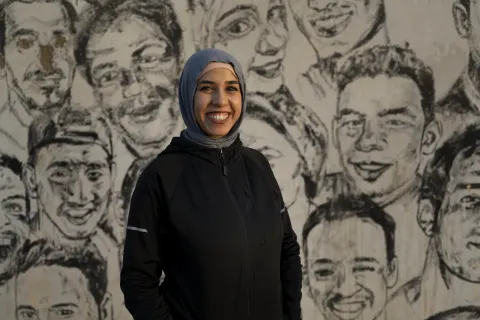
Today, Nadia balances a thriving career and personal interests with a mission to influence others positively. Through her social media channels, she spreads mental health advice, aiming to empower other women. Her husband, Mariam’s father, has grown increasingly supportive over the years, offering encouragement to both Nadia and Mariam.
Nadia’s influence now extends beyond her immediate family. She has inspired her nieces and become a beacon of encouragement for them as well.

UNICEF/Egypt 2025/Dalia Younis
“I want her to have all the opportunities and chances that didn’t come so easily to me”
What were/are your thoughts on your surrounding community’s views of girls like yourself playing football? In school for example. Can you tell us more about that?
At school, Mariam often found herself at the receiving end of bullying by some of her peers. “Why do you want to be a boy?” They would ask her. When probed about how she felt at that time, Mariam simply said “I didn’t care what they said. I didn’t let it affect me in the least bit.” Afterall, football meant more to Mariam than a mere sport, it was a way to take good care of her physical health, but also her mental and emotional health, it was an outlet for extra energy, moreover, it was an avenue for networking and bonding with other girls who shared her passion. She was doing what she loved, and on top of that, “I had a strong support system”, she said as she looked at her mother.
Her perseverance gradually turned critics into supporters, with some peers even cheering for her at matches. Her teachers and school administration also played a pivotal role, ensuring she could balance academics and sports by accommodating her training schedule.
How did you come to love football so much?
Mariam’s journey into football began by sheer chance. While accompanying her younger brother to his swim classes at the youth center, she noticed a group of boys practicing football on the field. The sight of them ignited something within her—an undeniable desire to be part of the game. She started asking around but quickly learned that the youth center had no team for girls. Undeterred, Mariam persisted and found a trainer willing to teach her and another friend.
At first, it was just the two of them. Slowly, other girls, who initially came just to watch from the sidelines, began to join. They hesitated at first, but Mariam’s enthusiasm was infectious. What started as a duo blossomed into a growing group, with friendships forming and confidence building along the way. The snowball effect continued until they formed a full team of 11 girls—a feat that seemed impossible at the beginning.
For many of Mariam’s peers, playing football was more than just a challenge on the field—it was a battle against deep-seated societal expectations. Some parents, particularly fathers, dismissed the idea outright, seeing it as inappropriate or unimportant for girls. But Mariam and her mother, Nadia, refused to back down. Determined to change perceptions, they took it upon themselves to engage with these families directly, addressing their concerns and demonstrating that sports were not merely a pastime but a powerful tool for growth and empowerment.
Nadia’s presence proved instrumental in shifting mindsets, especially among the mothers. Her involvement reassured them that their daughters were not only safe but also supported in their pursuit of the game. More than that, she inspired many of them to stand by their daughters, encouraging them from the sidelines and celebrating their victories. Together, Mariam and Nadia showed that football was far more than just a sport—it was a means of breaking barriers, building confidence, and strengthening bonds among girls, paving the way for a future where they could play, dream, and thrive.

Mariam, what are your hopes and dreams for girls in the future? And what’s one thing you would change right now about the status of girls?
Mariam’s vision was clear. For girls in general, she dreams of a world where they can speak up without hesitation, where they are presented with opportunities to pursue their passions, and where equality is not just an ideal but a reality. For herself, her dream is singular yet ambitious: she wants to be a world-famous football player.
If Mariam could change one thing about the current state of girls' lives, it would be the visibility of programs like Dawwie. "Dawwie helped me understand my rights," she said. "Obstacles and barriers cannot stand in front of a girl who knows her rights." She emphasized the importance of ensuring equal opportunities in education, access to sports, and proper healthcare for girls. "I believe that what I would want to change in the end is that more and more girls feel supported in order to be empowered," she added.
Her message to the football managers, predominantly men, of the sporting clubs she dreams of joining was equally powerful: "Give us a chance," she said. "Sports are not just for men. It is for everyone. And everyone deserves a chance at them." Mariam admires initiatives like Al-Ahly club’s focus on girls' empowerment and hopes more clubs will follow suit, creating a future where girls like her can thrive.
How about you Nadia, what were your biggest hopes and dreams when you were 15 years old?
Nadia’s answer was immediate yet quiet: "To get rid of the shackles," she said. She longed for freedom—a chance to pursue her studies, practice hobbies, and explore the world. Yet, even when she managed to achieve those dreams, it came with immense struggle and persistence.
And what do you admire the most about the younger generations of girls?
One thing Nadia admires about the younger generation is their courage. "They are more daring, more willing to speak up and follow their hearts," she said. Nadia often reflects on how much time and pain she could have saved if she had the same perseverance and boldness she sees in girls like Mariam. "They can save themselves so much time, pain, and effort," she adds. Looking at her daughter, she smiles and says, "I always tell her how proud I am of the person she is."
On institutional attitudes toward girl empowerment, Nadia acknowledged the progress being made. "There is a lot of change happening in favor of girls today,” she said. She reflected on positive changes happening on the institutional levels and on the policy levels. But gaps remain, especially in fields like professional sports, where girls still lack the same opportunities and support as boys. Nadia hopes that these gaps will continue to close, particularly while Mariam is practicing and pursuing her dreams.
What advice would give to a younger girl, an 11-year-old girl for example?
Mariam’s response was direct and heartfelt: "Know your rights. Take care of your health by playing a sport that you like. Express yourself and your opinions more."
"If some of Dawwie’s activities could be applied in her school, it would help girls so much," she said. Mariam emphasized the importance of involving families in these initiatives, creating an environment where girls feel empowered, less alone, and more supported. She believes this kind of platform could help girls become more aware of their rights and gain the confidence to advocate for themselves. "Even the school staff would encourage this," she added with a smile.
Mariam and Nadia’s journey is one of courage, resilience, and the power of unwavering support. Together, they have challenged norms (and still do), redefined possibilities, and in their own way—paved the way for a future where girls can dream freely and chase those dreams without fear. Mariam’s determination to play football and Nadia’s steadfast belief in her daughter’s potential are reminders that change often begins with a single voice—one that refuses to be silenced.
As Mariam continues to break barriers on the field, and as Nadia empowers others through her advocacy, their story stands as a testament to what is possible when girls are given the space to thrive. Their journey is far from over, but with every match played, every voice raised, and every girl inspired, they are shaping a world where no dream is out of reach.

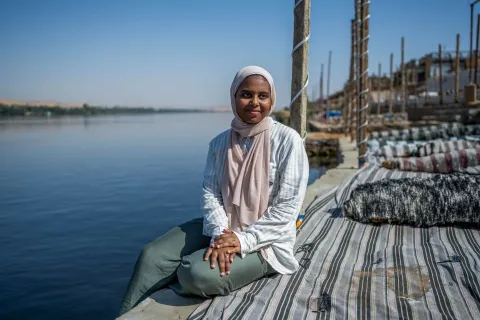
UNICEF/Egypt 2025/Dalia Younis
“I always tell her how proud I am of the person she is.”
Dawwie-the National Girls’ Empowerment Initiative-is a multi-stakeholder’s initiative to advocate for girls’ empowerment through enhanced access to quality services, skills development, and opportunities to participate and be heard. Dawwie was placed under the auspices of H.E. First Lady, Intissar El-Sisi within the framework of the National Egyptian Family Development Project and is led by National Council for Childhood and Motherhood (NCCM) and the National Council for Women (NCW) supported by UNICEF and in partnership with the Ministry of Education and Technical Education MoETE), Ministry of Social Solidarity (MoSS), Ministry of Health and Population (MoHP), Ministry of Youth and Sports (MoYS) and Ministry of Culture (MoC), Ministry of Information and Communication Technology (MoICT), National Council for Persons with Disability (NCPD) and the National Population Council (NPC), in addition to civil society organizations and international organizations.