Sustainability-driven education from childhood cultivates a green economy workforce
As the next generation of workers, decision-makers and innovators, young people in the Western Balkans have a pivotal role to play in advancing the 2020 Green Agenda

The Agenda aligns with the European Green Deal and sets ambitious targets for environmental protection, reduced greenhouse gas emissions, climate adaptation and economic development by 2050.2 It also aims to create new economic opportunities with bold goals for clean energy, sustainable industries and climate-resilient infrastructure.
The World Bank recognizes the green transition in the Western Balkans as a key driver of economic growth,3 while the European Commission’s Growth Plan for the region4 emphasizes investment in human capital as essential to sustainable development.


Ensuring that children and youth are included in the emerging green and circular economy5 is essential for promoting long-term economic stability and social equity across the region.6
Since 2021, UNICEF has partnered with ministries of education, educational organizations and universities in the Western Balkans to incorporate environmental knowledge and green skills into national education systems. Their efforts address critical gaps7 in climate change awareness, sustainability practices and environmental literacy across all levels of education.
In Albania, for instance, primary education has long served as a catalyst for environmental awareness.
UNICEF partnered with the Ministry of Education and Sport (MoES) and the National Agency for Quality Assurance in the Pre-University Education System (NAQAPUE) to boost learning in Grades 6–9 by creating a specialized teacher’s manual on climate change and sustainable development.8 In 2024, MoES officially incorporated the manual as a resource for teachers to support the standard curriculum, providing more than 14,700 educators with access to this resource as they teach nearly 124,000 students.
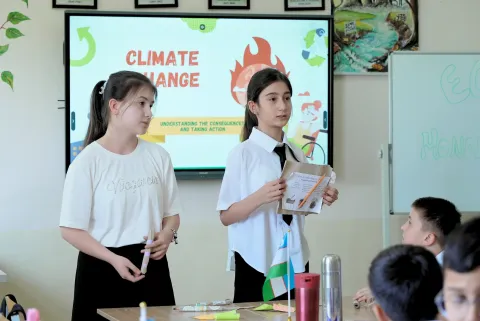
Using the teacher’s manual, 305 teachers from 15 primary schools in Albania were trained by UNICEF to deliver hands-on environmental education. They reached 3,000 students with lessons on climate science, air quality, health impacts and strategies for mitigating and adapting to climate change.
These students then mobilized 6,500 peers in green initiatives, including recycling drives, tree planting, biodiversity protection, eco-friendly transportation, air quality improvement and the sustainable use of energy, water and products at home and school. The activities equipped students with vital environmental knowledge and practical green skills.
Similarly, in North Macedonia, UNICEF and the Bureau for the Development of Education have laid a strong foundation for climate and environmental education. From 2022 to 2024, they integrated environment and climate change topics into 20 mandatory primary school subjects – including natural sciences, social science, math, geography, biology, physics and chemistry – as well as seven elective courses focused on environmental sustainability and climate change. These updates were implemented in all five languages of instruction, reaching the entire primary school population of approximately 180,000 children aged 7–14.
In Kosovo1, UNICEF developed digital courses on air pollution, making them accessible to 94,000 students in Grades 5–9. These courses enhance students' scientific understanding of air quality while offering practical strategies and advocacy tools to help reduce pollution-related health risks.
By introducing environmental education early across multiple countries, teachers are actively preparing young students in the Western Balkans to participate in – and eventually lead – the region’s green transition.
In later grades, UNICEF in North Macedonia has been actively advancing environmental literacy and practical green skills in secondary schools (Grades 10–13). The country’s Vocational Education Centre has formally integrated green skills into the national vocational education and training (VET) curriculum to reach thousands of students nationwide. Together with UNICEF, the Centre developed elective courses across all 14 VET sectors,9 including agriculture, chemistry, construction, transportation, economics, trade, law, health, machinery and textiles. By embedding environmental and sustainability practices into VET programmes, students are gaining valuable expertise in green skills that enhance their competitiveness in emerging green industries.

In Serbia, UNICEF and the Ministry of Youth strengthened adolescents’ green skills through innovation clubs embedded in youth centres and clubs. Across five districts, 629 adolescents participated in UNICEF-led training sessions focused on sustainable business, circular economy principles, energy-efficient prototyping and climate-smart design. Additionally, more than 250 adolescents from over 20 cities took part in five UNICEF-led eco- innovation workshops. Supported by UNICEF partner funding, participants developed practical and creative environmental solutions that have positively impacted more than 36,000 city residents.
One of the implemented initiatives was a bus stop roof covered with vegetation to absorb carbon dioxide, improve air quality and provide shade for waiting passengers. Another was solar-powered river alarms with backup battery power that have been installed to monitor water levels and issue flood warnings – even during power outages.
Through the youth club training sessions and eco-workshops held in Serbia, the innovation development process equipped young people with essential, practical green skills – preparing them to actively participate in the evolving green and circular economy.
In higher education in Bosnia and Herzegovina, UNICEF collaborated the University of Sarajevo to develop a specialized digital course on air quality.10 Launched on the university’s e-learning platform in 2024, the course is accessible to more than 15,000 undergraduate students. It deepens their understanding of the health and socio-economic benefits of a clean environment, sharpens critical thinking through air quality data analysis and policy evaluation, and encourages civic and political engagement. By applying these insights, students enhance their career prospects in environmental science, public health and sustainability.
Elsewhere in the region, UNICEF is enhancing youth employment prospects in Kosovo and Montenegro by facilitating internships, on-the-job training and career guidance. In 2024, 115 young people were placed as interns in 31 private companies, municipalities and civil society organizations – gaining real-world experience in sustainability-focused fields.
Looking ahead, UNICEF plans to expand its activities by facilitating 500 internships for VET students in North Macedonia.11 These internships aim to equip young people with the skills and expertise needed to become key contributors to the green economy.
By incorporating environmental education, vocational training and hands-on sustainability projects into both formal and informal learning spaces, these initiatives across the Western Balkans ensure that children and young people develop the knowledge and skills needed for the green transition. As industries adopt more sustainable practices, students with climate literacy and practical green competencies will be well-positioned to meet workforce demands, drive innovation and contribute to the region’s long-term environmental and economic resilience.
Footnotes
1. References to Kosovo in this document shall be understood to be in the context of the United Nations Security Council resolution 1244 (1999).
2. European Commission, 2020, Guidelines for the Implementation of the Green Agenda for the Western Balkans.
3. World Bank, 2025, Adapting for Sustainable Growth: Western Balkans Economic Report.
4. European Commission, 2023, Growth Plan for the Western Balkans.
5. European Union, 2024, Policy Report on the Green Transition in the Western Balkans.
6. UNICEF, 2023, Accelerating ‘Green’ School-to-Work Transitions.
7. European Commission’s Joint Research Centre, 2024, Status of Environment and Climate in the Western Balkans.
8. UNICEF, MoES and NAQAPUE, 2024, Education on Climate Change and Sustainable Development.
9. See the developed Curricula and Manuals.
10. University of Sarajevo, 2024, The Summer School ‘Climate Changes and Air Pollution’ completed and the digital educational platform presented.
11. UNICEF, 2025, Public institutions to foster green skills of students from vocational schools.