Evidence and sustained leadership help reduce lead exposure
Children are especially vulnerable to lead exposure because their bodies absorb lead more efficiently, and their developing brains are highly sensitive to its toxic effects

Infants and young children can absorb four to five times more lead than adults when exposed1.
Lead poisoning also causes irreversible neurological damage, attention deficits, learning difficulties and behavioural problems2.
UNICEF has identified lead poisoning as a significant environmental and public health threat to children in Georgia. Lead contamination in the country stems from various sources, including old lead-based paint, contaminated soil and dust and household items3 – all of which pose serious health risks, particularly to children. To address this issue, UNICEF supports a lead surveillance system that monitors lead levels and investigates sources of exposure while collaborating with the government and partners to reduce risks. The collaborations have delivered measurable impacts. For instance, a recent study shows that since 2020, the average blood lead levels in pregnant and breastfeeding women in the Adjara region have dropped by 59 per cent4, marking a significant improvement.
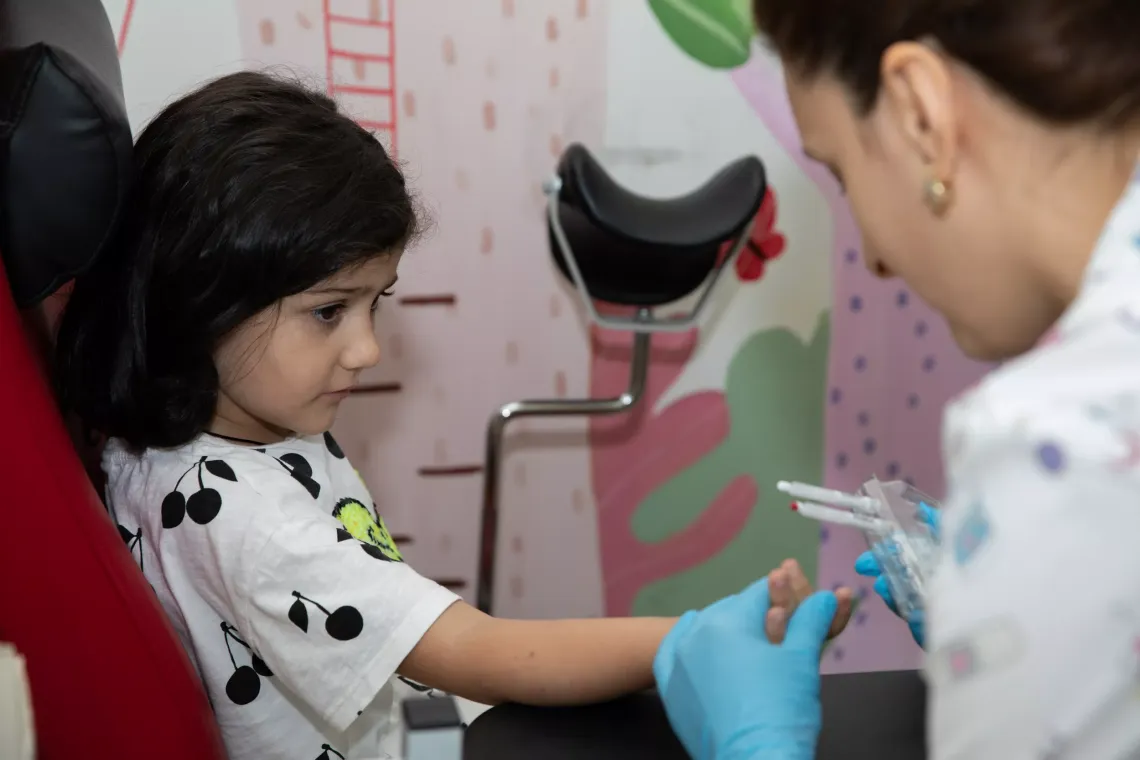
In 2018 when UNICEF, the National Statistics Office of Georgia and the National Centre for Disease Control and Public Health assessed lead prevalence in children’s blood. They used the Multiple Indicator Cluster Survey (MICS) – a research programme led by UNICEF that collects household data on children’s health, education and well-being5. The MICS found that 41 per cent of children in Georgia had blood lead levels (BLL) at or above 5 µg/dL (micrograms per decilitre), with western regions showing a particularly high prevalence6. The results were alarming and called for urgent action.
Following the study, UNICEF worked closely with the Government of Georgia to significantly and strategically strengthen its institutions, laboratories and surveillance systems to better detect and address lead contamination. The government also enhanced front-line health services, regulations, enforcement and accountability measures to protect children from lead exposure. This included providing free testing, consultations and supplements for children with elevated blood lead levels.
Global action
UNICEF provided the government with technical assistance, resources, and guidance for a long-term strategy to reduce lead exposure, with a focus on children. Additionally, UNICEF supported the establishment of the Chemical Risk Factor Research Laboratory and the government-endorsed Environmental Health (Lead) Surveillance System, which was piloted in two regions. The lab examines toxic elements in various specimens, while the surveillance system tracks lead prevalence and investigates sources of exposure. To strengthen monitoring efforts, the government is expanding the surveillance system to 6 regions in 2025, aiming for full implementation in all 10 regions by the end of 2026.
Footnotes
1. UNICEF, 2023 https://www.unicef.org/stories/7-things-know-about-lead-exposure
2. UNICEF, 2020 https://www.unicef.org/reports/toxic-truth-childrens-exposure-to-lead-pollution-2020
4. International Journal of Hygiene and Environmental Health, 2025, Time-trends of blood lead levels from 2020 to 2023 in pregnant and breastfeeding women from Adjara, Georgia – A birth registry-based study
5. UNICEF, accessed June 2025, About MICS Programme.
6. National Statistics Office of Georgia, UNICEF, 2018, MICS Statistical Snapshot: Georgia - Lead