How UNICEF is ending childhood lead poisoning in Georgia
Establishment of the Lead Surveillance System and the Chemical Risk-Factor Research Laboratory allowed identification of sources of contamination and providing support to families

- English
- ქართული
Five-year-old Nutsa plays with her cat Tsknapo in her family house on the outskirts of Batumi, in western Georgia, where she lives with her parents and two older siblings.
“She is an active, caring little girl,” says her mother, Irina. “Nutsa is well known and loved by all our neighbors, and their pets,” she laughingly adds.
Nutsa’s family did not have much information about lead or its harmful effects on children, when they received a call from the local health clinic, inviting the five-year-old to a random blood test for lead prevalence.
In 2019, when the data on lead prevalence in children’s blood was collected as part of the Multiple Indicator Cluster Survey (MICS), the results revealed that 41 percent of children in Georgia had blood lead levels (BLL) at or above 5 µg/dL. The results showed that regions in western Georgia had an elevated lead prevalence. In Adjara, where Nutsa and her family live, 85 percent of children had elevated BLLs.
“The MICS data on lead prevalence triggered an immediate government response, mainly through the state health programme providing free testing, consultations, and supplements to children with elevated blood lead levels. Before there was no state programme at all and once the data became public, UNICEF in partnership with USAID, the Estonian Government, and the Clarios Foundation provided necessary support to the Government to develop and implement a sustainable long-term strategy to address the situation.”, remembers Nino Dzotsenidze, the Environmental Health Officer at UNICEF Georgia. Nino works closely with the government of Georgia to achieve a lead-free environment for every child.
As part of the government strategy, UNICEF supported the establishment of the Chemical Risk Factor Research Laboratory allowing analysis of toxic elements in various specimens. Nino now works with her partners at the National Center for Disease Control and Public Health (NCDC) on the establishment of the Lead Surveillance System in two pilot regions of Georgia to monitor lead prevalence and investigate sources of lead exposure.
Nutsa was one of more than 1000 children in Adjara who were randomly selected to participate in the surveillance system. First, she was a bit nervous, expecting the process to be painful, but as she says, “it ended up being nothing”.

“A new methodology was introduced for blood sample collection, which requires only microvolumes of capillary blood to be collected through a finger prick,” explains Nino Dzotsenidze, “this methodology is less invasive and stressful for children and easier to manage logistically, because it does not require trained phlebotomists or special storage or transportation, as dried blood can be stored at room temperature for weeks.”
The test showed that Nutsa’s blood lead level was above 10 µg/dL. This meant that the surveillance activities now had to continue in her home, to investigate the possible sources of lead contamination.
Nino Dzotsenidze, along with three representatives of the local office of the National Center for Disease Control of Adjara, visits Nutsa’s family, equipped with lab containers and X-ray fluorescence analyzers – portable handheld devices purchased by UNICEF for detecting toxic metals in different kinds of specimens.
Specialists in blue lab coats ask the family members to support them in collecting samples of toys, food, dishes, and other household items that Nutsa commonly interacts with. Such visits are being conducted in every family where a child tested more than 10 µg/dL lead in blood.

At Nutsa’s house, the lab personnel discovered that some of the dishes owned by the family contain drastically high levels of lead. One feature these dishes have in common is that they are all brightly coloured.
“It is very unfortunate, since children are drawn to colourful, cheerful things,” says Nino Dzotsenidze, as she talks with the family and guides them through the next steps.
“The Environmental Health (Lead) Surveillance System allows for the scientific collection and analysis of data that will help in systematic monitoring of environmental and household products and samples to identify the sources of lead exposure,” explains Nino. “Once we have the results, we communicate them to the families along with the recommendations for their daily life.”
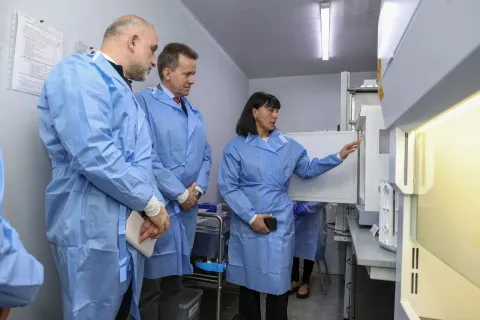
The samples gathered from the families are transported to the NCDC’s Chemical Risk-Factor Research Laboratory, which is central to the implementation of the Lead Surveillance System to detect lead in children’s blood and identify the sources of exposure. UNICEF has provided the bulk of the resources used to strengthen the capacity of the Laboratory.
The fully equipped laboratory provides Georgia with the infrastructure to test BLLs and other human and environmental specimens within its borders, which is an important step towards the sustainability of environmental health monitoring and elimination of lead poisoning in children.
Nutsa's story highlights the critical role of data gathering, early detection, and intervention. Now her family is better equipped with information regarding lead's harmful effects and prevention measures. Through the introduction of innovative approaches like the Lead Surveillance System and the advanced Chemical Risk-Factor Research Laboratory, UNICEF and its partners not only identify sources of contamination but also offer crucial support and guidance to affected families.
“We continue supporting the government in scaling up the Environmental Health (Lead) Surveillance System. The system will be expanded from a pilot programme to cover the whole country by the end of 2025. And we will be able to support more children like Nutsa”, adds Nino Dzotsenidze.
Background
Around one in three children – up to 815 million globally – have lead poisoning, indicated by BLLs at or above 5 micrograms per decilitre (µg/dL). Lead is a potent neurotoxin that is widely used in many industries and commercial products. The neurological effects of lead exposure – even at very low levels – are especially hazardous to children.