New high-performance Microwave Digestion System boosts laboratory capacity for testing lead exposure sources in Georgia
- English
- ქართული
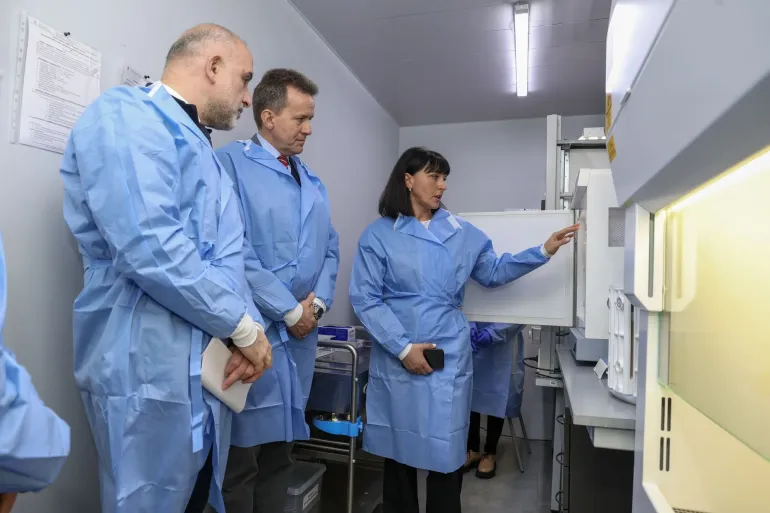
TBILISI, Georgia, 25 November 2025 - UNICEF handed over an additional state-of-the-art equipment- high-performance microwave digestion system - to the Chemical Risk Factors Research Laboratory of the National Centre of Disease Control and Public Health (NCDC) of Georgia to further enhance sample preparation for advanced lead analysis in Georgia. This technology uses high temperature and pressure to achieve superior decomposition, reducing preparation time and increasing efficiency.
The new system will be deployed under Georgia’s Lead Surveillance Programme, processing samples collected from households - including soil, paint, dust, spices, and various food products. These samples will undergo high-precision testing to detect and monitor lead contamination.
Previously, the laboratory’s existing microwave digestion system could handle only about 30 samples per day. With the new high-throughput instrument, capacity will increase by up to 50 additional samples daily, dramatically improving the speed and scale of lead monitoring efforts.
This upgrade marks a major step forward in protecting children and families from lead exposure, supporting Georgia’s commitment to public health and safety. By strengthening laboratory capabilities, the initiative aligns with global best practices and accelerates progress toward a healthier, safer environment for all.
Building the laboratory capacity and conducting the Lead Surveillance Programme are part of the Government’s response plan to prevent lead exposure and to protect children from the related toxic effects. UNICEF supports the Government in addressing elevated lead levels in children through diagnosing the problem by measuring lead levels, investigating the sources and pathways of lead contamination, and designing a national response plan to reduce or eliminate lead exposure.
The Lead Surveillance Programme includes annual monitoring of blood lead levels in children, nationally and regionally, in order to measure changes over time and to detect sources of exposure. The System was initially launched in two regions of Georgia, Imereti and Adjara Autonomous Republic, which had the highest rates of lead exposure in children. Now the Programme is being implemented in six regions of Georgia, including Tbilisi.
The equipment delivered earlier included a Triple Quadrupole Inductively Coupled Plasma Mass Spectrometer (ICP MS), a Gas Chromatograph (GC), and a Liquid Chromatograph (LC). Also, with the support of different donors including USAID and the Estonian Government, UNICEF delivered to NCDC Atomic Absorption Spectrometer, used for determining concentrations of different chemical elements in various
specimens, as well as four XRF analyzers, which are special portable handheld devices that can test for toxic metal content in different types of specimens. The equipment delivered is unique to the entire region and will significantly improve the environmental health laboratory capacities in the country.
UNICEF also supported the National Centre of Disease Control and Public Health of Georgia in undertaking an intensive re-training of employees, development and implementation of laboratory research methods and standards in the Chemical Risk Factors Research Laboratory.
Media contacts
About UNICEF
UNICEF promotes the rights and wellbeing of every child, in everything we do. Together with our partners, we work in 190 countries and territories to translate that commitment into practical action, focusing special effort on reaching the most vulnerable and excluded children, to the benefit of all children, everywhere.
For more information about UNICEF and its work for children, visit www.unicef.org/georgia/