Remote group health promotion sessions on childcare and development
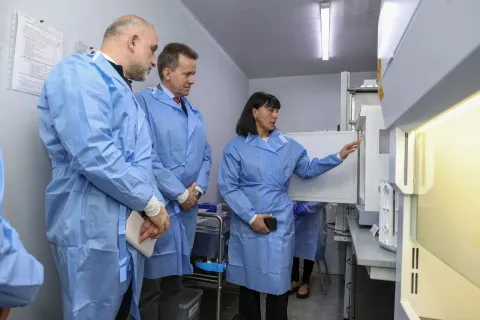
With support from the European Union, UNICEF established telemedicine services at 50 selected Primary Health Care (PHC) sites, enabling parents and caregivers to interact with doctors and each other on critical child care issues

- English
- ქართული
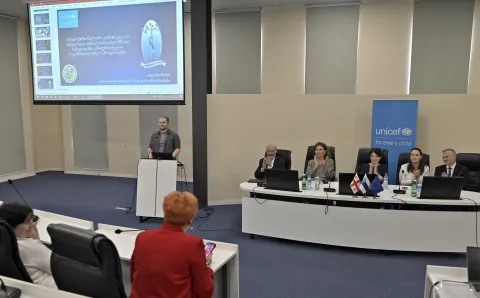
With support from the European Union, UNICEF established telemedicine services at 50 selected Primary Health Care (PHC) sites, enabling parents and caregivers to interact with doctors and each other on critical child care issues. This initiative, implemented on the ground by Caritas, includes the implementation of Shared Medical Appointments (SMAs) specifically developed for mothers and caregivers, aiming to deepen their knowledge and skills in child care and development. This approach has significantly increased the acceptance of remote consultations among Georgia’s rural population.
Expanding access to health-care services: telemedicine for child health care in rural areas
SMAs are doctor-patient visits in which groups of patients with similar health issues are consulted concurrently by a health-care provider. This innovative approach complements traditional in-person consultations, allowing clinicians to remotely counsel multiple mothers and caregivers on child care issues simultaneously via virtual platforms. Globally, there is growing interest in SMAs due to their proven benefits in various contexts in improving clinical outcomes and reducing health-care costs.
Building upon existing evidence that SMAs are effective, UNICEF introduced SMAs for parent education on infant and young child care and development, leveraging the experience gained during the COVID-19 pandemic, when SMAs were used for delivering information sessions remotely to groups of 20-25 pregnant women.
UNICEF rolled out SMAs to offer group health promotion sessions on child care and development to parents and caregivers of young children residing in the catchment area of 50 rural primary health (PHC) clinics, selected to become telemedicine sites with financial support from the European Union.

To ensure buy-in and create demand for remote consultations within rural communities, UNICEF partnered with four prominent Georgian health-care professionals, renowned for their expertise in infant and young child care and development. A survey was conducted on social media to gather insights into the most common concerns and needs, and five key topics were selected: (i) child development milestones using an evidence-based approach detailing necessary progressions; (ii) the danger signs of common childhood illnesses; (iii) issues related to immunization to address hesitancy; (iv) psychological support provided by child development psychologists; (v) nutrition advice focusing on infant and young child feeding practices.
Based on the successful delivery of remote health education sessions, UNICEF has drawn the following conclusions:
- Participation in SMAs helps mothers to combat feelings of isolation, thereby reducing uncertainties about their ability to manage their problems.
- By observing the experiences of others in taking care of their newborns, mothers indirectly gain valuable knowledge on how to manage their own child care challenges.
- Patients are motivated by observing others effectively manage their problems.
- Group dynamics foster the development of more balanced relationships between parents and health-care providers.
- Health-care providers experience a heightened sense of respect and connection with their colleagues, enhancing their efficiency.
- Health-care providers gain insights from the audience on how to better cater to their health-care needs.
- Allowing sufficient time for SMAs results in mothers and caregivers feeling well-supported.
Mothers and caregivers benefit from both the professional expertise of health-care providers and the experiential knowledge of their peers, leading to a more comprehensive understanding of child development issues.

Enhancing health education and promotion through SMAs
The interest in SMAs is growing due to their potential to improve health-care quality, reduce health inequalities, enhance self-management and save costs. SMAs can be effectively used for health education and promotion in the following ways:
- Group learning: SMAs provide a platform for patients to learn from each other’s experiences and challenges, fostering a collaborative learning environment.
- Expert guidance: SMAs offer patients the opportunity to receive professional advice from health-care providers in a group setting, enhancing their understanding of their health conditions.
- Peer support: SMAs create a supportive environment where patients can share their concerns and solutions, promoting a sense of community and mutual support.
- Efficient use of resources: By addressing common concerns in a group setting, SMAs can make more efficient use of health-care resources.
- Enhanced communication: The group setting can facilitate open discussions, allowing patients to voice concerns and questions they might not feel comfortable discussing in a one-on-one appointment.
- Health promotion: Through shared experiences and expert advice, patients can gain a better understanding of how to manage their health, promoting healthier lifestyle choices and proactive management of their conditions.

Following the roll-out of SMAs, Georgia has shown that not only it is possible to implement affordable remote health-care systems, but also that it is possible to improve health-care outcomes by adapting to and overcoming geographical challenges. However, it is important to note that while SMAs have many benefits, they are not a replacement for individual consultations, but an additional resource that can complement traditional one-on-one appointments.
About the project
The project, “Minimizing the impact of the COVID-19 outbreak in Georgia through telemedicine and digital health solutions,” aims to harness the potential of digital tools for advancing telehealth services and promoting health in Georgia. This assistance is an integral part of the EU’s and UN’s support to the COVID-19 response in the country, as well as ongoing WHO technical assistance under the UHC-Partnership to support the commitment of national authorities to primary health care reform and the advancement of UHC in Georgia.
The project is implemented by four UN partners (WHO, UNFPA, UNICEF, UNOPS) under WHO leadership.