EU and UNICEF support telemedicine to help families and doctors monitor children’s development
In recent years, Tamar’s growth and development have been monitored by a doctor at the primary healthcare clinic in the village of Meore Nosiri, Senaki. This monitoring is done remotely, without leaving home.

- English
- ქართული
Five-year-old Tamar has a rare disease, Angelman Syndrome, which requires frequent visits to the doctor. Her family lives in the Senaki municipality. Tamar’s mother, Natia, says Tamar’s condition requires constant monitoring of her child’s health. Tamar’s family regularly requires doctors of various specializations, which often means traveling to the capital and other large cities. “Traveling with a child comes with certain challenges. Our whole family is mobilized for this,” says Natia.
In recent years, Tamar’s growth and development have been monitored by a doctor at the primary healthcare clinic in the village of Meore Nosiri, Senaki. This monitoring is done remotely, without leaving home, which helps support the family and reduces medical costs.
"Due to my and my husband’s work commitments, we conduct visits with the family doctor remotely. This is very convenient for us." - says Natia
"Doctor Tea continuously monitors our child’s growth and development. I regularly receive information from her about my child’s needs, which helps me stay prepared and act quickly when needed. Thanks to her help, we’ve had access to many specialists. There was even a case where a high-level medical consultation was held for my child, where Tamar’s specific case was discussed, and I received answers to all my questions regarding her scheduled vaccinations,” says Natia.


Doctor Tea Sakhokia from the primary healthcare clinic in Meore Nosiri, Senaki municipality, says that with EU support and in collaboration with UNICEF, family doctors have enhanced their knowledge about child development from ages 0 to 6 and gained the competence to provide regular monitoring of the youngest patients according to established protocols.
“During remote consultations, the child’s anthropometric parameters are checked: height, weight, and head circumference. These data are compared against the charts outlined in the World Health Organization’s protocol. The earlier a problem is identified, the sooner the patient can be referred to a specialist,” says Tea Sakhokia.
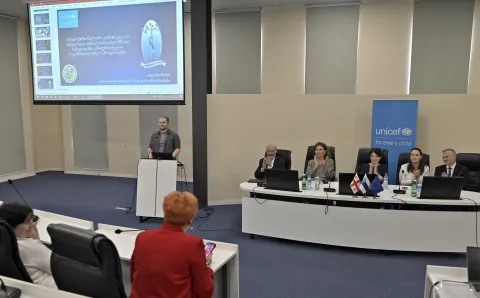
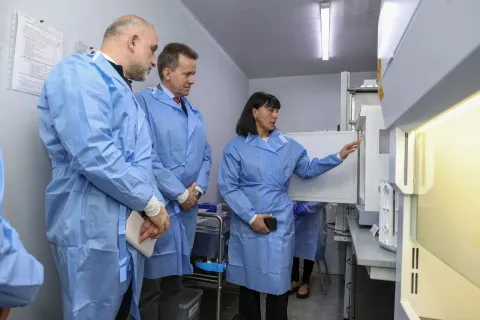
The telemedicine project trained 50 rural clinic doctors and gave them access to an electronic system for monitoring the growth and development of children up to 6-years-old. The system also includes a queue management feature, allowing families to book appointments with mobilized specialists and receive consultations at scheduled times.
"For me, a very important component was the improvement of professional qualifications. Now I’m no longer afraid of even rare medical cases." - Doctor Tea Sakhokia
First, because we gained essential knowledge about child development through remote learning methods. Second, because we also underwent case-based training as part of this project. Family doctors received support from a competent expert hub. I feel that a family doctor is no longer alone at the primary healthcare level. Many important connections have been established between rural clinic doctors and leading specialists. I’ve been a family doctor for 19 years, and I’ve never felt this confident,” says Doctor Sakhokia.

Through the digital platform, knowledge about child care and development was also shared with the parents of patients from 50 clinics. They had the opportunity to attend online sessions led by Georgia’s leading pediatricians, psychologists, and nutrition specialists.
The more support we parents have, the more doctors help us, the safer we feel. We have fewer fears and believe we can better cope with challenges,” says Natia.
With the support of the European Union, and in partnership with the Ministry of Internally Displaced Persons from the Occupied Territories, Labour, Health and Social Affairs of Georgia, UNICEF, the World Health Organization (WHO), the United Nations Population Fund (UNFPA), and the United Nations Office for Project Services (UNOPS),telemedicine services have been introduced to create equal access to quality medical care for families living in rural areas and to significantly simplify child care.
“Child development is one of UNICEF’s key priorities. The role of the family doctor in relation to newborns has significantly increased. The family doctor has become the first point of contact for families regarding child development, something that didn’t happen before. We have supported efforts to make quality medical services accessible to every child in Georgia, close to their place of residence. We have laid a strong foundation for the government to take over and sustainably integrate these services into the healthcare system. I believe this will happen, as Georgia already has a roadmap for primary healthcare reform, which envisions the sustainable integration of child development monitoring services into primary care. All the necessary groundwork has already been laid, based on model clinics. The electronic system is ready for use, and the rural doctors we’ve worked with are fully prepared to operate within it,” says Tako Ugulava, UNICEF Health and Nutrition Specialist.
About the project:
The project, “Minimizing the impact of the COVID-19 outbreak in Georgia through telemedicine and digital health solutions,” aims to harness the potential of digital tools for advancing telehealth services and promoting health in Georgia. This assistance is an integral part of the EU’s and UN’s support to the COVID-19 response in the country, as well as ongoing WHO technical assistance under the UHC-Partnership to support the commitment of national authorities to primary health care reform and the advancement of UHC in Georgia.
The project is implemented by four UN partners (WHO, UNFPA, UNICEF, UNOPS) under WHO leadership.
This publication has been produced with the assistance of the European Union. Its contents are the sole responsibility of UNICEF and do not necessarily reflect the views of the European Union.