Transforming social protection policies to protect vulnerable families
Climate shocks not only threaten lives and infrastructure but also exacerbate financial insecurity, pushing families deeper into poverty and hinder disaster recovery

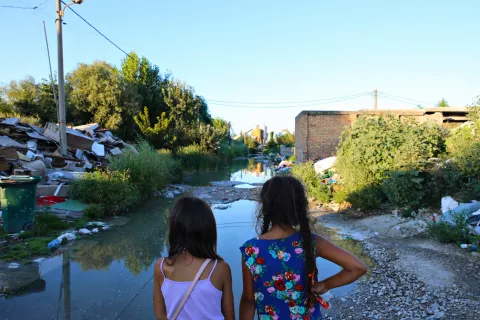
In 2024, floods, landslides and mudflows affected nearly 149,000 children and families in Eastern Europe and Central Asia, causing loss of life, displacement and disruption of essential services.1 Hazards like these disproportionately impact children, particularly those in poor and marginalized communities.
In Bosnia and Herzegovina, for instance, while 17 per cent of the population lives in poverty, nearly 30 per cent of children are in households classified as poor.2 This makes them highly vulnerable to the cascading effects of natural hazards.
Climate shocks not only threaten lives and infrastructure but also exacerbate financial insecurity. This can push families deeper into poverty and hinder disaster recovery. Reducing climate risk is therefore critical to ensuring education continuity, safeguarding children’s well-being and supporting their ability to grow and thrive in resilient communities.
Strengthening social protection for at-risk households
Historically, Bosnia and Herzegovina’s social protection system lacked mechanisms to scale up support for poor families during climate-related disasters, leaving the most vulnerable children at heightened risk. A turning point came in early 2024, when UNICEF and the government launched the country’s first national shock-responsive cash assistance programme for flood-affected households. This milestone followed years of UNICEF-led evidence generation, advocacy and technical support, which demonstrated the value and feasibility of shock-responsive social protection (SRSP).
The government activated the national shock- responsive cash assistance programme in October, when severe flooding struck five communities across central and southern Bosnia and Herzegovina. UNICEF, together with the Federation government, civil society and local partners, quickly mapped affected families and created a dynamic database to guide targeted support. UNICEF provided US$54,800 in SRSP funding to assist 93 families.
Critically, because the Federal Ministry of Labour and Social Policy – supported by UNICEF – had integrated SRSP into the national social protection system, it could rapidly allocate US$276,000 in additional funds to reach 600 more families. This response demonstrated how strengthened national systems can deliver timely, effective shock-responsive support. It also highlighted the viability of UNICEF’s SRSP model as a blueprint for scaling disaster-responsive safety nets across sectors and regions.3
Building a strong foundation at national and local levels
The 2024 activation of SRSP in Bosnia and Herzegovina was built on a strong foundation. Since 2019, UNICEF has worked with national authorities to integrate disaster risk management into the country’s social protection systems. This included feasibility studies,5 child poverty simulations and the integration of social welfare data with hazard exposure maps. Roadmaps for developing shock-responsive social protection systems were created and endorsed by authorities in both the Federation of Bosnia and Herzegovina and Republika Srpska (see FBiH roadmap, Republika SRPSKA roadmap).
Financial modeling was also undertaken to support evidence-based decision-making on appropriate benefit levels. Over time, these tools and processes were handed over to government counterparts, embedding SRSP into national protocols, funding mechanisms and emergency response frameworks.
UNICEF has also worked at the municipal level to localize SRSP. In 2023, the city of Bihać, prone to flooding, partnered with UNICEF to establish a city- level SRSP programme using US$50,000 in municipal funds.6 Designed to deliver rapid assistance to up to 8,000 vulnerable people, the programme is triggered by pre-defined natural hazard events.
Ensuring local ownership and sustainability
Taken together, the national response in 2024 and the Bihać municipal programme demonstrate that SRSP can be localized, institutionalized and sustained over time. Their success lies in their ability to operate independently of UNICEF, be led by government systems and draw on a mix of local and national funding sources – ensuring local ownership and long-term resilience.
Footnotes
- UNICEF Europe and Central Asia Regional Office (ECARO), 2025, Humanitarian Situation Report No. 2: End of Year.
- Agency for Statistics of Bosnia and Herzegovina, 2011, Household Budget Survey.
- UNICEF, 2025, Jablanica, Kreševo, Kiseljak: Vouchers of greathelp to families affected by floods and UNICEF, 2024, Support for families affected by floods: First vouchers distributed in Fojnica and Kiseljak.
- UNICEF, 2024, Floods in Bosnia and Herzegovina.
- UNICEF, 2025, Developing Costed Contingency Actions andUndertaking an Analysis of Pre-arranged Financing for Shock- Responsive Social Protection.
- UNICEF, 2025, When an accident strikes, help cannot wait.