

JABLANICA, KREŠEVO, KISELJAK: Vouchers of great help to families affected by floods
“The most important thing is that we were able to choose what we needed most at the moment,” voucher beneficiaries say

- Bosanski/Hrvatski/Srpski
- English
Mersiha Begović from Donja Jablanica has been living in the Jablanica settlement of Baćine with her husband and three children following the catastrophic floods that hit BiH in October last year. Her family is among the 694 families from the area of Herzegovina-Neretva and Central Bosnia cantons that have received vouchers totaling 600,000 provided by the FBiH Ministry of Labor and Social Policy and UNICEF, in cooperation with the BiH Red Cross Society and the FBiH Red Cross.
“The vouchers have been of great help to us. We’ve been able to buy some things that we were missing – a vacuum cleaner, mixer, hairdryer, an iron, pots, baking trays, and I’ve also bought a couple of toys for the children. What’s especially important is that we were able to choose ourselves what we needed the most at that moment,” says Mersiha who is now temporarily living in a house provided by relatives after her home in Donja Jablanica suffered significant damage during the floods and is now unfit to live in.
“The children are going to school, three girls, two of them in primary school, third and sixth grade, and the oldest one is in the first grade of secondary school. They too suffered a lot of stress during those events, it was horrible and unfortunately they witnessed a lot, and that’s why I immediately had them work with a psychologist who has been of great help,” she says and adds that immediately after the floods the children were provided a laptop as part of a UNICEF and UNESCO donation to schools in the areas affected by floods:
“It is of great help, they use if for school, especially the eldest daughter who uses it the most when studying, but also the younger ones when they need something done.”
Together with representatives of the voucher beneficiaries’ selection committees, the FBiH Red Cross and the Red Cross municipal organizations from Kiseljak, Kreševo and Jablanica, we visited families in these municipalities during the past several days. Families were able to use the vouchers ranging from 650 to 1,250 KM, depending on the number of household members, in Bingo markets by the end of the year. They say that they used the vouchers, made available in denominations of 50 and 100 KM, to buy food, hygiene products, but also dishes and household appliances which they lost during the floods.
“This assistance in the form of vouchers meant a lot to us and we are grateful to UNICEF and other donors. The vouchers helped me the most in buying hygiene products, which we needed in large quantities as everything had to be cleaned thoroughly, but we also used them to buy food because we are a big family and we have many needs. There were no problems, we would go to the shop and buy what we need and this really helped us a lot as it came at the right time and we really can’t thank enough for this,” Željka Barešić from Bjelovići near Kreševo points out.
Bruno Duno from Kiseljak also used the vouchers to buy hygiene products. The house he lives in with his wife and two children was also flooded:
“Floodwaters reached up to the windows, entered the house and created a lot of damage, but we were able to repair most of it. The backyard was also destroyed so we had to fill it, the water brought in a lot a garbage, mud, there were all sorts of things. We used the vouchers primarily to buy cleaning products because that’s what we needed the most at that moment. There were no problems is using them, we went to the Red Cross, received the vouchers, went to the shop, bought what we needed and they were of great help and we are grateful for this support.”
After the floods, Amila Bajramović from the severely affected Donja Jablanica has been living with her mother, husband and son in Jablanica in an apartment provided by acquaintances, but says they will be able to stay here for only another five or six months at the most:
“We remain here for the time being and we are grateful for this opportunity, but where do we go from here remains to be seen. A part of the house has been destroyed and until the final report comes out they are unable to tell us whether it will be possible to reconstruct it. The vouchers have helped us, we used them to buy things that we need at home, things for the child and food.”
Medical student Amna Zrno, who lives in Troska near Kreševo with her mother and brother, says that several tractors of mud were removed from their backyard after the floods. The water entered their garages and the ground floor despite the fact that they regulated the Kreševka river in this area, reinforced the banks with concrete and thought they would be safe.
“The flood was the last thing we expected and to be honest – it was horrible. We have fairly deep and well-regulated river banks, so this was unexpected, and as it turns out the water entered our backyard over the bridge and then it entered every facility. It destroyed all the furniture on the ground floor,” Amna says.
“We used the vouchers to buy food, cleaning products, which we needed the most, and we also replaced the vacuum cleaner which was destroyed when the water entered the ground floor. Given the totality of the damage, the amount is modest, but it meant a great deal to us. My mother was asked to come to the municipality, she immediately went there to receive the vouchers and we had no problems using them,” she added.
Danijel Kovačević from Kiseljak and his family, whose home suffered significant damage in the flooding, also used the vouchers to buy replacements for the destroyed household appliances:
“We took out a loan, we have recovered and only a couple of more things remain to be repaired. We used the vouchers for smaller items that we could buy in Bingo, such as a vacuum cleaner and an iron, so yes, they helped us replace some of things that were lost. Using them was fairly simple, the market had a separate cash register for vouchers and it all functioned rather well,” Danijel says.
Ana and Petar Buzuk from Kiseljak explain that they have lived here for 40 years and that there was never serious flooding along this stretch of the Kreševka river:
“It was difficult, a lot a damage, but we have been able to refurbish. The vouchers were of great help, they came at the right time and we used them in the best possible way. We primarily used them for buying food, because we already cleaned everything up, and the appliances were on the top floor and were not damaged. The best thing is that we were able to buy what we needed – you go and get what you need.”


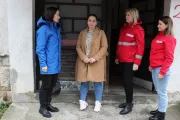
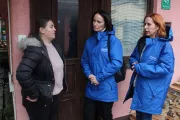
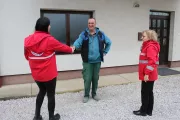
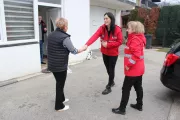


Ema Begić, her husband and two children from the Zlate village are living in Jablanica for the time being as the house they were living in is located below the rockslide and has been deemed unfit and unsafe to live in.
“A kind woman has allowed us to use her house and this is where we are for the time being because the rockslide still poses a threat. When all that started, we spent the first night in the house as it was unsafe to move and then the rescuers came and told us that we can no longer stay there. We packed the basics for our two girls who are 10 and 14 and left”, she says as she recounts those stressful moments and uses the opportunity to thank the Red Cross team from Jablanica who provided them support after they were displaced:
“The women from the Red Cross were with us every day from the beginning. They checked on us and asked us what we needed and I am grateful to everyone. The vouchers that we received before New Year were very useful and I’d like to thank everyone for making them available. Everything that has happened has been very difficult because we are not used to being provided for, we had everything and that’s why it was so good to be in a position to go on our own and get what we need.”
Nevenka Milanović from the FBiH Red Cross stresses the importance of mapping voucher beneficiaries in a timely manner so that they can reach those who need them the most:
“When the floods hit and the mapping started, a database was developed based on data gathered on the ground according to set criteria. All the criteria were taken into account – whether a housing facility was damaged and to what extent, was it entirely destroyed, whether and to what extent the household’s income depended on that facility, as well all other significant details. These criteria from the database were then used to create lists of beneficiaries who were issued vouchers provided by UNICEF and the FBiH Ministry of Labor and Social Policy, which together financed the entire project to the tune of 600,000 KM, of which UNICEF provided 100,000 KM and the Ministry provided 500,000 KM”, she explains and goes on to add that the databases are still used and as the donors come forward, they can be used to extract beneficiaries based on what the donors wish to cover.
Zehra Krnjić, member of the commission for mapping beneficiaries on behalf of the Red Cross from Jablanica says that the assistance provided by UNICEF for 22 families and by the Ministry for 144 families from this municipality was of huge importance at the time:
“I think that assistance in the form of vouchers in such situations is the most valuable and of greatest use for the beneficiaries because they can use these vouchers to buy whatever they need, according to their individual needs, without restrictions, barring alcohol and cigarettes. If anyone were to seek our recommendation in the future, we would recommend assistance to be provided in the form of vouchers, and perhaps in cash in certain situations.”
Red Cross Jablanica volunteers, including Emina Hodžić and Aida Letuka, participated directly in gathering data on the ground:
“During the mapping exercise we went out into the field, visited houses and families and were able to see the entire situation on the ground. In selecting beneficiaries, we were guided by the set criteria, whether these were households with three or more children, persons with disabilities, level of social vulnerability and damage to the house. The most important thing is that the beneficiaries are happy with the vouchers and that we have fulfilled the ultimate objective,” Emina says and underlines the good cooperation during the process:
“We have good cooperation with other institutions in the local community, some data was provided by the Social Welfare Centre or the Municipality and we went to the affected areas to get the data that we were missing. We had the basic databases, but given that we have never faced such a calamity, we had to be on the ground in order to get the other data as well. The database that we amended and completed with data obtained on the ground is now available and of use to everyone. We come out of this with important experiences which will definitely help us in future work.”
Begzada Šukman, who was the Director of the Social Welfare Centre in Jablanica during the mapping of beneficiaries and the distribution of vouchers, said that everything went as planned:
“All those involved really did their best, they looked for people who truly needed help, they went out in the field, examined everything, nothing was done arbitrarily. They physically saw, mapped and proposed beneficiaries. It would be good to create a database that would show who was provided what in order to facilitate the distribution of assistance and make it more equitable.”
Retired social worker and Jablanica Municipality Red Cross volunteer Šaha Kevrić offered to share her rich experience of working in the field, as well as excellent knowledge of the social situation in that area:
“I was engaged for three months to help with mapping. It was easier for me to work on the ground because I was familiar with the needs of Jablanica Municipality, I worked on all the social histories of the families that suffered damage and as a result I was already familiar with the situation, which even made it possible to contact some people by telephone. Despite the longstanding experience, working on the ground had its challenges, but we were also satisfied because we were going to people to provide help,” she says and adds that they all acted together as a good and well-rehearsed team:
“We did have a database and lists of people who reported damage, but we constantly discovered new cases on the ground and then we amended everything, so it turned out to be very useful in different ways. Before we even started with this, when we were only discussing what type of assistance should be provided, I proposed that it be vouchers. Some assistance had already been distributed and it was therefore important for people to be able to choose for themselves what they considered useful and what they were lacking. The database that we now have is fantastic, all the data is in one place, and whatever assistance comes in later, it will be possible to know who needs what and to whom to distribute it.”
Jablanica Municipality Assistant Mayor Aldin Širić said that cooperation with the Jablanica Municipality Red Cross, the Social Welfare Centre and other organizations is excellent and that their daily communication has enabled the smooth distribution of vouchers.
“This form of assistance provided to citizens is very good because you give them the possibility to choose what they need the most. When you give them a voucher, they will buy what they need the most and they alone will choose what they see as a priority. When you give them a product you chose for them, then it can happen that they already have it or that they received something similar from a different donor. That’s why I think using vouchers is the better option.”
Member of the Committee in Kreševo Zora Vidović, who worked directly on mapping and the rapid damage assessment in this municipality, also points out the good cooperation between all the institutions involved:
“Cooperation between the institutions was excellent, we did everything together. I was also a part of the Municipal Damage Assessment Commission so I already visited the affected areas and was familiar with the situation on the ground and we also had all the necessary data in the database, as well as records and photographs,” she says and adds that there were no major challenges in mapping voucher beneficiaries:
“We already visited all of them and they were already in the database so we ended up with a list of 81 families whose homes were damaged, including 11 families with children. The reaction was rapid and immediate and by combining data from the database and the field it was possible to target beneficiaries, they were notified directly and most of them came in quickly to receive the vouchers and to use them for what they needed the most at the moment.”
Kreševo Red Cross Secretary Josip Šakić points out that the law stipulates that a request for the compensation of damage needs to be submitted before the municipal commission goes out on the ground and that all this data was then entered into the database, which was later used to map voucher beneficiaries:
“The reaction was very quick thanks to this good cooperation. Vouchers certainly helped many families at that point and, yes, had they been distributed more quickly, the results would have been even better, but ultimately, its never too late to help people. We now have this experience which will be useful in the event of similar situations.”
Member of the Committee on behalf of the Kreševo Municipality Economy and Social Protection Service Antonela Stanić said that she too thinks that this is a good method of work:
“There were no problems, the data collected on the ground was easily accessible, I too visited the affected areas and we then entered the data into the system, and all of this together was rather efficient. We were able to record persons affected by the floods who were already social welfare beneficiaries. Hopefully, we will not see a repeat of such situations, but if they do happen, we now have a good experience that will help us react even better and more swiftly.”
Red Cross Kiseljak Secretary Zerina Smajlović said that as soon as they were informed that the mapping of beneficiaries would be taking place, they reached out to their most active volunteers who then visited the affected areas:
“The Municipality provided us a list of people who submitted requests for the compensation of damage and this list included their names and addresses, and where we had telephone numbers, we contacted those beneficiaries by phone. The fact that the area of the entire municipality was affected made our work more difficult, we are talking about a dozen local communities and there were houses in all of these local communities that were damaged by floods, some of them impossible to reach, so we had to complete the mapping for that part by telephone. UNICEF provided 25 vouchers and the FBiH Ministry provided 125, which is a total of 150 vouchers”, she says and adds that everyone has come out of this with important experiences and what should be improved in the future is information sharing:
“Our work would have been much easier and faster had we been immediately provided the telephone numbers of all the people who reported damage. There were no problems during the use of the vouchers and everyone praised this form of assistance as it allowed them to buy the things they needed the most at the moment, be it household appliances, hygiene products, furniture or food, they had a broad range of products to choose from. This also made our work easier because providing aid directly in the field carries a cost, its time consuming and ultimately you cannot always know who needs what.”
Through field activities, UNICEF provides comprehensive support to the population in the flooded areas, both through the already mentioned distribution of vouchers, but also through support for education, building the capacity of crisis-resilient social protection systems and disaster risk reduction.
“The voucher support program has proven to be one of the most effective and dignified ways of providing support to families with children affected by the floods. This approach allows families to decide on their own priorities and needs, providing them with greater flexibility and choice in crisis situations. By providing direct assistance in this way, we ensure that the most vulnerable have access to the basic necessities, we reduce the risk of further poverty and enable faster recovery of communities,” says Irina Kulenović from the Social Policy Program at UNICEF BiH, underlining that this model of emergency cash assistance is fully aligned with UNICEF's global standards for cash interventions in emergencies, which emphasize the importance of timeliness, inclusiveness and protection of the most vulnerable:
“UNICEF will continue to provide support to the authorities of Bosnia and Herzegovina in order to strengthen social protection systems, improve resilience and preparedness for future crises. Our goal is for this model to become an integral part of the social protection system, enabling a timely and systemic response to all future emergencies.”


