Children and Youth in Bosnia and Herzegovina for a Just Climate Future
Priorities defined at the Sarajevo Forum will echo at the global COP30 conference as the voice of young people from BiH

- Bosanski/Hrvatski/Srpski
- English
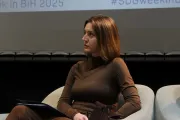
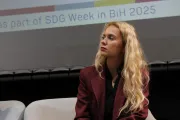
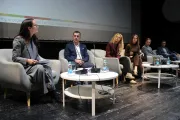
As part of the Sustainable Development Week (SDG Week 2025), the Forum “Generation of Resilience: Children and Youth for a Just Climate Future” was held in Sarajevo, jointly organized by UNICEF and UNDP in Bosnia and Herzegovina.
The event brought together young people, representatives of institutions, academia, and civil society to jointly shape proposals for a just and sustainable climate transition.
During the Forum, key climate policy processes in BiH were presented, including the Nationally Determined Contributions (NDC) and the Climate Landscape Analysis for Children (CLAC). The process of defining priorities that will represent the voice of young people from BiH at the global COP30 conference will continue through other youth forums and consultations shaping their recommendations for COP.
“It’s an honor to represent the voice of young people today. I feel deeply grateful — because even though we’re aware of the many challenges in our country, initiatives such as the UN Youth Advisory Board give us hope and a reason to stay. It’s not enough to just observe – young people must be active participants in shaping policies and strategies, because the future is not built tomorrow, but today. We want decisions to be based on science and evidence, because without that – and without our participation – nothing can be complete. That’s why it’s crucial to build bridges between generations, between politics and science, and to turn words into concrete actions,” said Adla Kahrić, a young researcher and nature conservation advocate, who highlighted the importance of informing youth about topics that directly affect them:
“One of the main problems is that young people are not well-informed. That’s why it’s important not only to provide them with information about climate change but also to educate them on how to properly interpret it. We need to approach this through education — to integrate climate change into school curricula, raise awareness, and help young people understand how and where they can act.”
Professor Azrudin Husika from the Faculty of Mechanical Engineering in Sarajevo emphasized the importance of including climate-related topics in education plans:
“For young people to be genuinely involved, they need to feel that their voice truly matters — not only that it’s heard and recorded. Currently, most activities take place through short-term projects without continuity, so young people don’t feel their priorities translate into decisions. Climate issues are still marginalized in public and political discourse because they’re not seen as vote-winning topics. Teachers also need greater involvement, as curriculum reforms move slowly while the world is changing faster than ever. Non-formal education is therefore invaluable, as it connects young people with similar interests and beliefs. It’s key to develop skills that make them competitive on the labor market – from solar power plant design to energy trading – because that’s where opportunities for youth with practical skills lie.”
Mirza Hujić, Assistant Minister at the Ministry of Foreign Trade and Economic Relations of BiH, stressed the importance of establishing dialogue and including young people in policymaking processes:
“Their presence at conferences should not be merely symbolic – young people must participate actively, express their opinions, and share their ideas. It’s essential to clearly define who represents youth and provide them with a channel to articulate their voice, while also encouraging teachers and professors to inspire students to get involved. Long-term progress can only be achieved by raising awareness and addressing root causes, not just consequences.”


Emina Kumrić, Head of the Department for Mobility and Youth at the Ministry of Civil Affairs of BiH, added that institutions play a crucial role – not only in adopting strategic decisions but also in creating frameworks that allow young people to engage in all matters related to climate change and its consequences:
“For a youth strategy to be effective, it must first recognize sustainable development as a key area, ensure that all climate plans undergo consultations with youth councils, and include indicators of youth participation. There should also be mechanisms to collect and analyze data on youth engagement in climate-related issues.”
Senad Tutić, Director of the Center for Social Work in Bihać, presented an example of local institutional support developed by the City of Bihać with UNICEF’s assistance, aimed at providing emergency support to families affected by climate-related disasters:
“Unfortunately, we often react only after the consequences of climate change have already occurred, directly affecting the lives of people in local communities. In our municipality, floods are increasingly frequent. Families who depend on agriculture lose their income, placing additional pressure on our services. That’s why, in cooperation with UNICEF, we launched an initiative to create a fund that enables immediate response and support to the most vulnerable right after a disaster, preventing displacement. The City Administration embraced the idea and allocates annual budget funds for this purpose, with plans to introduce property insurance for residents in high-risk areas — reducing the burden on the budget and strengthening community resilience. Unfortunately, we are currently the only municipality in the Federation of BiH with such a regulation, but we hope others will follow soon.”
The panel was open to participants from the audience as well. Young researcher and activist Lajla Jusko noted that youth are already engaged through local conferences and COP-related mechanisms, showing great interest and potential, but facing limited employment opportunities. She stressed the need for funding internships and creating jobs, since long-term engagement is difficult without economic stability.
Mirza Valjevac, a student at the Faculty of Agriculture and Food Sciences in Sarajevo, pointed out that the main challenge lies in the complex political structures and lack of policy alignment across government levels. He emphasized the importance of policy harmonization, restoring public trust in institutions, and increasing student engagement in climate-related activities.
Renaud Meyer, UNDP Resident Representative in BiH, highlighted during the opening that this event demonstrates how the UN, together with partners, engages younger generations in its work:
“Climate change is real – and it’s not a question of the future anymore, but of the present. The world’s pursuit of profit has led us to neglect nature, and now we’re paying the price. It’s crucial that young people are involved, because without their voice and energy, we cannot build a just and resilient future. It’s wrong to think that youth should get involved later – the longer we wait, the higher the cost for society. We’ve seen it worldwide – when young people say ‘enough’, change happens, and fast.”
Marc Lucet, UNICEF Representative in BiH, underlined that climate change, both globally and in BiH, is not an abstract concept – it directly affects children’s lives:
“Imagine a child breathing air polluted beyond WHO limits, or a newborn inhaling more pollution than adults. The consequences are real and measurable. In uncertain times, it’s essential that schools remain open, that health centers provide rapid support, and that social services are ready to respond. This isn’t a cost – it’s an investment in societal resilience. UNICEF doesn’t have all the answers, but we want to be part of a collective effort to adapt to climate change – through evidence, collaboration, and stronger systems capable of withstanding shocks. The social sector should not be an add-on to planning, but an integral part from the very beginning.”
The Forum emphasized that children and youth must have a permanent place in decision-making on climate issues, and that education, social protection, and healthcare are key pillars of resilience to climate risks.
The conclusions of the Forum “Generation of Resilience” will serve as the basis for the document Youth Climate Priorities in BiH, while the messages and outcomes will also be shared across other youth forums shaping their recommendations for COP30, ensuring that the document fully reflects the voice of young people from Bosnia and Herzegovina.
“We’ve recorded everything, and over the next month, we’ll be holding a series of consultations with young people and partners to discuss the panel’s outcomes and analysis findings. One goal is to establish an official mechanism for youth participation in COP, and another is to enrich the development process of the Nationally Determined Contributions (NDC) through a multidisciplinary approach. The conclusion is clear: this is only the beginning of the dialogue – the real work lies ahead in the coming months,” said Irina Kulenović, Social Policy Officer at UNICEF BiH, closing the Forum.