Support Brings Smiles Back to Flood-Affected Families
Following the severe October floods, the FBiH Association of Psychologists, with backing from UNICEF BiH, is providing psychological support to children and parents from affected areas

- Bosanski/Hrvatski/Srpski
- English
After losing her home in the October floods last year, Mersiha Begović from Donja Jablanica now lives in an emergency container camp with her husband and three children. Alongside the material destruction, the flood and the terrifying events of that night – when torrential rain struck their community – have left numerous other consequences.
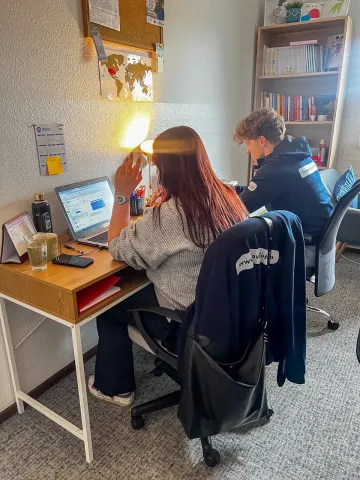
“I’m afraid of being alone. When the children leave home for school, I immediately go out too, just to be around people. I usually go to the women’s association here in Jablanica, or I come for an appointment for psychosocial support at the Centre for Social Work (CSW), which is very helpful to me”, says Mersiha. She is one of the recipients of psychosocial support provided in recent months at the Jablanica CSW by the FBiH Association of Psychologists, with support from UNICEF BiH, to help children and adults cope with the trauma they experienced.
“Everything that happened on 4 October was very stressful – for me and for the children. We turned to the CSW for psychological support, which was made available to us, and psychologists from Sarajevo come to see us regularly. Just today, we have a session with Ivana, whom the children have really grown attached to and are always eager to see. One of my girls attends folklore classes, and she once told me she wanted Ivana to come and watch her. Ivana came, and she was overjoyed”, says Mersiha Begović, adding that she has noticed significant improvements in the behaviour of her daughters, who had previously been under considerable stress, as well as in herself.
“Initially, I pushed my own needs aside. I focused on the children and sought help only for them. Then one day, Ivana – who was there to support the children – simply asked me, ‘When will it be your turn?’ It was hard for me at the beginning, but over time I joined the conversations with her, and that’s when I began to realise just how much I needed that support. Psychological assistance is important for everyone – not just for us who were affected by the floods, but for others in Jablanica too. It would be beneficial to have psychologists available on a continuous basis”.
Umija Arfadžan from Donja Jablanica is also currently living in the camp. She recalls the sleepless night when a powerful wave surged through, carrying mud, soil, cars and debris. She narrowly escaped by running to the balcony on the upper floor of the house, where she managed to pull several injured neighbours to safety and provide assistance. She says the events of that night, along with the existential uncertainty that followed, have had a traumatic impact on everyone.
“The psychological help we received meant so much to us. At first, we were housed with a friend in the city, and it was Naziha from the CSW who approached us and suggested professional counselling, which we gladly accepted. Psychologists from Sarajevo, including Senka Čimpo who was there with us regularly, offered ongoing support. I’m thankful to all of them. Every conversation helped me greatly, and I still use counselling services today, as I was in a very difficult state. That night alone left a deep mark on all of us. All the psychologists have been a real source of strength and we’re always happy to come in for a session.”
Mumin Macić and his family from Donja Jablanica also endured severe trauma during the October floods.
“There were houses here once – now it’s all just a pile of rubble and debris. At around two in the morning, a torrent struck and destroyed the homes. I was able to get my little daughter out of her room, and we managed to escape. Only when we reached the railway line did we see the full scale of the destruction. It was all incredibly stressful, but the CSW in Jablanica made it easier by involving psychologists who worked with my daughter and with us. They’re available whenever we need them. My daughter is doing fine now – she goes to school, has made friends, and we’ve enrolled her in the extended day programme so she can spend as much time with other children as possible.”
Ivana Kozina, a psychologist and psychotherapist working with the Association of Psychologists, has been assisting Jablanica residents from the outset. She recalls that within days of the flooding, a response was coordinated with the CSW:
“There was a tremendous need for psychological support, and just days after the disaster, we volunteered to help in Fojnica and Jablanica. That’s how it all began. Not long after, UNICEF joined us as a partner, and we’ve been continuing the work ever since. Initially, we provided psychological crisis interventions, as is standard practice in emergencies, aimed at preserving and stabilising mental health to the extent possible. Afterwards, we continued offering psychological counselling and psychotherapy, depending on each individual’s needs – whether they were children, adolescents or adults. We structured our efforts according to the capacities we had”, says Kozina, adding that both children and adults were affected by the crisis in different ways:
“Our counselling work also focuses on children, with the aim of preventing the lasting psychological impact of the traumatic experience. The most common issues we’ve observed in children include difficulty concentrating, trouble sleeping and a reluctance to even talk about the traumatic experience. These symptoms differ from those shown by adults. Unlike adults, children don’t fully comprehend the scope of the situation or reflect on its long-term implications. Adults, particularly those with memories of the war, may link past experiences with the current crisis, making their emotional response more complex.”


The psychologist notes that while there has already been an improvement in the population’s mental wellbeing, the system as a whole still has significant work ahead:
“People are smiling again, and they’re looking to the future with more hope, but there are still unmet needs. It’s important to understand that psychological support doesn’t rely solely on the work of psychologists – it also involves engaging with and connecting the entire community and its resources. Unfortunately, there is still very little to offer, and ongoing uncertainty about people’s living conditions makes our job more difficult. Our role includes providing clear information, establishing a sense of predictability and security, so people can understand what lies ahead. In this case, we managed to organise ourselves, but the situation has clearly shown that a more systematic solution is needed, not just for this crisis but for others that may arise in the future.”
Naziha Zebić from the Jablanica CSW highlights that they have been actively working on the ground from day one, maintaining direct contact with the affected population and gathering information on their condition and needs, despite working with limited resources:
“Our main concern was to support our community and the beneficiaries we identified through direct field contact, with a particular focus on families with children. Prior to this disaster, I was the only psychologist employed in Jablanica – there were no psychologists at either the Primary Health Care Centre or the school. At that time, the Association of Psychologists began offering professional psychological assistance, which proved to be of great significance and immense support not only to our beneficiaries, but also to us at the CSW. That support has continued to this day, and I’m especially grateful to them as a colleague who values their work, knowing that I could not have managed all this on my own. This experience has shown us that, in times of crisis, we must be better prepared to respond to the needs of our community and provide appropriate professional psychological support.”
Lejla Kevrić, a pedagogue at Jablanica Secondary School, says the floods left a lasting impact on both students and staff, and that psychological support arrived at a crucial and much-needed moment.
“The children faced numerous challenges – from difficulties coming to classes and following online lessons to catching up on the curriculum, all while coping with their own personal experiences. The absence of a school psychologist makes it even harder for us to address such issues. As the school pedagogue, I initiated counselling through workshops and discussions, but I’m particularly grateful for the collaboration with the CSW, which brought in the Association of Psychologists. They organised workshops for our students, and the level of interest among them was high”, says Lejla Kevrić, adding that a positive shift is already noticeable.
“We’ve observed positive effects on the children’s academic performance, their engagement and overall mood, as well as on how they perceive the entire situation. For this reason, it’d be very important for us to maintain the cooperation with the Association of Psychologists moving forward. Each child, particularly during such a delicate developmental phase as adolescence, needs a dedicated professional approach to process the traumas and difficulties they’ve experienced.”
According to Goran Čerkez, assistant minister in charge of the Public Health Sector in the FBiH Ministry of Health, the October 2024 floods in BiH have left deep and enduring impacts on communities, individuals and society at large.
“Floods and similar crises are not just immediate shocks. For many of us who lived through the war, they reactivate old traumas – they become psychological triggers. This is why it’s crucial that society recognises the importance of investing in psycho-social assistance for at least a year after such events, if not longer. At the same time, we need to develop lasting support structures – strengthened mental health centres, ECD centres and other services that communities can rely on”, says Čerkez, stressing that the health, education and social protection sectors must work hand in hand, particularly in times of crisis:
“In ordinary circumstances, Jablanica has a streamlined and functional system of social and healthcare services. However, crises such as this one necessitate a reorganisation or expansion of both sectors. The long-term psychological consequences faced by those affected must be addressed now, as failure to do so could result in transgenerational trauma, passed from today’s youth to their children. Preventive measures taken at this moment are crucial to ensuring lasting security and mental wellbeing for the people of Jablanica.”
Psychotherapy and psychological support services form part of UNICEF’s broader field activities, which offer comprehensive assistance to flood-affected populations through support for education, strengthening shock-responsive social protection systems and reducing disaster risk.
In the immediate aftermath of the floods, UNICEF and UNESCO donated 44 notebook computers to primary schools in the Konjic and Jablanica communities most severely affected by the floods to support remote learning for children and teachers during the period when regular schooling was disrupted. In addition, prior to the New Year, 694 families from the Herzegovina-Neretva and Central Bosnia Cantons received vouchers totalling BAM 600,000. This assistance was provided by the FBiH Ministry of Labour and Social Policy and UNICEF, in cooperation with the Red Cross Society of Bosnia and Herzegovina and the Red Cross of the Federation of Bosnia and Herzegovina.