When a phone becomes a lifeline for families in emergencies
Innovation doesn’t always mean new technology. Sometimes, it’s about finding new ways to use what’s already in place: a reliable database, a phone, and the trust built with communities.

What stays behind after a cash transfer programme using mobile phone or ‘mobile money’ ends? Income generating activities, better meals on the table, children back in school, long lasting changes… and often, a simple mobile phone.
In Minova, a town nestled between Lake Kivu and the mountains of South Kivu in the Democratic Republic of the Congo, that phone – initially provided to support a previous cash assistance project – became a lifeline for thousands of families in January 2025 as violence flared across the region.
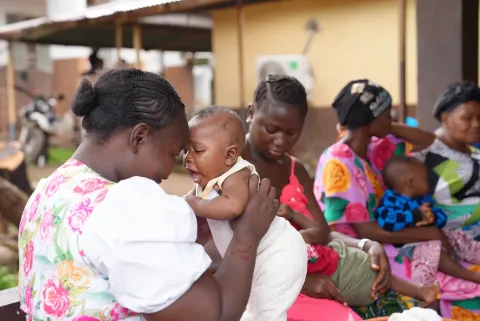
The town was among the first to feel the impact of the escalating violence early 2025. At that time, the 300,000 displaced people who had sought safety in Minova were pushed into even deeper hardship. Families displaced from other conflict areas who were living in camps, churches or even schools were often left with nothing following the dismantling of displacement sites and new mass displacement.
For humanitarian actors, losing access to the area meant operating with limited visibility. Without being able to reach Minova, UNICEF and its partners had to find new ways to quickly understand and respond to families’ needs.
"We were facing an exceptional crisis and had to change how we worked," explains UNICEF Emergency Specialist Jean Wilner Bassette. “We needed a way to understand the situation of families in Minova without putting anyone at risk.”
Then came an idea, one that changed everything.
In December 2023, more than 14,000 families had received mobile phones as part of an integrated programme to prevent gender-based violence and other protection risks that included a cash assistance component. When this programme started, the first activity after identifying participants was the distribution of phones with activated mobile money accounts.
Those phones, if still in use, could be the key.
Through the RapidPro platform, an interactive SMS application, UNICEF sent out a survey to all the families. Within 24 hours, hundreds had responded. By the end of the week, more than 9,000 families had shared information about where they were, how they were doing, and what they needed. They also confirmed that their mobile money accounts were still active and, most critically, that there were functioning cash points that they could safely access.

Espérance Shukuru, a mother of three, has been displaced for most of her life. She was just eight years old the first time she had to flee her home. “When the latest crisis broke out, we were asked to leave the displacement sites,” she explains. Fortunately, she still had her phone and was able to respond to UNICEF’s survey.
It was a game-changer as the responses provided a real-time snapshot of the situation. Because family data was already in UNICEF’s Humanitarian cash Operations and Programme Ecosystem (HOPE) platform, the team could launch one of the first large-scale humanitarian interventions in eastern DRC and the first cash intervention in Minova during the current crisis.
These bulk transfers were also the first time for UNICEF to use its global contract with Western Union to deliver money via ‘mobile’ wallets at scale. This allowed cash teams to issue payments almost immediately after phone numbers and mobile money accounts were verified as functional.
“Those who answered first were the first to receive support,” says Programme Officer Muhindo Mbonzo. “We didn’t need to send teams into insecure zones to register people or assess needs.”
Since the first cash transfers started on 7 March, the programme reached more than of 6,000 families, improving the living conditions of tens of thousands of people. In coming weeks, UNICEF aims to reach other families not included in the first round of support.

Gisèle Byamungu and her six children arrived in Goma a few weeks ago. “Business was going well in Minova until the new crisis hit,” she recalls. “With what little money I had left, I paid for transport to get my whole family to Goma.” When she received the cash transfer from UNICEF, her priority was getting her children back into school. She also bought a few pieces of fabric, which she now sells at the local market. “I’m proud to be able to provide for my family,” she says.
Mobile cash assistance offers speed, dignity, and choice. It lets families decide what their children need most. In places with poor network coverage or limited access to cash points, UNICEF will work with partners to set up mobile cash counters for a 'cash-in-hand' distribution.
This wasn’t just about fast delivery; it was about reaching families at a critical time. And maybe the biggest lesson of all? Innovation doesn’t always mean new technology. Sometimes, it’s about finding new ways to use what’s already in place: a reliable database, a phone, and the trust built with communities.