Water flows in Zemio, but the deeper thirst is for peace
Despite insecurity and difficult logistics, UNICEF CAR and its partner APSUD, supported by CERF funding, have brought a clean water supply system to three towns of the southeast.

- English
- Français
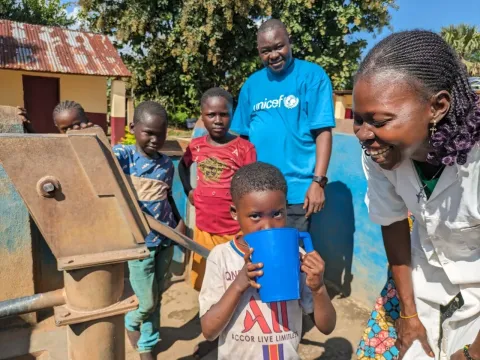
At the age of six, Dieuveille enjoys a happy moment with his friends near the water point in their neighbourhood of Kondo, in Zemio. As the children play, his family takes advantage of the facility’s proximity to fetch the water they need for the household. Marie Christine Nadjiwi, one of the mothers who have come to the water point, smiles as she watches her children jump and laugh out loudly:
“Until very recently, we had to walk a long way to fetch water, and we often returned home late, leaving everyone waiting before we could prepare the meal and eat. There was also a hand-operated water pump a little closer to our home, but we would have to queue for hours.”
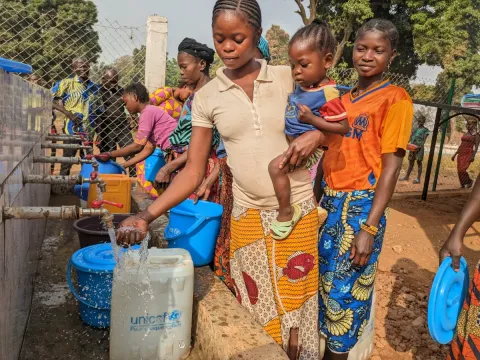
“ When we see now that the water flows abundantly from three taps at the same time, it looks like a dream,” she concludes.
Crossing a swamp from Kondo, one enters the centre of Zemio. Some few hundred metres beyond, at the Arege neighoburhhod, Angélique, a 65-year old grandmother who has lived there since childhood, shares the same enthusiasm as she comes to the newly rehabilitated water pump, now powered by a solar energy system. .
“Clean water is something we badly need in Zemio,” says Angélique. “For years, insecurity forced many of our neighbours to seek refuge across the river in the Democratic Republic of the Congo. Today, the situation is a bit calmer, and many people are returning home, even if only for the evening. The first things they do is make sure they have enough water for their families.”

On his way to the Arege market, where he sells small sweets, Aroune, a young Fulani from the Kondo neighbourhood, stops for a few moments to quench his thirst at the water point set up near the market. He is one of the many people living in Kondo who, over the past few years, have settled there in large numbers after fleeing violence and insecurity in villages further inland.

Max Pacific Nzil-Dja, UNICEF’s water-and-sanitation specialist who has been coordinating this programme, explains its advantages, adding that it is being implemented also in Rafai and Obo, both in the southeast of CAR.
“This new system draws and distribute water more efficiently, bringing a reliable source of clean water to the community.”
While in Arege one single water point suffices for its inhabitants, in Kondo -which has a much larger population- the solar-powered system distributes water through a network of pipes to three collection points, each equipped with three taps. Located in various strategic spots in the neighbourhood, these water points provide nearby households with easier access to a reliable supply of clean water.

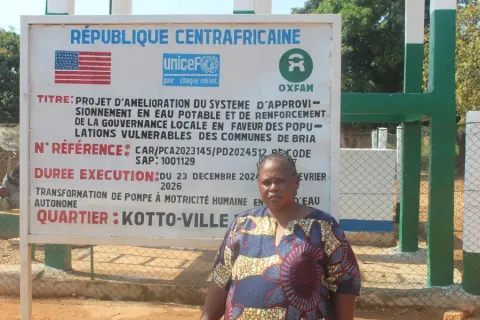
Over the past several months, UNICEF, in partnership with the national NGO APSUD, coordinated this ambitious water programme. Supported by funding from the UN Central Emergency Response Fund (CERF) to respond to urgent humanitarian needs, this work aimed at expanding access to clean water supplies for communities that have long faced the combined challenges of insecurity, displacement and limited basic services, as it is the case in this vast area of the country’s southwest.
For several years, Zemio, along with other areas of the Haut-Mbomou Prefecture, has experienced successive waves of violence, characterized by alternating periods of armed conflict and relative calm.
According to the UN Office for the Coordination of Humanitarian Affairs in CAR, approximately 65,000 displaced people from the area are currently living in Zapai, on the opposite side of the river in the Democratic Republic of Congo. Many hold asylum-seeker status, and the vast majority engage in regular cross-border movements. Every day, hundreds of individuals commute from Zapai to Zemio in the morning to access markets, services, and their homes before returning to the DRC in the evening.
Intermittent insecurity, combined with the poor state of the roads, creates major logistical challenges that make projects like this particularly difficult to implement. The cost of construction materials in Zemio is extremely high: a single bag of cement can cost as much as CFA 50,000 (approximately US$88). To keep the project within a reasonable budget, most building materials are transported from Bangui. The journey is long and arduous, with trucks often taking three weeks—or even longer—to reach Zemio.

But much as people need water for drinking, cooking and washing, another deep thirst is present in Zemio: after decades of conflict, people crave peace.
For more than a decade, Zemio has experienced persistent ethnic tensions, which is one of the drivers of the conflict. These days, beneath the surface of an apparent calm, deep-seated grievances, mistrust and rivalry continue to characterize relations between members of the majority Zande community and the Muslim population, composed primarily of Fulani and persons of Arab-Chadian origin.
Hundreds of Fulani have been living in a settlement on the outskirts of Zemio, in the Kondo neighbourhood, commonly referred to as the “Peulh Camp.” Community leaders say that they have lost virtually all of their livestock, which had traditionally been their primary source of livelihood. As a result, many households have been compelled to turn to agriculture. However, insecurity severely restricts their access to farmland, making it difficult for them to travel more than three or four kilometres from the settlement.

The UNICEF project also includes a strong sanitation component. In addition to improving access to safe water, it supports the construction of community latrines and the installation of an incinerator at the hospital to strengthen hygiene and eliminate waste generated in the hospital wards and laboratory.
Mélina Solange Manbawiso, who has worked as a hygiene officer for the district hospital since 2021, plays an important role in promoting safe sanitation practices.
Shortly before sunset, as dusk begins to settle over Zemio, potentially hazardous medical waste is fed into the incinerator and reduced to ashes.
Watching the dark smoke rise from the chimney, as flames consume the waste, one cannot help but wish that violence and hatred could be eradicated just as completely, allowing Zemio to move toward a future defined by peace, recovery and hope.