Water for a new life in Batangafo
Faced with the challenge of a growing population, UNICEF and its partners, with US funding, are developing a programme to provide clean water for all

- English
- Français
Benon Liji, 25, is among an estimated one million Central Africans who over the past 13 years have been forced to flee their homes either within the country or abroad as refugees.
Her worst time, she recalls, came in 2019: “We were used to seeing armed herdsmen roaming around our village of Goffo, but one morning, at daybreak, they stormed our community, shooting and setting houses ablaze. Some of my relatives were killed, including my maternal uncle. I narrowly escaped with my firstborn son to Batangafo, where I have been living ever since.”
Seven years later, she has two more children, and another is on the way. Holding two-year-old Ostiana in one arm and an empty jerrican in the other, she stands beside a tap where clean, fresh water flows freely.
“After cleaning my house, the first thing I do every morning is pick up a jerrican and go to fetch water from the new water point nearby. Before, we had to walk to the river and collect dirty water that often made us sick. Since this new facility was installed in November last year, I am so happy—and it is very close to my home.”
After collecting the water, she walks back to her home, just 200 metres away. Her two older children are at school, and she prepares to head to nearby farming fields, where she earns a living as a day labourer for other families. For a full day’s work, she is paid 2,500 CFA francs ($4.5). In the evening, she stops by the market, before returning home to prepare the family’s meal.
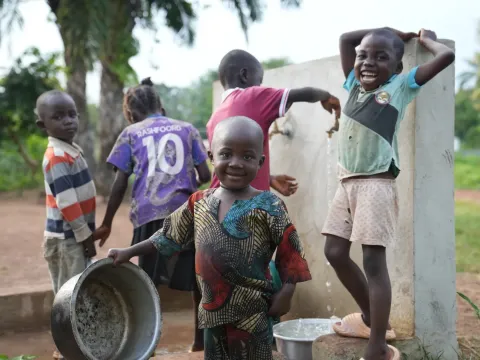
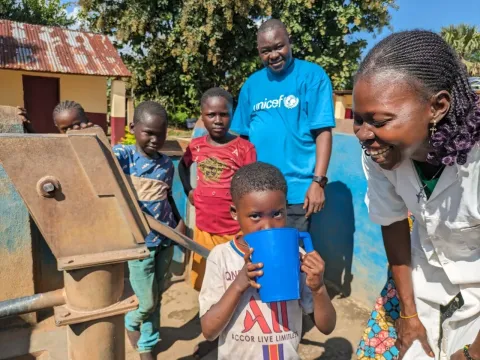
Benon gets her daily supply of water from a new water point near her neighbourhood. Inside a fenced compound stands a tower supporting two water tanks, each with a capacity of 5,000 litres. A solar-powered pumping system draws the water from a borehole that was drilled years ago and long relied on a manual pump. With the new system in place, water can flow simultaneously and effortlessly from six taps, sparing users long hours of waiting.
Mr Tom Konou, the neighbourhood chief, talks about the infrastructure with a lot of satisfaction: “This installation supplies water not only to our neighbourhood but also to the about 3,000 internally displaced people living in a nearby camp. Also, since the water point was built within the compound of a nursery school, their pupils also benefit from access to clean water.”
Not far away, in another part of town, a similar installation in the “Arab neighbourhood” supplies water to residents of five neighbourhoods, serving an estimated 3,000 users. A third water point is also nearing completion in the town centre, in the heart of the bustling Lakouanga market.

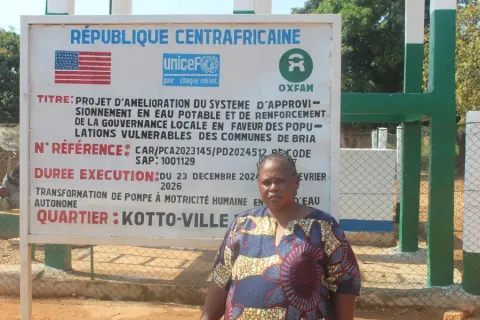
Before the crisis, Batangafo was home to about 15,000 people. Since 2013, when hostilities erupted in the Central African Republic, the town and its surrounding areas became among the hardest hit by the conflict. Years of violence and displacement have dramatically increased the population, which now stands at an estimated 40,000. In response, UNICEF, in partnership with international NGO Oxfam, has developed an ambitious water and hygiene programme, supported by funding from the United States Department of State, so that nobody is left without access to clean water. In CAR, it is estimated that only a third of its population has access to clean water.
Two additional neighbourhoods on the outskirts of the town—Boukita and Bissangai—are expected to receive similar water points in the coming months. New boreholes have already been drilled, and construction of the towers, along with the installation of solar-powered pumps and taps, will follow shortly. The programme also foresees connecting several pipes to an existing water reservoir on a hilltop to supply some other neighbourhoods.
Batangafo has gradually regained a measure of peace since 2021, when the armed group that had controlled the town was driven out. As displacement camps are dismantled, people who are unable or unwilling to return to their original homes are being offered the chance to start anew in newly established settlements on the town’s outskirts. Access to clean water is the first and most essential service they need.

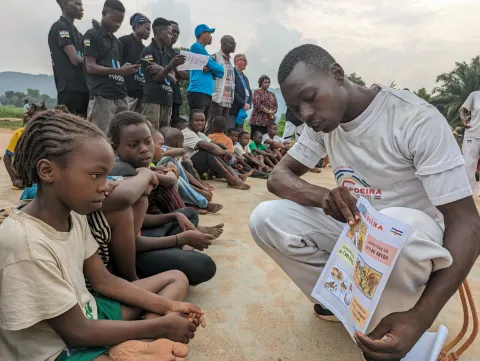
To ensure the water supply system is community-based and sustainable, Oxfam has trained and equipped a committee of eight people at each installation to oversee proper operation and maintenance. Genetona Rich, chairperson of the committee managing the water point in the Arab neighbourhood, explains:
“Every day, before opening the facility to users, we come to clean the compound. We also raise awareness so that everyone helps keep it tidy. Each user contributes a small monthly fee. This is our own water-supply facility, and it is our responsibility to keep it functioning properly.”
For now, Benon Liji has no plans to return to her village of origin. “I have visited my former homestead several times, but it lies in ruins, and each time I come there I remember the horrors I endured the day of the attack, and I feel very sad. Moreover, it is not unusual to see armed nomadic herdsmen still passing nearby, so going back is out of the question.”
Benon and her husband continue to rebuild their lives in Batangafo, laying clay bricks and raising a new, better home of their own.
Asked about her plans for the future, Benon simply shrugs. “Tomorrow,” she says, “like any other day, I will wake up, pick up my jerrican, and walk to collect water for my family.”