Mariam: from the shadow of conflict to the hope of a new life
Behind each child formerly associated with armed groups lies a history of suffering, but also immense potential when they are given a second chance.

- English
- Français
At just 17, Mariam already bears the scars of a childhood marked by violence, loss and deprivation. Having recently left an armed group, she sees her future as a new beginning.
“I just want to get back to a normal life, learn a trade and never have to experience war again”
Originally from the village of Pehouri, some 20km from Baboua, in the Nana-Mambéré prefecture of the Central African Republic, Mariam’s life took a dramatic turn at a very early age. In 2014, when she was just five years old, her village was attacked by armed men, as she recalls: “My life changed the day when my parents were killed. I couldn’t understand why that happened. After that, I stayed with my grandmother, who did all she could to take care of me.”
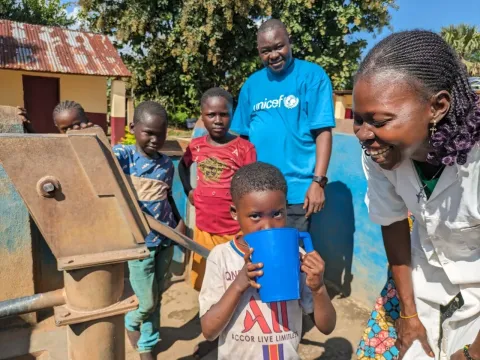
Pehouri is a village that relies mainly on livestock farming. For several years now, residents have been living under the constant threat of armed groups, highway robbers and kidnappers who covet their herds. As a result of this insecurity, the village school was completely destroyed during the violence of 2014 and has never been rebuilt. Even today, their inhabitants have neither a school nor access to drinking water.
Despite these extremely difficult circumstances, Mariam’s grandmother worked hard to secure her granddaughter’s future. After they moved to a location about five kilometres from Baboua, she managed, with very limited resources, to enroll Mariam in school in 2015.
For several years, Mariam pursued her education with determination: “I used to love going to the school in my village, but after it was destroyed, I had to travel a long way to study. My grandmother could no longer afford to pay for my school fees. I had to stop, even though I still wanted to learn.” In 2019, while she was in Primary 4, Mariam was forced to leave school for good.
Deprived of an education, without any means of support and living in a region severely affected by the conflict, Mariam became particularly vulnerable. At the age of 16, she was recruited into an armed group, where she endured one of the most harrowing experiences of her life:
“At my age, I didn’t have the means to make my own decisions about. When I ended up with the armed group, I had to do things I didn’t want to do. I just wanted to be safe and be reunited with my family, but I had no choice.”
During the time she spent with the armed group, she was used as a cook and forced to live as the commander’s wife: “One day I found out that I was pregnant. Those months, as well as the delivery, became very hard for me, especially when my baby died one week after his birth, leaving me in deep sorrow.”
Disarmament and reintegration operations
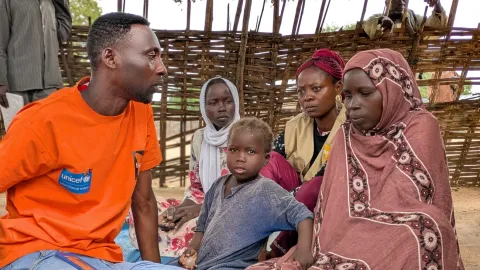
Today, thanks to the Disarmament, Demobilisation, Reintegration and Repatriation (DDRR) operations she went through, a new chapter is beginning for Mariam. UNICEF teams, in collaboration with the Regional Directorate for Gender Promotion, a government agency, have identified her, secured her release and reunited her with her relatives.
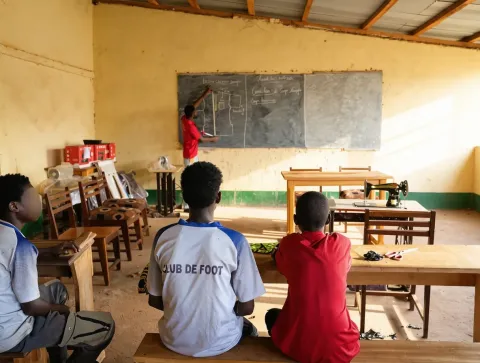
She will now receive comprehensive support, including psychosocial support, healthcare, assistance with family reunification, socio-economic reintegration activities, and opportunities to return to education or vocational training, in line with the aspirations she has: “All I want is to go back to school or to learn a trade, so that I may work, support my family and live in peace. I don’t want to back to the nightmare I had with the armed group.”
In 2025, UNICEF in the Central African Republic, together with its partners and thanks to financial support from the Spanish Committee for UNICEF, reintegrated 880 children who were released from armed groups.
“Children like Mariam highlight how children have borne the brunt of the civil conflict in the Central African Republic,” said Adele Rutsobe, chief of the Child Protection for UNICEF CAR. “No child should face such a childhood, and by establishing these programmes we are giving them a chance to hope again in a better future.”
Mariam is now well on the way to a new life.
……………………………………….
*The name of the protagonist of the story has been changed, for protection purposes.