A future for children leaving armed groups in CAR
For more than a decade, armed groups in the Central African Republic have forced children into their ranks. UNICEF met recently with three boys and a girl who were reintegrated

- English
- Français
Hadija's* hands slowly knead the dough that she left to rest the night.
Early in the morning, she carefully places the loaves she has shaped on a tray and puts them in an oven that her mother has heated with firewood. About 30 minutes later, she takes the baked bread out of the furnace and quickly replaced them with another full tray.
“I am about to begin my last year of secondary school, and I must study hard. With my bakery, I pay my own school fees. My dream is to become a midwife.”
Before she has left for school, the first customers arrive at her mother’s compound in the town of Bria while the bread is still cooling. Hadija sells each piece for 100 CFA (about 15 euro cents). If she has no time to sell the whole batch, her mother shall continue for her after she leaves.
Five years ago, Hadija, now 19 years old, was with one of the armed groups present in Bria, her hometown, which for several years was divided into sectors, each dominated by a different militia.
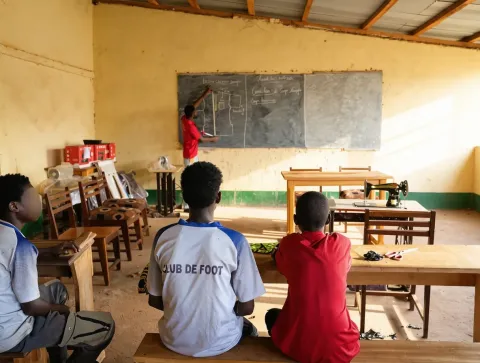
She escaped their ranks in 2020 and for several months hid herself with relatives to avoid being forcefully recruited again. When, on the following year, the government regained full control of Bria, she signed up for a skills training programme, as part of a UNICEF intervention for children formerly associated to armed groups, thanks to fundings from the Spanish and the French sections of UNICEF plus the US State Separtment.

Not far from Hadija’s house, in the same neighbourhood, Moustapha, 21, runs a kiosk where he sells mobile phone airtime. He too was a member of an armed group, although a different one from Hadija’s. It is not unlikely that on more than one occasion they may have taken part in skirmishes fighting on opposite sides. When he ran away from the militia, also in 2020, he managed to reach her parents’ home in a different part of CAR, but there too he found an even worse situation and he decided to return to Bria.
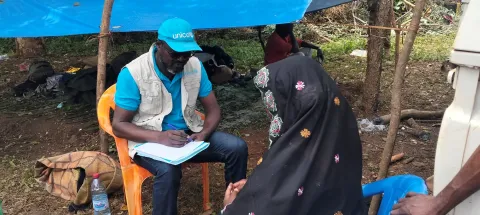
When he enrolled in UNICEF’s vocational skills training programme, he chose to learn about commerce. For several months he was taught the basics of income generating activities. “I usually get between 2,000 and 3,000 CFA a day, enough to take care of myself and pay my studies,” he says. The staff of NGO Esperance, UNICEF’s partner, regularly visits him as well as many other children who used to be with armed groups.
Still several grave child rights violations
The annual report of the UN Secretary General on Children and Armed Conflict, published on 17 June 2025 still reveals an alarming escalation in UN-verified grave child rights violations in CAR, including 733 cases affecting 479 children (283 boys and 196 girls), marking a 77 per cent increase in incidents and more than double the number of affected children compared to 2023. Recruitment and use of children by armed groups nearly tripled (from 103 to 331).

Foster families for unaccompanied minors
Hadija and Moustapha are thriving, but exiting armed groups is never easy. In another neighbourhood of Bria, the “quartier Gobolo”, inhabited mainly by people of Fulani ethnicity, Mahamat, 16, lives with a foster family. His foster mother, Amina, has been taking care of Mahamat for the last month, after he left the armed group following a recent peace agreement.
While NGO Esperance provides psychosocial support to him twice a week, UNICEF and its partners are trying to trace his parents. Mahamat is a native of Darfur, in Sudan, and he was recruited from there before coming to CAR. He speaks only fulbe, hence why he has been placed in the care of a family with whom he can communicate.

While Mahamat waits, another former child in an armed group, Abdel is a shining example. When he escaped his group five years ago after two years in the group, he had a single-minded focus on continuing his education. The fact that he was able to find his parents soon after his liberation made his process of reintegration smoother. Today, at the age of 21, he has completed secondary school. And he is happy to have succeeded in passing the pre-university examination.
“I want to study Economics. My country needs a lot of development,” he says. “There is too much poverty here, this is why there are wars. The day that everyone shall have enough to live, there will be no more violence.”
*Names have been changed for protection purposes.