Listen, encourage, give hope
In Birao, a pyscho-social counselling led by the Directorate of Social Affairs, UNICEF CAR and partner Triangle, provides individual care to children and families.

- English
- Français
Eight-year-old Ousmane Nour* looks sad and it is difficult to persuade him to look up from the ground as he whispers. He is his mother’s only son, and she has been admitted to Birao Hospital for the last three months.
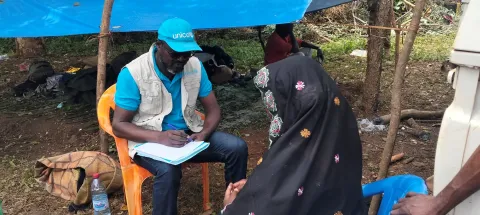
Ousmane’s father stayed behind in neighbouring Sudan when he and his mother fled three years ago because of the war. They have had no news of him since. Khalifa Oumar, a 32-year-old Sudanese volunteer whose face is always ready to break into a smile, listens to him and encourages him.
“Here in Korsi [a neighbourhood on the outskirts of Birao that is home to around 25,000 refugees] you meet many children who look deeply sad. They have experienced violence in their own country because of the war, and although they are now safe, they still face other challenges, including family separation, abuse and neglect. We visit them in their homes to listen to them, offer support and help their families.”
Khalifa Oumar is a member of a RECOPE (Community Network for Child Protection, in its French acronym), a community-based volunteer group that identifies children in situation of vulnerability and assures a follows-up for those who need particular attention. Working together with social workers, they accompany children and their families. They also manage Child-Friendly Spaces where children come daily for games and educational activities.
Ousmane is one of the 170 children identified by RECOPE as needing psyco-social health support. They all received personalized care thanks to a programme coordinated by four social workers from Triangle. When his mother was admitted to hospital three months ago, Khalifa’s team stepped in to care for him, placing him with a foster family.
Kousar Mahamet, a lively Sudanese woman in her thirties, lives in a house with a spacious but simple compound. She already has seven children of her own to look after, but when RECOPE approached her to request her support, she didn’t hesitate to accept one more.
“I know Ousmane’s mother,” she says. “When I heard that she was sick, I saw her son alone and sad I was really moved to pity. I welcomed him in my house as my own child and to me he is just like any of my children.”
Every day, Koussar takes Ousmane to hospital to take food to his mother.
“She is still under treatment, but I am confident that she will recover. When she sees her son Ousmane, she revives and is happy. We visit every single day.”
Every morning, Ousmane joins scores of other children from Korsi in the nearby Child Friendly Space in “Block Six”. There, a team of monitors organizes them by age groups and conducts games, songs and educational discussions. Soon after midday, as schools close for the day, some older children arrive and organize a lively volleyball match. UNICEF and Triangle run three of such centres in Birao for Central African and refugee children.

Reine Grekpobou, from Triangle, is one of the four social workers who conducts the mental health project. Originally from Bangui, she came to work in Birao five months ago. As she shows the notebook where she registers the details of the 46 cases she follows, she is convinced that parents have a crucial role to play in helping their children to recover from trauma.
“Children living in Korsi came here having endured already a lot of violence in Sudan. Here, you find many cases of children being mistreated. We try to tell parents not to take them to work in the fields or at their homes and convince them that a child’s place is in school.”
Every week, Reine helps the monitors organize the Child Friendly Space activities.
“When children are experiencing mild stress, we engage them in age-appropriate games and activities. This helps them release tension and feel more at ease.”
But often, she says, you find children who show more severe signs of psychological distress and need a more specialized treatment, as Reine remarks:
“If you notice that a child is always aggressive, doesn’t want to play or cooperate with others, it’s a clear sign that they may be suffering from a psychological distress that needs a deeper evaluation, and we refer them to the district hospital, which has a mental health unit supported by an international NGO.”

One of the most dramatic cases Reine is following is 35-year-old Hadiya Adam. Four years ago, whilst living amidst the armed clashes in her hometown of Nyala, she lost her sight due to an illness that could not be treated in time. Her husband died there. Hadiya arrived in the Central African Republic by lorry in 2024. Today she lives in a small mud-brick house with her four daughters. She has another son, who is older, who stayed behind in Am Dafok (at the border with Sudan).
Reine and Khalifa visit Hadiya regularly. They began visiting her home last year, when her eldest daughter, aged 12, came home one day in tears, saying that the children at her school were bullying her, telling her they didn’t like Sudanese people. Khalifa explains how they managed that situation.
“Our RECOPE group organized several meetings, with the headteacher and the teachers, as well as the parents’ association. The fact that RECOPE brings together Sudanese and Central African people is an advantage because we can see the perspectives of both communities and act as a bridge in cases of conflict such as this. In the end, things calmed down and today the Sudanese children attend that school and mix with their Central African classmates without any problems.”

“People like her need a lot of support, especially the children. You must listen and show that, although they may be undergoing situations of serious distress, they are not alone. We are there for them,” concludes Khalifa.
The mental health scheme in Birao is a showcase of UNICEF’s commitment in CAR to strengthen access of children and their families to mental health services, particularly in situations of humanitarian emergency.
*The name has been changed.