Dealing with child mental health in the aftermath of conflict in the Central African Republic
The theme of this year’s World Mental Health Day, on 10 October, highlights the importance of access to mental health services for people in catastrophes and emergencies.

- English
- Français
“For several days, I couldn't sleep or eat,” says Aissetou, a high school student who witnessed the tragic stampede in June 2025 at the Barthelemy Boganda High School in Bangui, capital of the Central African Republic.
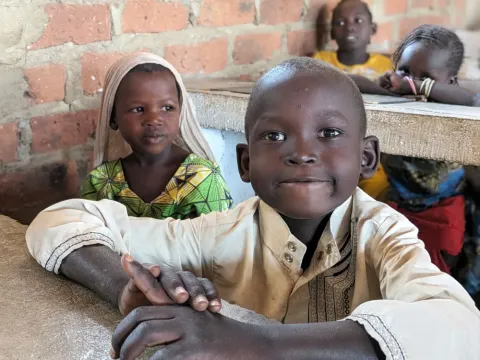
Now, a month later, she is sitting on the benches of a classroom in Bangui’s Technical High School on a Saturday morning, one of two dozen students learning about the symptoms of traumatic situations and how to respond.
“At night I had nightmares and thought about death,” she says. “But despite everything I am determined to take my exam because it's my future.”
The students are part of around 5,300 candidates that were taking their baccalaureate exams on 25 June 2025 in the Boganda High School when an electrical transformer located on the school grounds exploded with a bang, causing panic and stampedes that killed around 30 students and injured at least 260 others.

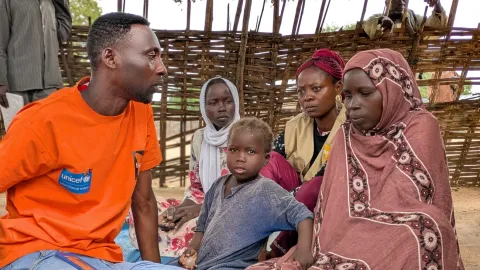
Now, on this Saturday morning, scores of students - some of them walking on crutches - spread across several classrooms following similar sessions on dealing with trauma, led by a team of psychologists under the mental health psycho-social support working group, coordinated by the Ministry of Health and Population and UNICEF.
Aissetou’s combinations of symptoms is a well-known denomination in psychiatry: Post-Traumatic Stress Disorder (PTSD), a serious mental health condition that affects many people who have been exposed to a traumatic event.
From one trauma to another
This is not the first traumatic experience that Aissetou, 19, has witnessed. About a decade ago, when fighting between armed groups raged in her PK5 neighbourhood in Bangui, she, a small child at that time, had to spend numberless nights shaking with fear while hearing firearms detonations nearby. She had to leave her home with her parents and siblings and live on site for displaced people. Adolescents in the Central African Republic, where collective trauma runs deep, have known civil conflict first-hand, growing up through the crisis that broke out in 2013.
According to the World Health Organization, natural disasters, conflicts, and public health emergencies cause emotional distress, with one in five individuals experiencing a mental health condition.
“Supporting the mental well-being of individuals during such crises is not just important – it saves lives, gives people the strength to cope, the space to heal and to recover and rebuild not only as individuals but as communities”
Leticia Silvela, a psychologist who has worked for over two decades in UN-run mental health programmes in Ethiopia, Angola, Siria, Palestine, South Sudan and Ukraine. Silvela laments that “psychosocial wellbeing is often overlooked in the early stages of crisis response” and strongly argues that “it must be integrated from the outset of all humanitarian action.”

A legacy of unhealed trauma
Providing such support can be a huge challenge in a country like CAR which has only one trained psychiatrist in the public health system and a modest mental health clinic -run by the Brothers of Charity- which opened less than five years ago.
Recalling the case of the Boganda’s high school in June this year, Keven Bermudez, a UNICEF consultant on mental health services, stresses that although mental health working group members were able to deploy quite rapidly to provide psychological first aid, a coordination mechanism regrouping different emergency actors had not been set up previously. This meant that given the magnitude of the catastrophe, many surviving students, teachers, grieving family members and friends were not reached in a timely fashion by professionals who could have supported them in meaningful ways.
“Then, there were few mental health services to refer survivors and family members to for continued support,” he says.
Integrating such psychosocial support into crisis responses is a must. As Silvela stresses, “this is not optional. Building strong mental health systems and empowering local actors to lead these efforts are essential to healing collective trauma and fostering resilience.”
In CAR, several cultural elements can complicate things more, with people with mental health issues sometimes attracting stigma or even accusations of witchcraft.
Other mental health conditions affect much larger sections of the population. Having survived a string of violent political crisis over a large period of time, many people in Bangui are affected by the “ten-year syndrome”, as they are convinced that a new explosion of violence invariably breaks out every ten years. Events, such as the proximity of elections, or rumours of impending disasters, can also be occasions for people to become restless. Such discomfort is easily passed on by adults to children, whose traumatic experiences are rekindled.
To deal with these and any other traumatic events, it is important to involve the mental health and psychosocial support working group in wider health partnerships. As Dr. Bermudez concludes, “it is hoped that these broad-based partnerships will result in improved access to mental health and psychosocial support in future catastrophes and emergencies in CAR