“Our parents say that with this paper we can go very far”
UNICEF and its partners in CAR have delivered more than one thousand birth documents to schoolchildren.

- English
- Français
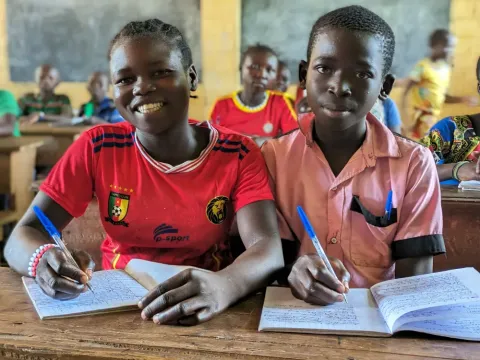
Adora Kayubo, 12, and Azor Kayibe, 14, beam with pride as they hold up official documents bearing their neatly written names accompanied by official stamps.
Their parents and teachers have explained that this paper—known as a “supplementary judgement”—will open the door to many opportunities in their lives.
Both children attend CE2 (the fourth year of primary school) at Ndima Primary School, a newly built complex that serves 182 pupils, including 60 girls. Last year, every student at the school received the same document as part of a UNICEF-supported programme to boost education and basic rights to a legal identity. Under the programme, the government has issued 1,339 supplementary judgements to children in 12 schools across the prefecture of Ouham-Fafa.
“I want to become a teacher because, in my village, I have always loved seeing young children happy. I have not always been happy myself—my mother died a few years ago—but my father encourages me to continue my studies. He tells me that, with this paper, I will be able to sit for exams and move on to secondary school. That is why I am keeping it with a lot of care.”
A birth certificate is the gateway to a legal identity, conferring a recognized nationality and enabling the full enjoyment of children’s rights. In the Central African Republic, this document is officially required for school enrolment. In practice, however, many headteachers show flexibility and waive the requirement. But without a birth certificate, no child can sit for the official end-of-primary examination.
This poses a serious challenge in a country that has one of the lowest birth registration rates in the world. An estimated 55 per cent of children under five are not registered at birth. The rate is even lower for infants: three out of five children under the age of one lack a birth certificate.
Located 28 kilometres from the town of Batangafo, Ndima Primary School serves children from three neighbouring villages. Until recently, lessons were held in a makeshift shelter with a grass-thatched roof.
The new school complex—constructed by UNICEF and its partner, the Norwegian Refugee Council, with funding from the European Union—features three fully equipped classrooms, an administrative office, and four blocks of latrines. The support package also includes teacher training sessions, the distribution of school kits to all pupils, and support for the provision of birth registration documents.
Strengthening civil registration systems
In CAR, as in many other countries, UNICEF works closely with the education sector to identify and register children who lack birth certificates, particularly at the point of school enrolment. To strengthen the civil registration system, UNICEF supported the judiciary in Batangafo—the administrative centre of Ouham-Fafa—in issuing supplementary judgements.
A supplementary judgement is a legal document equivalent to a birth certificate and can be issued by a judge to children who were not registered at birth and are now over six months old. In most cases, a declaration from the parents, along with a witness statement, is sufficient.

Children like Adora and Azor face additional challenges. For several years, the area has endured repeated attacks by armed groups, which has forced many children to miss one—or even two—academic years due to displacement. Azor remembers those years vividly:
“I was always afraid of gunshots. Whenever I heard weapons firing, I stayed at home and didn’t go to school. Many times, my parents and I had to hide deep in the bush for several days, and I missed a lot of classes.”
Today, armed groups are largely a thing of the past and the security situation in the area has improved significantly. However, during the dry season, the intermittent presence of armed groups travelling with their herds of cattle can still spark tensions that disrupt daily life.
Despite these challenges, the interventions of UNICEF and its partner, the Norwegian Refugee Council (NRC), have renewed hope among communities, who are now witnessing tangible signs of progress across the prefecture of Ouham-Fafa. Through a European Union–funded programme, nine new schools have been built, 19 classrooms rehabilitated, 237 teachers trained, and 6,975 school kits distributed.
The issuance of 1,339 birth registration documents is part of this comprehensive support package—an effort that reassures communities that they have not been forgotten.
“I really like football,” says Azor. “Maybe one day, thanks to this paper, I will be able to travel and watch Barcelona play in their stadium.”
Adora laughs. “I prefer Real Madrid,” she says. “But I would like to travel abroad too. People have told me that with this paper, you can get a passport.”
………………………………………………………………………………
UNICEF cooperates with the European Union to directly support the strengthening of birth registration systems and ensure the registration of at least 150,000 children as part of a four-year programme.
https://www.unicef.org/car/en/press-releases/150000-children-central-african-republic-benefit-birth…