Disability is not inability for children studying in CAR
UNICEF and its partners, with support from the European Union, are working to better include children living with disabilities in an ambitious education programme—ensuring that no child is left behind.

- English
- Français
Since birth, 12-year-old Salomon has only been able to use one of his arms. While he knows his disability limits some of his movements, it has never diminished his determination.
“I can write with my right hand. I’m also very good at playing football and reciting in French.”
Salomon lives in a village near Kobo-Suzanne Primary School, in Kémo Prefecture in the Central African Republic, about 35 kilometres from the central town of Sibut. He began school only three years ago, having previously been unable to attend due to financial constraints. His enrolment became possible when the headteacher, Jean Baptiste Semandele, chose to waive the registration fees for his family.
Although children his age would typically have progressed to secondary school by now, Salomon is still in the third year of primary education. If he continues on this path, he could reach secondary school within the next three years—by the time he turns 15.
Ensuring a smooth transition from primary to secondary school remains one of the Central African Republic’s greatest challenges. According to UNICEF data, only 27 per cent of children who start primary school complete it, and just 8 per cent go on to attend secondary school regularly—a figure that is even lower for girls.
For children living with disabilities, the chances are lower still.
“Paying particular attention to vulnerable children, including those with disabilities, is a core objective of this four-year education programme funded by the European Union."
Since its launch in 2023, the programme, which is being implemented by the Norwegian Refugee Coundil, has aimed to support 60,000 children as direct beneficiaries.
By its completion, it is expected to have built or rehabilitated 450 classrooms and trained 750 teachers—half of them women—across eight prefectures.
Salomon’s school, Kobo-Suzanne, is among 46 schools recently completed in three central prefectures: Kémo, Nana-Gribizi and Ouham-Fafa.

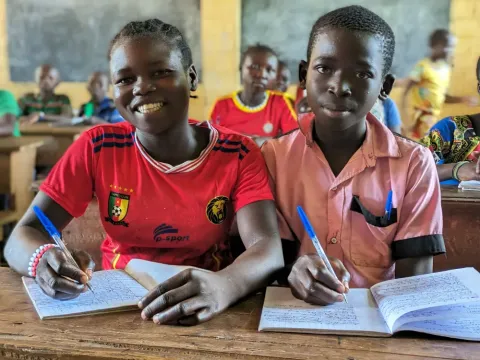
The school’s three newly built classrooms accommodate around 300 pupils. It has four teachers, only one of whom is formally qualified, while the others are volunteers with limited training.
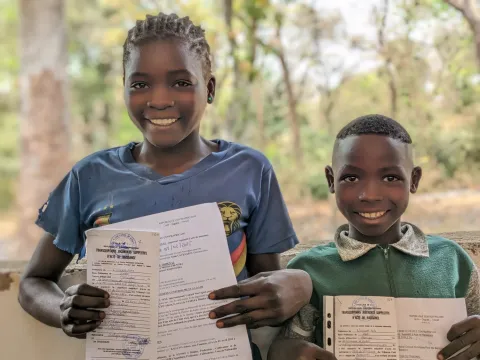
The construction package also includes an office, latrines with handwashing facilities, and a borehole—an invaluable asset in a country where most schools lack access to clean water. The programme has further supported a highly active parents’ association, known as Kundukua, and facilitated the issuance of late birth certificates for all pupils.
Salomon is not the only disabled child to frequent Kobo Suzanne’s classrooms. “We have another girl, with a leg impairment, among our pupils,” says headteacher Jean Baptiste Semandele. “Unfortunately, her home is quite a distance and many days she misses her lessons,” he laments.
The programme places particular emphasis on vulnerable children, especially those living with disabilities. Cultural barriers and financial hardship continue to hinder their inclusion in schools. To address this, facilitators working with parent-teacher groups and members of the Kundukua association encourage communities to go the extra mile, ensuring that no child—regardless of their disability—is left behind.
Fifty kilometres north of Salomon’s school, a newly constructed building stands in the village of Brouilli, in Nana-Gribizi Prefecture. It serves 470 pupils, including three children with disabilities. One of them is 12-year-old Dorelle, who was born with a damaged foot and walks with difficulty. Fortunately, she lives close enough to the school to make the journey each day.
Eight-year-old Dhabama Silo’s situation is quite different. He sits with his classmates and is happy to be among them. “The problem is that, since he hardly talks, it is difficult to assess whether he is learning. He simply smiles, and so far, he has not been able to write,” explains Elli Passiri one of the school’s parent-teachers.
“But we haven’t given up,” she adds. “With patience, I am confident that we will succeed.”

In CAR, 41,000 children with disabilities need education support. These children face additional barriers to learning driven by stigma, economic hardship, and an education system that is neither equipped nor trained for inclusion. Families often have to deprioritise schooling for children with disabilities, teachers lack skills and resources to support them, and overcrowded classrooms and inaccessible buildings make it even harder for them to be included. (source https://eiehub.org/country-briefings-forgotten-education-crises/the-central-african-republics-education-crisis)
Children with a supportive family have the greatest chance of success, and Solomon is one of the lucky ones. His father, Pougaz Blanclaim, who lives close to the school, often visits to check on his progress and encourage him. “I want him to study like all the other children,” he says.
Pougaz and his wife, Alima Moteba, are farmers with five children. Solomon, their first-born son, is the eldest of three boys and two girls.
“I have never seen my boy discriminated against. He is happy, and we have always supported him, even though we don’t have many means. I want him to continue his studies as far as he can go,” Blanclaim says.
Full of enthusiasm, Solomon approaches life with optimism, as if there are no limits to what he can achieve.
“I want to become a teacher because I enjoy helping children. But if I cannot go that far, I have another plan: I would like to be a driver for an NGO. Even if I can only write with one hand, nothing will prevent me from driving well with it.”