“I feared for the baby’s life. Later, they named him after me.”
While delivering emergency support in remote communities, UNICEF staff often face demanding and unpredictable conditions—moments that call on them to go beyond their limits.

- English
- Français
For UNICEF’s Roy Josse Ngombe, the field mission he carried out in early April 2026 to Bowaye—a remote village in the Central African Republic’s Ouham Prefecture—was unlike any other.
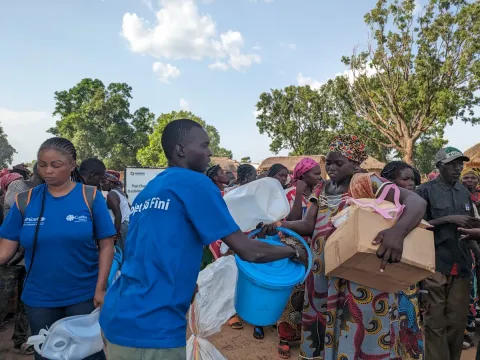
Following armed clashes that devastated villages around Bowaye in mid-March, residents fled, regrouping at three makeshift sites deep in the bush. After an alert from the UN’s Office for the Coordination of Humanitarian Affairs (OCHA) and a rapid needs assessment, UNICEF CAR deployed an emergency team just days later under the So Fini programme, funded by Sida (Swedish cooperation). UNICEF’s Emergency Specialist, Roy Josse Ngombe led the response, coordinating operations with support from partner Caritas Bossangoa.
“I’ve spent the past ten years working as a humanitarian. Often, while you’re focused on coordinating aid for thousands of people affected by a crisis, you suddenly notice one extremely vulnerable person who needs your full attention and care. During our intervention in Bowaye, I experienced one such moment I will never forget.”
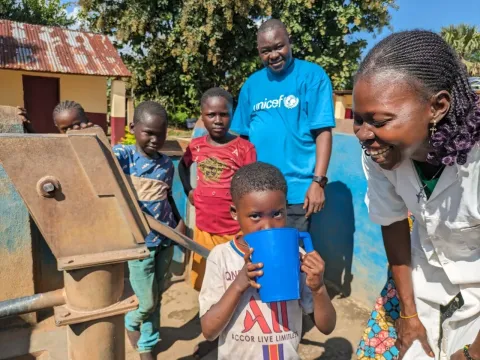
In Bowaye, 792 households—around 4,000 people, half of them children—were left in urgent need of basic services. All received emergency relief kits, and four boreholes in the area were rehabilitated to restore access to safe water.
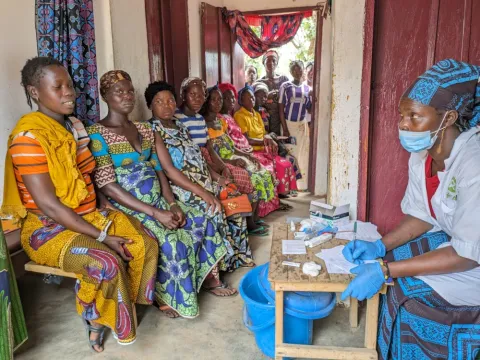
With the local health centre closed, UNICEF deployed a mobile clinic that, over several days, treated 251 children, including cases of moderate acute malnutrition, and vaccinated 200. In addition, 125 women received pre- and postnatal care.
A Child-Friendly Space was also established, providing games, sports and recreational activities to hundreds of children throughout the intervention, and helping them to overcome their recent trauma.
“Then, among the hundreds of people queuing for assistance, I counted 70 pregnant women seeking care at the mobile clinic,” recalls Roy Josse. “One of them was already in labour. With the help of two matrons, she delivered a baby girl in the compound of the mobile clinic. But there was a second baby still in her womb and the delivery became complicated. With clear concern, the head of the health centre said they could do no more. The only option was to transfer her to the referral hospital in Nana-Bakassa.”
Nana-Bakassa lies 38 kilometres from Bowaye. Having carried out numerous missions in remote areas, Roy Josse knew the road was in a poor condition. If they attempted the journey, could the baby’s life be saved? And would the trip itself put the mother at even greater risk?
“We had to act fast,” he recalls. “Within minutes, I arranged for the mother—her newborn on her lap—along with a relative and a driver, to set off in a vehicle from Caritas Bossangoa. The father of the twins was nowhere to be found, and I couldn’t bear to let her go alone, so I decided to accompany her.”
“Without delay, we set off for Nana-Bakassa,” he says. “The journey was gruelling, lasting more than two hours. The woman gasped and cried in pain, while I sat beside her, doing my best to comfort and encourage her along the way.”
Then, the miracle happened. Soon after reaching the hospital, with the help of the health personnel, the second twin, a baby boy, was born.
“I felt a deep sense of relief and returned to Bowaye,” says Roy Josse Ngombe. “We provided her with a baby kit to help care for her newborns. But over the next three days, I followed the same routine: each morning I oversaw the humanitarian response, and every afternoon I travelled back to Nana-Bakassa to check on Lucie and her babies.”
But on the final day, just before Lucie was discharged, a surprise awaited Roy Josse Ngombe.
Lucie had already named her twins: the girl was called Catchia, and the boy was named…Josse—after him.

That gesture moved Roy deeply. There was a strong reason for that.
“Just a few days earlier, I had lost my wife. She died while giving birth to our fourth child, who was also born lifeless. I was left with our three children, aged between two and ten. I was still in mourning, trying to cope with that loss,” recalls Roy Josse Ngombe.
“When I learned that the baby who had been saved had been given my name, I saw it as something extraordinary. It felt as though the life my beloved wife had surrendered was, in a way, being carried forward in this fragile child. It brought me immense joy—lifting me from sorrow to hope.”
It was not the first time that, while doing his work, Roy saw that a newborn baby was named after him. In November 2025, another child also born under difficult circumstances during another emergency intervention was named “Roy”.
“Just before I left, as I cast a final glance at the twins in their mother’s arms, I recalled what the head of the health centre had told me: during the violent events in March, several pregnant women who fled the village gave birth in the bush, without any medical assistance.”
In his Bangui office, as Roy Josse Ngombe prepares for his next field mission, he reflects on what drives him.
“Yes, we deliver non-food items, medicines, and clean drinking water to people who have lost everything due to armed attacks or natural disasters. But above all, I have seen that our presence brings encouragement—and restores hope.”
Recent estimates indicate that roughly 1,600 mothers die every year in childbirth in the Central African Republic – one of the highest rates in the world, and equivalent to nearly 5 women every day. In partnership with the Ministry of Health, UNICEF works tirelessly to reduce this toll, so that no woman who brings a new life in the world does so at the cost of her own.