Bebele’s courageous midwifes
UNICEF and its partners in the Central African Republic are supporting the Ministry of Health’s efforts to increase the number of midwives, particularly in hard-to-reach areas.

- English
- Français
Elodie Derako has set up an improvised consultation desk in the corner of a corridor inside the cramped building that serves as the antenatal clinic in Bebelem, a small village about 70 kilometres north of Paoua, near the border between the Central African Republic and Chad. Ten women wait quietly for their turn inside, while another thirty sit patiently outside in the sparse shade of two trees—some having walked for several hours to be seen.
“I’ve always felt a strong calling to support the women in my region,” she says. “In 2012, I completed a six-month training course at Betoko Hospital to become a midwife. Since then, I’ve been working here, in my own community,”
For Elodie, seeing dozens of pregnant women each day—many with serious medical needs—has become routine. Today, however, the numbers have surged. UNICEF, together with its partner Caritas, has organized a three-day mobile clinic serving several remote villages in the northwest of the Central African Republic.
This initiative forms part of an emergency response for hundreds of families whose homes were destroyed or severely damaged just weeks earlier, when a violent storm tore through the area. Uprooted trees blocking the roads and debris scattered across the ground still testify to the force of the winds that ripped away roofs and walls.
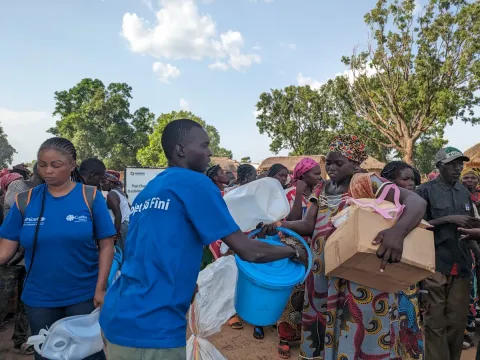
Over four consecutive days, the UNICEF supported shock response So Fini , supported by the Swedish International Development Cooperation Agency (Sida), is distributing essential supplies—including household items, tarpaulins, blankets and hygiene kits—to 394 households. The programme also supports the repair of water wells and provides free access to the mobile clinic.
Today alone, 74 women are attending antenatal and postnatal consultations, along with 103 children. At the heart of this effort are the midwives, whose role is essential and critical to keeping the clinic running and ensuring that care reaches those who need it most: vulnerable pregnant women, babies, children and their mothers.To acknowledge their role in saving lives, every year, on 5th May, an international day is observed worldwide. This year’s theme is “One Million More Midwives," emphasizing the urgent need for a massive increase in the global midwife workforce. The campaign focuses on improving sexual, reproductive, maternal, and newborn health services to prevent millions of deaths annually by 2035. calling for increased investment and recognition of midwives in strengthening health systems.

Bebele offers a striking example of how midwives like Elodie Derako save lives every day. In a small room within the same building, her colleagues—assistant matrons Elodie Rose Narambessan and Edith Assana—attend to cases requiring more specialized care.
“Most of the women we’re seeing today are suffering from conditions like malaria and candidiasis,” Elodie explains. “We do everything we can, but our biggest challenge is the lack of resources. For serious cases, we have to refer patients to the Betoko health centre, about 30 kilometres away—and finding transport is often very difficult.”
Remote villages in CAR, like Bebele, face severe barriers to access neonatal and maternal health care: few trained health workers, poor roads, and weak medical infrastructure. This puts mothers and babies at high risk. With support from partners like the Eleva Foundation and UNICEF, trained midwives working with trained matrons now play a key role. They monitor pregnancies, detect warning signs early, and refer high-risk cases to maternity waiting rooms and health facilities. Yet resources, ongoing training, and better infrastructure remain urgently needed to prevent maternal and newborn deaths.
Training and equipping midwives and matrons improves maternal safety and reduces risks in pregnancy and childbirth.
Based on CAR’s community engagement policy adopted in 2023, the strategy targeted advocacy with local authorities and village chiefs to promote maternal health awareness. This drives policy development and resource mobilization framework.

Since the initiative was implemented, significant progress has been observed. The number of prenatal consultations and deliveries assisted by trained midwives has increased, allowing for a notable reduction in complications related to pregnancy and childbirth and maternal deaths in targeted health districts. Ambulance transfers have ensured rapid care. Thus, the completion rate for four prenatal visits (ANC4) rose from 16% in 2022 to 46%; the stillbirth rate decreased from 49 per 1,000 in 2022 to 29 per 1,000.
A woman being examined in a small room by assistant midwives Rose and Edith—suffering from high blood pressure and clear signs of exhaustion—may represent many similar cases. With timely and adequate care, she could safely give birth without the fear of losing her own life or that of her baby. Despite limited resources, the dedication and compassion of these caregivers make a meaningful difference, helping women in remote villages carry their pregnancies to term with greater safety and confidence.