Saving Lives in One of CAR’s Most Remote Corners
Far from major towns and cities, thousands of people in remote areas of the Central African Republic can have their lives upended by extreme weather events.

- English
- Français
“Our house was destroyed by torrential rains. The water swept through our village, carrying away most of our belongings,” says Bohari Baba Kette. He lives in the far north of the Central African Republic in the small town of Sido. When the disaster struck on 28 August 2025, he struggled to care for his nine children.
The town of Sido has long endured the impacts of the country’s armed conflict. From 2024, a fragile peace has returned, but climate change has emerged as a new threat. Several hundred households were affected by recent storms, leaving thousands of people in urgent need of support.

When crisis struck, a locally based NGO alerted the office of the United Nations OCHA office in the town of Kaga Bandoro. UNICEF was tasked with leading a rapid relief operation, under the recently launched ‘Sô Fini’ programme (“saving lives” in Sango). In partnership with Caritas Bossangoa, an immediate assessment was carried out, identifying 528 of the most vulnerable households.
The next step was to mobilize a convoy carrying hundreds of essential household kits, already prepositioned in UNICEF’s warehouses in Kaga Bandoro. On 11 September 2025, after several hours of loading, a large truck of UNICEF supplies - accompanied by Caritas staff - set off for Sido.

Nestled along the border with Chad, Sido has endured years of chronic isolation due to the appalling condition of the roads connecting it to the rest of the country. Although only 120 kilometres from Kaga Bandoro, it took the UNICEF team three days—driving in two vehicles—to reach the town.
Recent rains had turned the journey into an ordeal: roads submerged in water, thick mud, and deep craters made every kilometre a challenge.

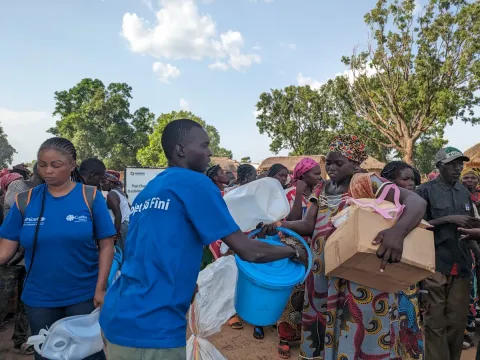
The logistics fell into place. On 14 September 2025, early in the morning, the joint UNICEF–Caritas team had already prepared a large space to welcome beneficiaries, with local authorities in attendance. To ensure smooth operations, recipients had been given tickets the day before.
Almost everyone in the town turned up, and the atmosphere resembled a community celebration, with music echoing from loudspeakers. Before the distribution began, humanitarian staff explained the process and outlined the items each family would receive.
Thanks to generous funding from the Swedish International Development Cooperation Agency (Sida) and to UNICEF' Global Humanitarian Thematic Fund, this urgent assistance reached the population in need.

Before the distribution began, a Caritas staff member outlined the items to be provided and shared practical advice on good hygiene practices. Families were then called in one by one to enter the distribution compound. After verification of their names, each received a package of essential household items: a full set of cooking utensils, a jerrycan, a bucket, a sack containing a tarpaulin, a mat, several metres of cloth, and ropes. Women were also given a hygiene kit.
Once their attendance was confirmed on the presence list, beneficiaries—joined by their family members waiting outside—carried the supplies back home.

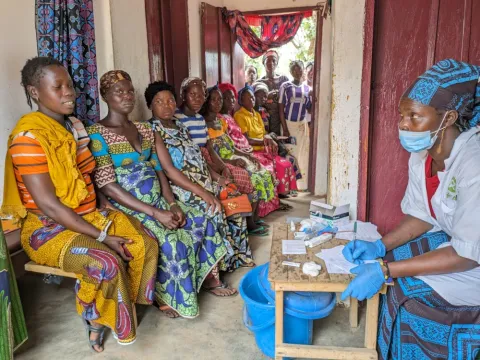
Under the shade of a tree near the humanitarian site, Solange, a nurse from the Sido Health Centre, examines a sick child, checking carefully for the symptoms of her illness. As part of the same humanitarian intervention, an open-air clinic operated throughout the day alongside the distribution exercise. In total, 130 people received free treatment, including children under five, pregnant women, and patients with open wounds.

Oma Prinsi, a resident of Sido, brought her two-year old child Mamadou for consultation. “When, yesterday, he started developing fever, feeling weak and refusing to eat, I became so worried,” she says. After undergoing a blood test, little Mamadou was diagnosed with malaria and given a complete round of tablets. Sido has one health centre with only one medical doctor. Mobile clinics are part of the UNICEF Emergency programmes, to boost these health services in remote areas.

Fifteen-year-old Angela Kamkili came to collect the household items, as her parents were away that day working in the fields. When heavy rains hit Sido in August, her family lost most of their belongings, and the houses in their compound in the Maikolo neighbourhood were severely damaged, leaving her seven siblings without shelter.
“Tonight, we will sleep under a roof, and we will be able to start rebuilding our huts,” she said with hope.

Pedro Namsoka, a water and sanitation technician, knows his craft well. “I can repair a broken borehole in three or four hours, depending on the damage—but I will definitely fix them all,” he says confidently, while working on a valve in the Sido 4 neighbourhood.
As part of the ‘So Fini’ humanitarian response, seven broken water pumps were repaired in just two days—a tremendous relief for families who, for months, had no choice but to fetch water from unsafe springs. Nearby, eight-year-old Senior watches with curiosity as the work unfolds.