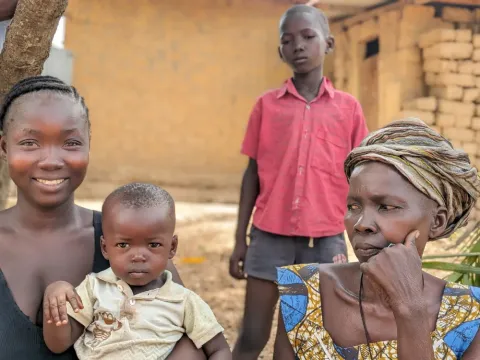
The heroes that are kicking polio out of CAR
Coordinated by the Ministry of Health and Population, with the support of UNICEF and the Global Polio Eradication Initiative, thousands of volunteer community vaccinators teams are going door-to-door so that no child is left unvaccinated.

- English
- Français
Mercie Yambouka knows every alley of his Ngongono neighbourhood by heart, deep in the lively and densely populated 8th district of CAR’s capital city Bangui. At first light, dressed in the bright yellow vest of a health mobiliser, he leaves the main health centre where he briefly reported for duty and sets off along the muddy maze of paths that crisscross his sector.
When he reaches the Saint Martin de Porres dispensary where vaccines are safely kept in solar-powered fridges, he joins the two other members of his team. Together, they collect the oral polio vaccine doses and carefully place them in a cold box. Before setting out for the day’s work, the team meet with Dr. Johnny, their supervisor, and review their checklist, making sure everything is in order.
“I’ve been doing this job for two years now, and it fills me with joy to know that I’m helping to keep the children in my country healthy. “I’m proud to be part of a great team: in our district there are 38 teams, each made up of three or four vaccinators. Dr Johnny helps us to coordinate effectively so that no child is left unvaccinated. We go from house to house and so far, we can say that we are welcome everywhere.”
This same exercise is being done simultaneously across the whole country, thanks to the dedication of thousands of volunteers. “None of us gets paid for this work,” explains Mercie. “We start at seven in the morning and finish around three in the afternoon. At the end of each day, we’re given about two thousand francs each (equivalent to three euros) as a volunteer allowance, so we can buy something to eat and pay for our transport back home.”
In 2025, 2.5 million children from 0 to 5 years of age received the polio vaccine in CAR, according to UNICEF’s data. This year’s campaign is expected to reach out to the same number of children, thanks to a joint effort from the Ministry of Health and Population, UNICEF, OMS, with funding from donors of the Global Polio Eradication Initiative, which includes Gavi the Vaccine Alliance, the Atlanta CDC and Rotary International.
“We are seeing great results. Thanks to this strategy, the Central African Republic has been maintaining its status of polio-free country since the year 2020.”
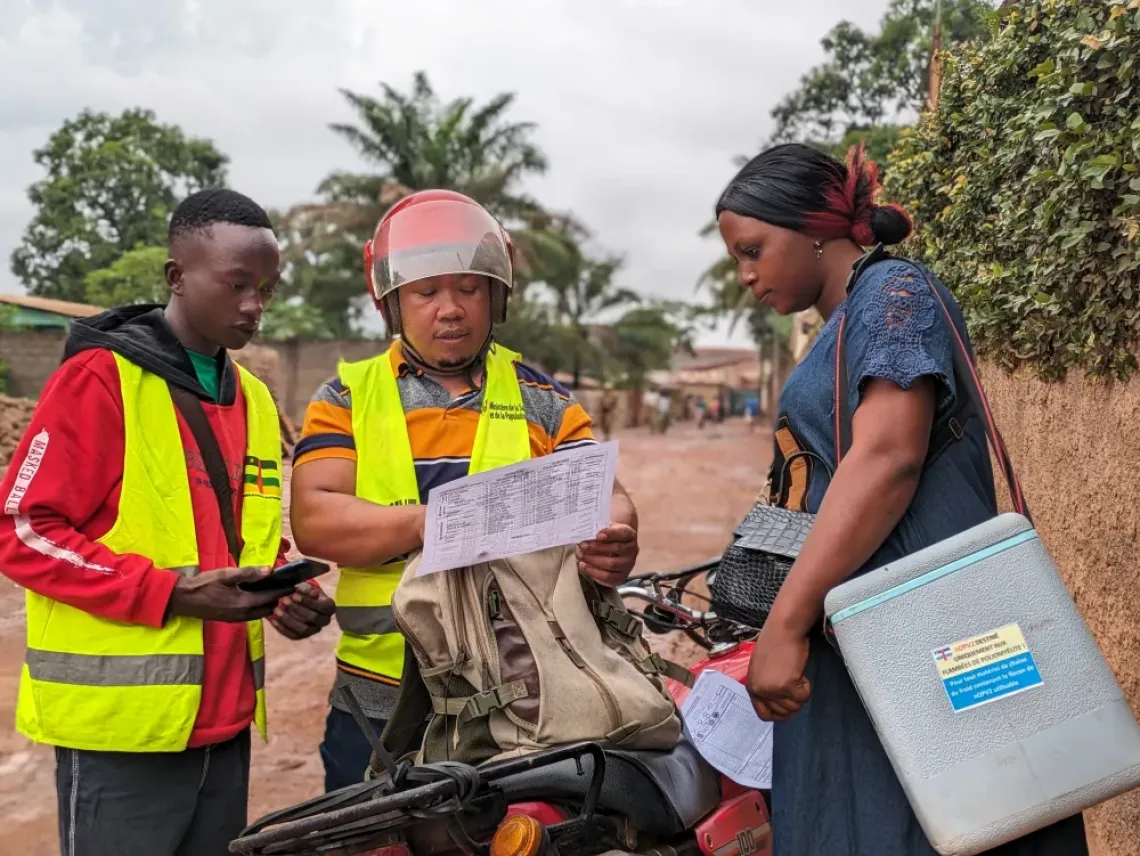
For many years, UNICEF and sister agency WHO have been working with the Global Polio Eradication Initiative to eradicate polio across Africa, supporting national governments. Despite the certification of polio-free in CAR, UNICEF continues to focus on preventing the resurgence of the virus, helping to organize massive community-based immunization campaigns and acting as a watchdog for possible surge situations, including from elsewhere in the sub-region.
Mercie and her colleagues Merveille and Axele are one of the many links in that huge chain.
As they set off for the day, it started to rain, but neither the raindrops nor the slippery patches that almost cause them to slip and fall can dampen their enthusiasm. They arrive at the first house on today’s itinerary, where the neighbourhood leader and another team of three young outreach workers have been waiting for them. They greet them warmly. Over the previous two days, around 40 of these teams have laid the groundwork in the municipal district, going from house to house, as well as from market to market, to inform residents that vaccinations are starting today.
Okta, a woman in her thirties, approaches the team, bringing her children Insala, aged one, and Adam, aged three. The little one is crying and needs soothing, whilst his older brother strides forward resolutely, mouth wide open, ready to receive the drops. They mark his finger with a marker pen. Everyone applauds and they set off for the next house, just a few metres away.
“It’s going well,” says Merveille with conviction. “We don’t have the problem of vaccine sceptics here.”
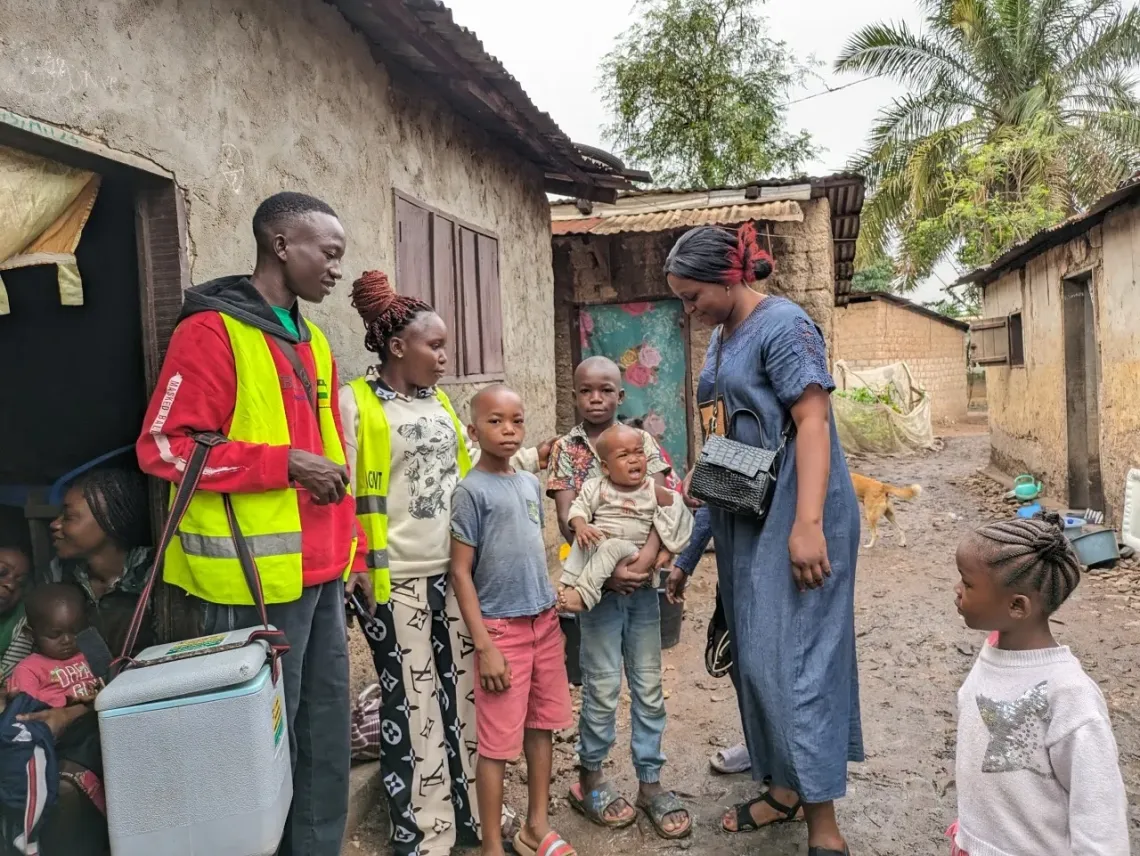
Part of this success can be explained by the community mobilisers who are trusted community figures, utilizing their local knowledge and relationships to provide information, support and care in door-to-door visits. In addition, the use of mass media - particularly the radio- and the use of influencers like local chiefs and religious leaders - reinforced the dissemination of crucial information.
At the next house, three-year-old Triomphe walks up confidently to receive his dose drop. His father brings his two younger brothers along. All the neighbours say “thank you” to the team of vaccinators and outreach workers, who now continue their way together.

Meanwhile, about one kilometre away from the place where Mercie’s team do their work, another joint team has set up an improvised vaccinators centre at the entrance of one of the local markets. Mothers who have come to buy and sell come confidently with their toddlers in their laps.
“Today, we are expecting to complete the vaccination of at least 90 children. And we shall continue for the next three days until we complete every household of our sector,” explains Christelle, the team leader.
The 38 community health teams in Bangui’s 8th district are part of the thousands of nation-wide groups reaching everywhere to make sure that no child is left unvaccinated. The results are encouraging, as Dr. Bruno Aholoukpe concludes: “in the Central African Republic, the total eradication of this disease is almost complete.”