Vaccination off the map in the Central African Republic
Many people in CAR live in remote areas lacking essential services. UNICEF and its partners endeavour to reach them so that no child is left without life-saving vaccines

- English
- Français
Mandaba is a village in the Central African Republic (CAR) that you won’t find on the map. Nevertheless, Michel and Fabien, nurses from the Kidigra Health Centre in the regional town, Bambari, know how to get there.
Several times each month, their job is to load up a motorcycle with vaccines and ply the rough roads of their catchment zone to reach remote communities. Mandaba is one of them, and their mission each time is always the same: make sure every child is fully vaccinated no matter how remote.
“I love my work,” says Michel. “I have been doing it since 2020, and I am happy to contribute to our children’s health.”
Mandaba is 20 kilometres from Bambari. It doesn’t sound like a big distance, but as they leave the town behind, the road conditions become more trying.
Today’s early morning heavy rain has made some stretches of the path slippery, and more caution is needed. They deliberately slow down at points, particularly when negotiating a stream crossing that doesn’t have a bridge.
As they approach Mandaba, they stop in the houses on the edge of the community to start spreading the word; a difficult task otherwise, since the zone has no mobile phone network.

Trust is the key
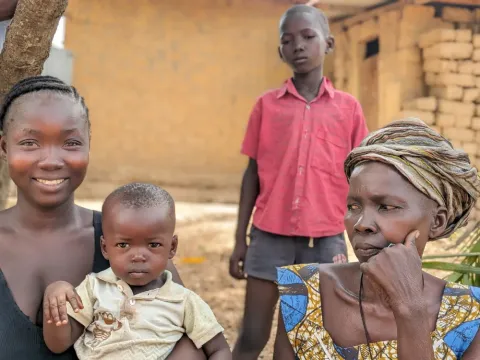
Roger Mbengegui, the village chief, did receive advanced notice of their arrival and has gathered a group of parents - mostly mothers - who have come with their toddlers. According to him, the village hosts 460 people.
“I am happy they have come today,” said Mr Mbengegui. “Their work is a guarantee that our children will grow healthy. If they didn’t come, mothers would find it very difficult to walk the 20-kilometre distance to Bambari to take the children for immunization.”
As the two nurses install their modest structure under the generous shade of a tree, more people come and soon they have a small crowd. As Fabien checks children’s vaccination records, Michel begins talking to the parents in the local Sango language, advising them about the importance of keeping up to date with vaccines.
“Trust is the key. At the beginning, we used to see some people raising objections against vaccines, but we have done a lot of sensitizations, and it is the parents whose children are healthy after being vaccinated that have convinced sceptics.”
Flora Jouleko, a mother of six, is one of the persons who has taken Michel’s advice seriously. She proudly shows the vaccination records of her son, two-year old Saturnino, who that day received his very final routine vaccine.
Before starting the actual work of giving shots, Michel and Fabien take their time to check patiently that all children have their records in order and that there is no mistake, to make sure that no one is left behind.

Every day, hundreds of nurses like Michel and Fabien reach out to villages scattered across the Central African Republic. Doing this work in a country like CAR is an uphill task; a country with just four basic health professionals per 10,000 habitants (against a WHO target of 23).
Poverty, lack of basic infrastructure and waves of violent conflict have left only 1 in 7 children fully vaccinated. Despite that, Dr Osias Guerebiko, in charge of Bambari’s health district, remains optimistic.
“For the last few years, stability has increased and we can concentrate on making sure that no child is left without immunization. Although some zones suffering from intermittent insecurity are still difficult to reach” .
The villages in the Mandaba area were all burned down during the events of 2013 and 2014, and the area was deserted. Today, people have returned and rebuilt their homes, but the scars of the conflict have left a traumatized and impoverished population.
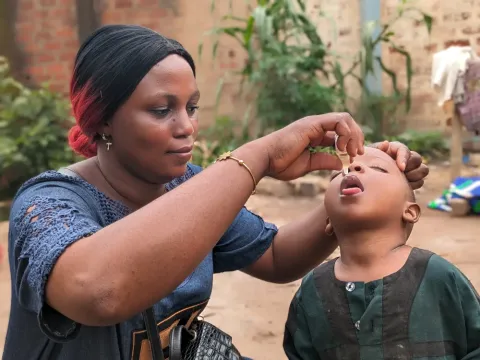
After an hour, with everyone having been briefed and in possession of their vaccine records, the actual work of immunization begins. The routine vaccines include doses against measles and polio.
Thanks to funding from the King Salman Humanitarian Aid & Relief Center, Saudi Arabia, UNICEF is supplying 10,000 bivalent oral polio vaccine and 11,500 measles vaccine vials, both of ten doses each, in 24 of the 44 of the country’s health districts. The support has also provided 35 solar-powered refrigerators, 50 cold boxes and 250 vaccine carriers like the ones that Michel and Fabien came with today.

Michel and Fabien may not be aware, but thanks to the work of dedicated nurses like them, despite all challenges, vaccine coverage in Penta3 has passed from 86 per cent in 2022, to 97 per cent in 2024. In the two countrywide campaigns last year, 1.9 million children aged 0-59 months were vaccinated against polio, well beyond the target of 1.66 million.
Access to vaccines in CAR has also greatly improved with the reinforcement of the cold chain to keep vaccines at the right temperate. As of 2024, 83 per cent of the country’s health centres were equipped with solar-powered fridges and freezers, and by the end of 2025 that percentage reached is expected to reach 95 per cent, with 500 fridges and 30 deep-freezers in the process of being installed.
As sunset approaches, Michel and Fabien pack up their equipment, say their goodbyes, and start the journey back to their base. Next week will see them visiting another village. Whether or not it appears in the map doesn’t really matter, so long as there are children there: Children who have a better chance of a healthy start in life thanks to the vaccines they receive.