Boosting education in the heart of the Central African Republic
UNICEF and its partners are working to improve conditions of access to school in a difficult zone.

- English
- Français
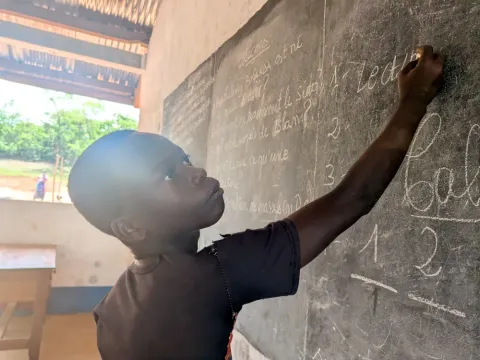
The Central African headmaster writes his question on the blackboard.
“A school yard has a perimeter of 280 metres. The width exceeds the length by 30 metres. Calculate the dimensions.”
Headmaster Thierry Wamatchi steps back and 14-year-old Florence Mbata comes up quickly to answer. After a couple of minutes, she shows the correct solution and the whole classroom bursts into a loud applause.
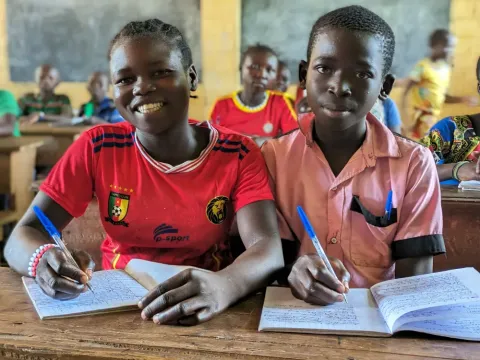
Welcome to Bokolobo Primary School in the centre of the Central African Republic, a school with 960 pupils (of whom 430 are girls) crammed into four classrooms. He is not just the head teacher; he is the only qualified teacher. Four other volunteer parents provide assistance.
Equipping volunteers
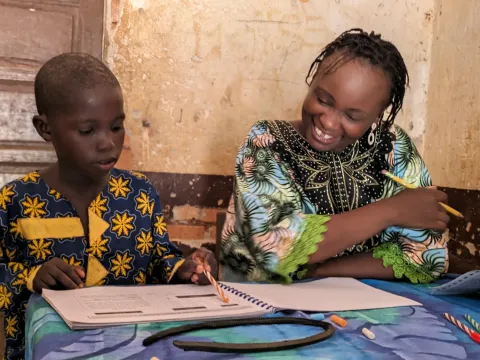
UNICEF, with the support of the European Union, has started a programme of accelerated training for ‘parent-teachers’, as the volunteers are called. The first training workshop took place during the last school holiday and the four parent-teachers say they feel excited about going for the second part, in June, at the end of the academic year. The programme also includes school construction and rehabilitation at 150 schools countrywide, and Bokolobo is on the list.
The 75-kilometre dirt road from the town of Bambari to Bokolobo is in an appalling state and takes at least five hours by vehicle. For several years, the area was the headquarters of one of CAR’s rebel groups and, although they are no longer there, years of conflict have left a legacy. Insecurity is still rampant in the region, with regular reports of robberies and abductions. Conflicts between settled farmers and armed nomads moving with cattle are also rife.
Back to school
“During the conflict, the school could not function regularly,” says Headmaster Wamatchi. Because of this, it is not unusual now to find 18- or 19-year-old boys in the first years of the primary school cycle.
With the semblance of stability that people enjoy these days, parents are eager to send their children to school, despite the lack of means. Kalkouma, a mother of four, is proud to see them all in the classrooms, “so that they become somebody in life” and is happy to learn that soon the school shall be rehabilitated.

According to UNICEF’s data, only 66 per cent of children attend primary school and 8 per cent attend secondary school regularly in CAR. Only 27 per cent of children complete primary school, and of the lucky ones who make it to secondary schools, only 12 per cent complete the cycle. Most of the children dropping out are girls.
Changing this situation for the better is the main aim of UNICEF’s education work in CAR, and supported by the European Union, it is working in some of the country’s hardest to reach places. As part of this, in 2024, 1,539 new schoolteachers were integrated in the civil service (the target is 6,000 by 2027).
On top of building classrooms and training parent-teachers, school kits also encourage children to enrol and stay in school. On 22 May 2025, UNICEF through partner COOPI distributed school kits to children in Bokolobo, and in three other schools along the same road: Digui, Yangouya and Bato Badja.

In Bato Badja, about 40 kilometres from Bokolobo, we find a similar situation: there are 812 pupils (of whom 384 are girls) across four classrooms.
Ezek, 12, is grateful to receive a school kit, and hopes learning in school will help him in future work as a farmer, following in his father’s footsteps. “Why not?” he says as he climbs his classroom wall to gaze inside, “you can have a happy life and feed your family well, but studying is important, because it helps you to do business with your produce.”

The visit is completed with a stopover at Digui, a busy village on an important road junction, with many lorries parked next to its busy market. The headmaster says market days can hit school attendance as children engage in odd jobs on those days. The presence of children in some of the nearby artisanal diamond mines is also one of his concerns.
In Digui, classrooms are makeshift shelters, and the European Union project envisages raising two new cement blocks to replace them. The work is due to be completed with an office, toilets and a water point.

The day ends with a lively football match which seems to be guided by some eccentric rules: apparently, there are no teams, and dozens of boys and girls run after the ball and cheer loudly every time that they score a goal in the space between two stones guarded by the one who seems to be the biggest boy around. Hopefully, soon they children shall have some other reasons for cheering joyfully: the sight of a brand-new school where they shall sit in new desks, inside good classrooms, using brand new learning kits.