Shattered by war, Ukrainian families find solidarity in Bulgaria
Meet the women and children who fled war in Ukraine and are featured in the UNICEF documentary highlighting how solidarity changed their lives.

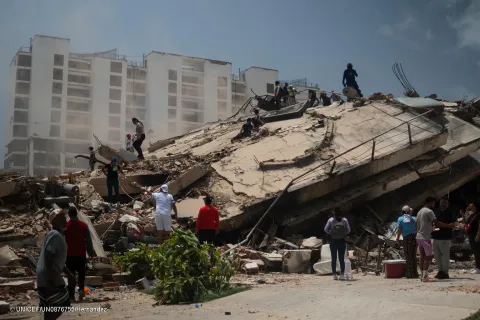
Nearly two year of war in Ukraine has wreaked havoc on the lives of families and children. Millions have lost their homes, loved ones and livelihoods, while scores more have sought safety abroad, with more than 180,000 people – including 50,000 children – having received temporary protection in Bulgaria alone.
The UNICEF documentary “Childhood 2.0” charts their journeys, following four Ukrainian families who sought refuge in Bulgaria after the start of the war. Their extraordinary stories show that integration is possible and that, by building bridges and believing in a better future, all of us have the power to change the world.
Meet four women who are rebuilding their lives in Bulgaria.

Anastasia fled the violence for Bulgaria, together with her eight-year-old daughter and 70-year-old mother. After finding her feet, she was determined to give back.
“She spent two weeks in a hotel and then said: ‘I’m not going to leech off Bulgaria, I have to rent an apartment and go to work’,” says Lyubov, Anastasia’s mother. “And we all moved to Varna, and she immediately found a job.”
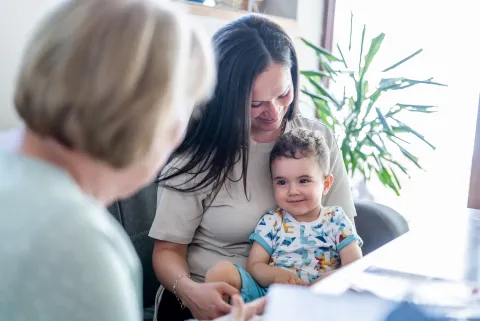
Today, Anastasia volunteers with children at a refugee support centre, built by UNICEF and partners. These spaces, known as Blue Dots, provide support to families fleeing the war in Ukraine, acting as one-stop hubs for protection and essential services. They also give children a chance to play in safety.


As a mother, Anastasia knows how the war can impact children. She still vividly recalls the missile attack that forced them to flee Ukraine.
“The windows were shattered,” recalls Anastasia. “And we heard: Boom! Crash! Zlata was completely undone and shaking. I was trying to calm her down. Here, I acted not as a volunteer, but as a mum.”
Yeva

Dog lover Yeva arrived in Bulgaria at the age of just 16, after the war brought terror and devastation to her home city of Kharkiv.
"I was not ready to go anywhere, all I wanted was to stay in Ukraine,” says the youngster. “When my father told me to pack up my things, to prepare for a big move, I said that I would not leave without my dog.”
After saying goodbye to her father in Chernivtsi, Yeva crossed the border alone and was welcomed into the home of Fani Davidova.


“I think that in a situation like this, it is very important to feel accepted, welcome, to have someone to hug you,” says Fani. “Especially if you are a child.”
Since then, Yeva has found a way to care for both her own mental health and animals by working at a local pet grooming centre.
“I’ve been dealing with animals my whole life,” she says, smiling. ”I took a dog grooming course and now I do this as a job.”
Lena

Lena, a photographer from Kyiv, lives in Sofia with her three young sons. The morning of 24 February is etched into their memories forever.
“I woke at 4.20 a.m., when the bomb exploded,” recalls Lena. “It was a horrible morning, so we didn’t say ‘good morning’ but instead: ‘Boys, get up – it is war’.”
After crossing into Bulgaria, the family found shelter at a summer house belonging to locals. Having endured so much, the children breathed a sigh of relief.
“I liked it a lot,” says 11 year-old Artem. “There was a swing and very warm sunny mornings. The birds were singing, bright sunshine and the mountains. It was unbelievably beautiful. And while swinging, you’d just see all that and calm down.”


Locals, NGOs and UNICEF helped the family to rebuild. Today, Lena uses her photography skills to document life at a refugee support centre and the children are settling into school. However, they still dream of returning home one day.
“There are many Ukrainians here,” says Lena, “and each of us is grateful to someone here in Bulgaria, because they offered their help. And when everybody returns, they will also come to Ukraine, visiting us – they definitely will.”
Tetiana

Tetiana fled after a rocket destroyed her home. The shelling followed her all the way to the Polish border, where she squeezed into a van bound for Bulgaria.
“There were only seven seats,” recalls the 25-year-old. “But ten people squeezed in, if not even more. We travelled in the trunk. Me, my mother, my sister, my grandmother, our belongings. We were just shocked by the sheer number of people.”
Although starting over in a new country can be difficult, Tetiana is determined. For years, she battled cancer and was told she might never have children.
“We arrived and on the second day, I said: ‘I want to work’,” she says. “I went online and just wrote that I was in Bulgaria and was looking for a job. Children are my thing. I love them and they love me back. I worked as a nanny the whole summer.”
In Bulgaria, she has overcome her illness, found love and is even expecting a baby. One day, when the war is over, she hopes to return home.
“Most likely, the first thing we will do when the war is over is go to Ukraine,” she says. “To show the children what Ukraine is really like. How beautiful it is, how beautiful our cities are, what our history is and our architecture.”
***
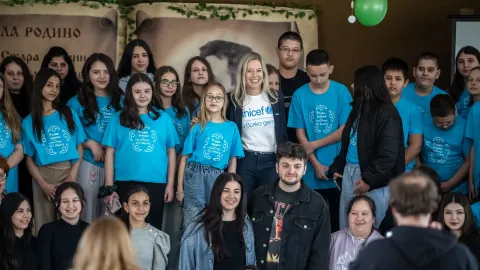
In Bulgaria, UNICEF has been working with authorities, donors, local organisations, communities and partners to deliver much needed assistance and support services to families fleeing the war. In 2023, UNICEF reached 80,000 children and caregivers on the move with psychosocial support, legal assistance and access to social services. UNICEF has also ensured access for 12,000 Ukrainian refugee children to education through support with their enrolment in the Bulgarian system, and by establishing learning hubs across the country.
‘Childhood 2.0’ is the documentary, produced by UNICEF and studio NO BLINK, that follows the stories of Ukrainian families who found refuge in Bulgaria after the start of the war. Those featured show that integration is possible and a shared responsibility – for both refugees and the welcoming Bulgarian community.