Humans of the EU Child Guarantee
Project for Pilot Testing of #EUChildGuarantee

- Български
- English
#HumansoftheEUChildGuarantee

#HumansoftheEUChildGuarantee, they are the children, young people and their families. They are professionals, teachers, social workers and all the people behind #EUChildGuarantee who work tirelessly to guarantee that all children in need have access to quality basic services and equal opportunities in life.
These are the people employed in kindergartens, social services, health care establishments, Child Protection Departments, municipalities and other institutions at the national and local level who are applying in practice the innovative approaches, models and services that contribute to putting an end to the cycle of poverty and social exclusion. These are the people who make The EU Child Guarantee happen for the children in Bulgaria.
Learn more about their work, hopes and aspirations in this blog that pools and amplifies the voices of all those who are part of #EUChildGuarantee.

‘The phrase ‘special child’ took on a completely new meaning for us, as we came to understand it. We experienced first-hand the possibility of having the child actively participate in the activities of the group.’
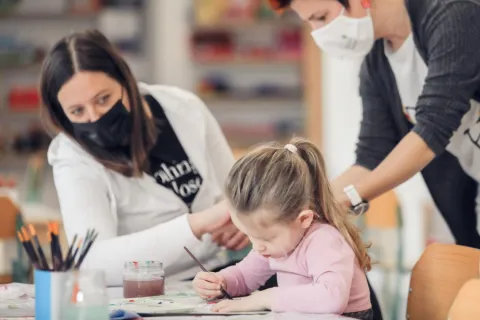
‘Even though the project activities started a short while ago, we already can see the results and the benefits for the children and the group teachers alike. We got a lot of knowledge. The word ‘special’ took on a completely new meaning too – we came to understand it as the possibility of having ‘special’ children actively participate in the activities of the group, to work at their own pace depending on their abilities rather than stay on their own on the side, while the teachers are actively engaged with the rest.
Now we did realise that inclusive education can materialise and be something other than a concept on paper. We are able to see that it can happen when the specialists needed are there for you.
There have always been problems of not having enough specialists; now we are so grateful to have a special education teacher under the project, as our teachers cannot handle alone all the challenges and effectively integrate the children in the group activities. We are so happy with this special education teacher and how capable, qualified and trained she is. She works both with the children with special needs and with the other children, to genuinely integrate them all.
With her help the children who need support are able to find their place in the activities organised by the teachers; they no longer tend to be isolated, as they used to back in the times when there was no one to work with them specifically.
The entire team of the kindergarten benefited greatly from all the trainings to date – they provided us with a whole lot of new ideas and proved really helpful. We are impressed with the practical examples of visualisation, we learned how to create an inclusive environment, in a very functional and convenient way. The practical sessions on augmentative and alternative communication equipped us with ideas for outdoor games that we are looking forward to having in practice.
The trainings, provided by ‘Karin Dom’, as well as the webinars for the teaching and non-teaching staff alike gave us so many answers and helped us understand child behaviour.’
‘Being part of the project is a huge chance for me, an incredible opportunity.’ - Vesselina Angelova, newly-appointed social assistant with the Community Support Centre in the town of Kazanlak working at the remote workplace in the community in Maglizh:
‘I used to be one of those children whom I help now. Back then, I needed so much someone help me, support me, be by my side; someone I could confide in, someone to tell me that it is possible to have a different life, an alternative. Back then, no one helped me.
I grew up in a Roma family, I am Roma. I know how the families live, what life in the community is like; I know each family, each house. I know all too well how people’s values, moral and the love get stifled and killed by the shutting off, the isolation, the lack of education, the fear to go out, even as close as to the neighbourhood nearby.
As time passed, I started wanting to become the person I did not have by my side – the one to help those children. Every little thing helps – simple explanation of what is good and bad, right or wrong, a nudge to finish education, or go from the closed community out into the big world. Sometimes we may have someone in need spend the night at our home or have children drop by for a shower or warm meal.
I am doing what I was doing before the project and will continue to do it after it; my involvement in the project, however, is a great incentive for me. And a huge chance too.
It was an incredible opportunity. Now that I am representing a certain type of social institution, the people from my community will see that institutions can help indeed. For many are afraid; they tend to think that institutions might do them harm. Now they will see that it is not the case; that the institutions are there to help them.
At the same time my communication with institutions will be much easier in my efforts to help people and be the bridge between them and the services intended for them.’
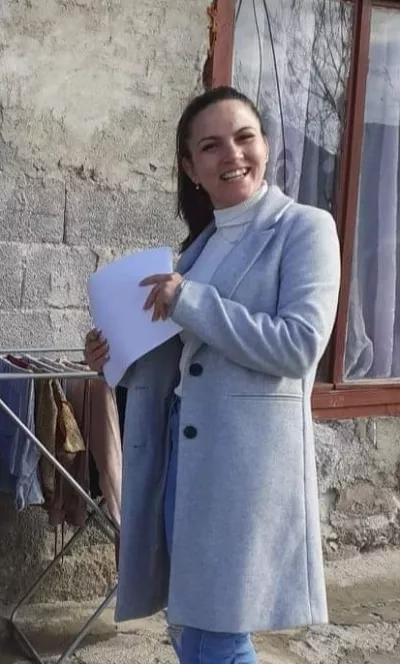

‘We, as parents, need support as well. Because when we are trained, we help our children too.’
‘What is needed is more centres where people can get information about what they can expect upon hearing a diagnosis. When our child was diagnosed, it was a shock for us; we knew nothing and we got disorientated. We would go from one place to another, we resorted to the internet in the desperate attempt to get information, which can sometimes mislead you and get you on the wrong path. In each town there must be people, specialists, to go to young mothers, to observe the children, to keep track of their development, especially if there are some things that do not feel right. If there are more specialists to watch the child in his/her environment – at home, outside, then it would be so much easier and parents would not need to go endlessly to all those doctors.
It would be great to have people who would spend a couple of hours with us several times a week – at home, on the playground, and watch what the child does, what we do and tell us what we are not doing right. As sometimes, when my son has a fit, I would first try one thing, then another, then another, and when nothing works and he gets more and more upset, I would just give up and let go. But I do not know what the correct thing is, when we need to leave the child alone and when to try and calm him down.
We, as parents, need support as well. Because when we are trained, we help our children too.
What is also needed is to talk to the other kids and to explain them that our children are just a bit different. That they need help.’
‘We will have more information on the needs, more personalised services, more work on prevention and in the field.’ - Maria Gineva, Head of the Community Support Centre, Kazanlak:
‘The support under the project on the implementation of the EU Child Guarantee in Bulgaria would help us get even closer to the families and children in need. Having one mobile team in the municipality of Maglizh and appointing there a person who comes from the very local vulnerable community and is quite recognizable, will facilitate the access to support. Also quite important is the work to be done by the newly-appointed social workers that already started mapping families – i.e. going from door to door and surveying the needs of those families. This will allow us to clearly identify what the families need, early on detect possible problems, engage more actively in prevention and come up with services that fit even better the type and level of vulnerability. This will also enhance the picture of the family, the environment, the overall situation for more targeted and relevant support.
We have always needed someone who knows the community better. Now, thanks to the project, we went exactly for this and appointed the right people – from and in the community, people that are known and already trusted.

The new mobile team is already up and going, doing the mapping and having already covered approximately 200 children just in the first months. The team is also monitoring kindergarten and school attendance, and in case of absences they provide support to families so that the children get back on. The new members of staff are getting on working together with the Child Protection Departments.’

‘We will fill the gap – working with marginalised groups.’ - Maria Atanassova, Head of the Community Support Centre in Burgas
‘The new activities that will be introduced at the Community Support Centre in Burgas with the financing under the EU Child Guarantee will allow people who up until now were not able to access social services to get support. There will be greater outreach to all children and families in need, especially in remote areas that so far tended to be on the fringe of our work and were prevented by their extreme poverty from coming to a larger town and receive services and support. There will be a focus not only on the most vulnerable families and only following a report of an emergency situation but on prevention too as well as on families at a lower risk but vulnerable and needing support nevertheless.
The fact that we will be able to do more work in the field is a great plus. Better prevention will be possible, to identify vulnerable families while working in the field and providing targeted services based on analysis of needs.
We will also get a car, as planned. It would allow us to reach remote locations, especially in the southern parts of the Black Sea coast, where municipalities have almost no social services.’
‘In the beginning, when I started the job I used to think: ‘Well, really, what difference going to people and talking to them would make, how could this possibly help them’. Yet it did not take too long to see how wrong I was. There was that case early on – I was imploring like forever a pregnant woman to go for a check-up. She would not. And it all ended terribly both for the baby and the mother.
I realised then that it was all about convincing people, referring them on time for the sake of timely adequate help for their baby, talking with them and really trying to make them do something they were not used to doing yet that was urgently required. This makes the whole difference.

...A little bit more support is needed, especially if it is the first child of the mother and things are not completely ‘on track’. The child is otherwise healthy, all that is needed is support for the child and the family. And results are not late to come – children successfully integrate in kindergarten and learn more and more self-care skills.’

The need for standards guaranteeing the inclusion of all children with developmental difficulties
“Thank God, Alex is developing well, keeping pace with his peers, and this is generally thanks to the additional support of the resource teacher, who works with him in the kindergarten, his other teachers, the rest of the kindergarten staff and the principal. They all worked together throughout these years for him to be accepted, not only to attend the kindergarten, but also to participate – in celebrations, performances and what not. Actually, among all my friends with children with special needs, Alexandar is probably the only one who has participated in celebrations and performances with his peers. And he does not feel isolated.
In order to achieve this integration, it took me a long time to select the kindergarten Alexandar is attending now – the selection process started even before he was old enough to attend kindergarten. This is due to the fact that our children are not accepted in the same way as other children and don’t participate fully in the activities. Now my concerns continue as he is supposed to start school soon and I have to start my research again.
For me it is of critical importance that this acceptance, approach, commitment, and activities are equally guaranteed in all schools and kindergartens and become a standard.
I would like to see a change in several areas, such as the facilities, the availability of specialised materials, the number of hours that children are entitled to receive as additional support by a resource teacher, a psychologist, a speech therapist – in my opinion, they are currently absolutely insufficient. It would be good if all the staff were better trained for working with our children, so that they would be able to effectively include them and enable them to participate in the group life.
And most of all we need standards that are guaranteed in all schools and kindergartens, so that we don’t need to search for years and constantly change kindergartens." - Katya Atanasova, mother of Alexandar (6 years) with hydrocephaly.

“The most serious issue for me is that parents understand too late that their children need support and help.
- Desislava Sevova, Resource Teacher at RSCPIE – Burgas, working at “Zvezditsa” kindergarten.
"Children come to us after they’ve turned three years, which does not enable us, the specialists, to have access to them and support them from more early age. Thus, many parents find out about their children’s developmental delays quite late. Consequently, it can be very hard for them to accept their child’s conditions and needs. This is why, one of the areas where I would like to see a change is with regard to medical support – to enable early identification of children who need support and help at a younger age and to refer them.
Regarding my own work, our greatest needs are related to ensuring opportunities, teaching materials and educational tools, software, educational websites. A major challenge we have is related to communication, as we need to support non-verbal children and don’t have the tools to help them communicate with us and the other children. It would be good if every such child had a personal device that allowed them to communicate and give them the same opportunities as their classmates.
An analysis of the personal needs of each child should be carried out upon entry into kindergarten. Based on this they should be provided with the personal aids that correspond specifically to their needs.
The truth is that what children need most is inclusion, warmth, and care. This is possible only if we work as a team. This teamwork begins with the parents, who are our most important allies. This team includes: teachers, other school staff, and us – the specialists, speech therapists, psychologists, who provide can provide support to each member of this team at any time.” - said resource teacher.
This project is financed by the European Union
© UNICEF-Bulgaria, 2021
The information and the views contained in this article are those of the authors and they do not reflect an official position of the European Union. The institutions and authorities of the European Union or any entity acting on their behalf, shall not be responsible for the way in which the information contained therein might be used.
Inclusion of children with development delays is possible only if we work as a team