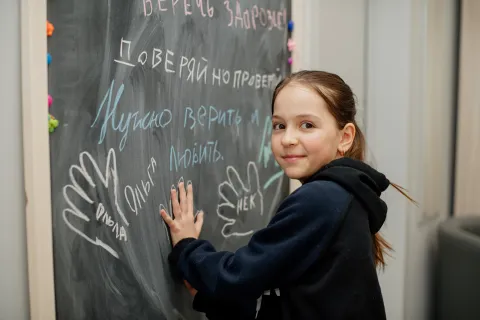
"I refused to leave home"
How virtual space becomes a real danger for children

- русский
- English
"My name is Olya. I'm 17 years old. In the 7th grade, I already wore shoe size 42. That's why I always wore sneakers. And for my birthday, my mother allowed me to cut my hair short and dye it blue. A few days later, I found a fake page on the Internet, signed by a male name with my pictures there. Every day someone uploaded a new photo with my head photoshopped to different male bodies. Almost all my classmates and a bunch of strangers were subscribed to this page. I was shocked."
In Belarus, there are many children and adolescents like Olya who have suffered from cyberbullying, or bullying on the Internet. More than 12,000 children from different regions of Belarus have passed the test of MTS and the United Nations Children's Fund (UNICEF) on cyberbullying. It turned out that more than 30% of children have face intimidation and bullying on the Internet. However, most of them don't tell their parents.
Today, on Safer Internet Day, we spoke with experts to tell you about top Internet threats for children and how to deal with them.
"No one will talk to you!"
Cyberbullying (cyber – related to computers, information technologies, the Internet; bullying – insulting, intimidating) – is purposeful and systematic aggressive behavior towards the victim on social networks, online games, instant messengers and other online platforms. It's not just offensive insults on the Internet. Offenders can exclude the victim from virtual communication, create a fake account where they will post offensive content, etc. The reasons for such behavior are envy, revenge, boredom, a desire to assert themselves.
In addition to cyberbullying, children on the Internet also face other threats like "adult" content, excessive online games, fraud, online harassment, grooming (establishing a trusting relationship with a child for their sexual exploitation (intimate photos and videos).
"There is a reverse side to developing digitalization, and it is the threats for children on the Internet," explains Dmitry Shilin, Senior Coordinator for Child Protection of the United Nations Children's Fund (UNICEF) in the Republic of Belarus. "In Belarus, about 95% of children use the Internet. According to surveys, parents are increasingly giving their children mobile devices in the first 3 years of life. And at the age of 4-6, half of the children already have their own phone or tablet. Parents themselves teach their children to use gadgets. As a result, about a third of children aged 15-18 spend almost all their free time on the Internet.
"Parents are trying to limit the time their children spend online. According to surveys, they actively control how much time the child spends on the Internet at the age of 4-6. But as the child grows older, the parental control weakens. Adolescents are left face to face with the challenges they face online."

"I dare you!"
The problem of cyberbullying and violence on the Internet has become even more relevant in the context of COVID19, when children, especially in the first stage of the pandemic, started spending much more time online.
"The bullying that took place at school or in the neighborhood moved online," Dmitry Shilin continues to talk about the problem. "Of course, children spend most of their time online playing computer games. But in many modern games, participants communicate with each other. And sometimes this communication comes down to bullying of one or several participants of the game. An adolescent can also be stalked, harassed, or other offensive things can happen that shape children's vulnerability and low self-esteem."
Cyberbullying is digital, but its consequences are real and physically tangible. Children may experience severe stress, lower self-esteem, poor academic performance, depression, reduced social activity, in every fifth case, children may have sleeping problems.
After Olya faced online bullying, she said she would never go to school again. "Mom called the teacher, and my classmates were forced to delete the fake account. But I still refused to leave home. I felt like I couldn't trust anyone anymore. My parents suggested transferring me to a new school in another area. There was a completely different atmosphere in the new class. A few guys told me that I was cool and I had a cool style. But it was hard for me to believe they were serious. My response was: "Why are you lying to me?"
Olya's mother suggested she go to a psychologist to get help. "I thought: ‘Why should I do that? I am a regular person, even though I don't trust people.’ But as it turned out a psychologist is a person who helps you to love yourself and begin to understand yourself better. Recently, I realized that I really am cool, even if someone does not notice it at first."

"This will be our secret"
Children may not talk about their problems.
But there are signs that parents and close ones should pay attention to:
● the child's behavior has changed dramatically;
● they react irritably to a message on a smartphone;
● they have deleted instant messengers or pages on social media;
● they have become withdrawn, communicate less, do not want to go to school;
● they share stories of someone else being bullied online;
● they are depressed;
● they complain about feeling unwell.
To help children and adolescents facing bullying on the Internet, UNICEF Belarus and MTS created the #InternetWithoutBulling project. The main goal of the project is to provide information about safe online behavior and tools that help in case of bullying.
"We need to understand how important it is to counteract cyberbullying and violence against children in general," comments Dmitry Shilin. "The Internet, with all its positive aspects, can easily and quickly harm a large number of children. And the offender may remain unidentified. We believe that children and their parents need to be taught how to use the Internet safely and how to avoid danger. It is also important to provide the information on where to go when a child faces such a problem. The child should be referred to psychologists and other specialists."

Where to get help?
If you are experiencing online bullying or other problems, you can call the hotline for children and adolescents (24/7, anonymous and free of charge) 8 801 100 16 11.
UNICEF Belarus, together with its partners, has prepared a lot of useful information that might help understand how to deal with cyberbullying, how to protect personal information and avoid becoming a victim of scammers, as well as some advice for children on how to behave on the Internet, and for parents and teachers on how to help adolescents:
● Recommendations for parents of adolescents aged 11-13 (how to prepare children for possible problems on the Internet)
● About children's online safety
● Tips on how to protect information and recognize intruders on the Internet
● Comic book for children "Super Uni and his friends on the Internet"
● Series of videos on cyberbullying prevention.