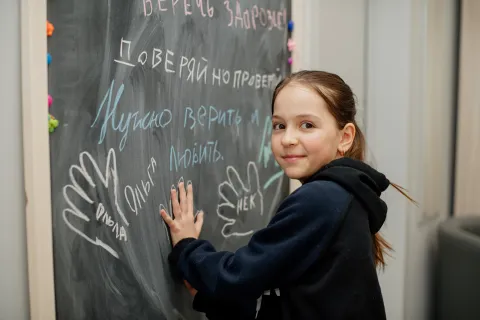
Two Lives of Zhenya
How family environment changes a child's world

- русский
- English
"I’m not going to study — school’s just not for me."
That’s what Zheka said when he left the institution. And people believed him. He had been diagnosed with "psychophysical developmental issues" and barely managed a simplified curriculum — scraping by with Cs and Ds.
Today, three years later, he says:
"I’m into HTML now — programming is my thing."
The diagnosis has long been removed. His average grade in mainstream school is 7.8 out of 10.
At just 13, Zheka feels like he’s already lived two lives.
In one, there was neglect and then an institution.
In the other — a family-style home where the same child became someone entirely different.
What Is a Family-Style Home?
A family-style home is a special foster care model for 5 to 10 children left without parental care. For adults, it’s a full-time job — they sign a contract, receive a salary, and have rights and responsibilities like any employee. But for the children, it means something more: a space that feels like a real family, where they’re seen, heard, and allowed to simply be children again.
For kids like Zheka, sometimes that’s enough to completely change the trajectory of a life.
That’s why UNICEF in Belarus — together with partners — supports the project “A Family for Every Child.” The program promotes deinstitutionalization: creating conditions where children grow up in families, not orphanages. It helps develop alternative care models — adoption, guardianship, foster families, and family-style homes.

"I’m into HTML. I want to learn how to build websites"
"Tomorrow after lunch I’m meeting with my IT teacher, Ludmila Ivanovna. We agreed I can do some extra lessons with her. The moment we started informatics, I knew — this is my path."
Our conversation with Zheka happened naturally. It’s hard to say why he was the one who stepped up — in the family-style home in Zhernoseki (Polotsk District), we were greeted by nine children. But Zheka became our guide — showing us around, explaining everything, and quietly, confidently sharing his story.
He speaks like a thoughtful kid who reads a lot. And he does. His current favorite genre is fantasy.
When we ask about the future, he already knows: finish 11th grade with a strong diploma, then study programming.
“If I can, I’ll move to Minsk — that would be great,” he says.
Just three years ago, he was struggling to complete the most basic assignments in a special school.
BEFORE: “School’s not for me”
“When he first came to us,” recalls Anna Goloborodova, his foster mother, “he said straight out: ‘I don’t like school, I don’t want to study, and I never will. I’m just not smart enough. It’s not for me.’”
We didn’t talk about Zheka’s “old life” in front of him. But as we pieced it together with Anna, it felt like we were talking about a completely different child.
Zheka had been diagnosed with psychophysical developmental delays. He spent his early years in a special-needs class, struggling even with a simplified curriculum. Mostly Cs, sometimes a D. Rarely anything higher.
“At first we told him: You don’t have to be a top student. Just keep it peaceful for all of us — follow the routine, don’t skip school, do your homework when you get home. That’s all.” He thought about it and agreed.
It wasn’t some clever trick. Anna and her husband Aleksandr have raised 45 children in their family-style home — Zheka was their 40th. Many of the children had disabilities or cognitive delays.
“We’ve learned not to pressure kids with developmental challenges,” Anna says. “If you overload them, it only gets worse. We wait. If we see growth, we slowly add more responsibility. But if not — we stay where we are and focus on what’s realistic. For some kids, just mastering hygiene is already a huge success. With Zheka, we took the same approach — we accepted him as he was.”
Research backs this up: institutional care often stunts emotional and cognitive development. A child who spends their early years without consistent affection and adult support can fall behind by as much as a month for every month spent in care. The longer a child lives in an institution, the greater the risk of long-term developmental delays.
When Zheka moved into the family-style home, things began to change quickly. He arrived in March. By May, his grades were already improving.

NOW: “Zheka is reliable and responsible”
“I seem to connect with kids who feel a little down,” Zheka tells us.
“That’s how I made friends with Danik. He didn’t really have anyone — but then we found out we read the same books, and that was it. We became close.”
Zheka writes, too. He shows us a notebook filled with hand-drawn comics and fantasy stories. His characters are a mix of made-up figures and kids from school — his classmates.
Though he doesn’t have a large circle, Zheka is well-liked and respected. At summer camps, he makes new friends easily. At home, in the family-style house, other kids look up to him.
“If I ask him to be in charge of something, he handles it. He’s responsible,” says Anna, his foster mother. “He’s even in charge of keeping the shelves in order.”
BEFORE: “I was basically a troublemaker”
Words like “responsible,” “reliable,” or “tidy” weren’t part of Zheka’s world before. Instead, what came up more often were things like “out of control.”
Until age 10, he lived with his family. His older siblings had already grown up, and his mother, struggling after the loss of his father, began to drink.
Zheka and his younger brother skipped school, got into fights, were seen by the police, and already had brushes with alcohol. At home and school, Zheka was overwhelmed with violent outbursts — screaming, throwing himself on the floor, self-harming. Sometimes he said he didn’t want to live.
Eventually, he was removed from the family and placed in state care.
The behaviours didn’t go away. His emotional state worsened. He didn’t improve academically or socially.
“In the shelter, I was wild,” Zheka says now, almost as if talking about someone else.
Even when he moved into the family-style home, the first weeks were difficult.
“He would throw tantrums over anything — not wanting to shower, put on a jacket, go to school,” Anna recalls. “We didn’t pressure him. We just stayed with him.”
With time, Zheka began to settle. He realised that this family wouldn’t give up on him. That he was accepted — even in the hard moments.


NOW: A Quiet Leader Among Kids
"That’s Matyusha," Zheka says, introducing us to a quiet first grader. "He’s homeschooled — doesn’t go to regular school."
At first, Zheka helped Matvei with the basics: reading, counting, simple assignments. Sometimes Matvei calls him brother, but Zheka gently corrects him — they're not related. Still, he helps with everything: games, hygiene, chores, even phone settings.
He’s not loud. He’s not showy. But it’s clear: among the younger kids, Zheka is a calm, respected leader. The kind others quietly copy.
What Zheka might not realise is how deeply this role — being needed — has shaped him too.
BEFORE: “Just sit with her for a bit”
Zheka wasn’t always Zheka. He was born Zhenya — a common name. But when he arrived, there was already a girl named Zhenya in the house. To avoid confusion, they asked him:
“Do you mind if we call you Zheka?”
He didn’t.
That same girl, Zhenya, loved dancing and drawing. When she had trouble navigating the bus route to art class, Anna asked Zheka:
“Could you walk her there and bring her back?”
He did.
One day, he asked:
“Can I… go to class with her?”
“Just sit with her for a bit,” Anna said.
So he did.
And kept going.
Then came drawing, a local history club, guided tours at the village museum. Zhenya signed up. So did Zheka.
“These activities do more than keep kids busy,” Anna says. “They shape the brain. But more importantly — they shape the sense of I can.”
At some point, the dynamic shifted. Zheka, once the one being helped, began helping others.
Anna remembers how it started:
“I didn’t have time one day, and I asked Zheka to check the younger kids’ homework. Just point out the mistakes — I’ll help them fix it later.”
First-grade material was easy.
But by second grade — he had to think.
To keep up, Zheka started reviewing his own basics. Then third grade. Then more.
And that’s when the learning finally clicked.

Tomorrow, Zheka is leading a museum tour. Again.
He’s one of the main guides at the local heritage museum. When important guests come — they ask for him. Calm, prepared, engaging. He knows the stories and the tone.
And then, after that — back to art class, to dance practice, to extra informatics lessons.
Next week? Summer camp.
Then, more friends.
More plans.
More life.
Three years ago, Zheka thought he’d be moving in with his older brother — a plan built on hope more than logistics. But the brother finished his military service, moved on with his life, and Zheka stayed here.
He didn’t seem upset.
"Turns out," says Anna, "we were the ones who stayed close. And at some point, he stopped waiting. He realised — he had to build his own path.
We told him: ‘Why wait? Let’s just live.’"
And he did.
He’s doing it now.
This is just one of many transformations that have happened for Zheka over the last three years. And there’s more to come. It’s not magic. It’s what happens when a child feels like they belong.
UNICEF in Belarus continues working to ensure that every child grows up in a family — not in an institution.
This is the mission of the “Family for Every Child” programme.
Would you like me to create a polished full-page version of the story for the UNICEF website, or adapt it for a donor brochure or campaign email?