‘Pusti Apa’: A Trusted Friend to Mothers and Children
In the world’s largest refugee camp, nutrition counsellor Sadia is helping mothers overcome fear and misinformation to protect their children from malnutrition.

- বাংলা
- English
“Every time I walk through the rows of makeshift shelters in the Rohingya refugee camps and someone calls out Pusti apa (nutrition sister), it just makes my day,” says Sadia Arafin.
For Sadia, those two words mean much more than her job title.
She is an Infant and Young Child Feeding (IYCF) Counsellor and has spent the past two years working with Rohingya refugees in Kutupalong, Cox’s Bazar. Having studied nutrition, she cannot think of a better way to use that knowledge than by helping mothers give their children the healthiest possible start in life.
In a setting where overcrowding, poverty, and displacement place children at increased risk of severe acute malnutrition (SAM), her work often begins with a conversation, not with treatment. By listening to mothers, understanding their concerns, and promoting optimal infant and young child feeding practices, she helps identify children in need of timely nutrition support. “My job is to meet all mothers and inform them how they can improve their babies’ health and nutrition with the resources they already have,” she says during a break at a nutrition facility.
“Most of the mothers I meet have never received practical guidance on breastfeeding.” Sadia said.
A few weeks ago, a young mother in her early 20s came to the facility. Her baby was struggling to breastfeed and not latching properly, and incorrect positioning had caused severe breast engorgement – a common condition during the first two weeks of lactation.
Sadia patiently sat with her and demonstrated how to help the baby latch properly, explained effective breastfeeding techniques, and referred the mother to the nearest primary health centre for treatment. Two weeks later, the mother returned. This time, smiling, pain-free, breastfeeding comfortably, and eager to thank the counsellor who had helped her through one of the most difficult moments of early motherhood.
For Sadia, helping mothers does not end once effective breastfeeding is established. As babies grow, new questions and challenges emerge. One big challenge she sees mothers facing is the transition to complementary feeding after six months of exclusive breastfeeding.
“Many mothers come to me saying their children refuse to eat. Out of desperation, they try to force-feed their children, and that turns every mealtime into a battle,” says Sadia.

Sadia encourages them to be patient. She advises parents to let children explore food at their own pace and to make regular meals like rice and lentils fun by offering a variety of soft, nutritious meals such as eggs, cereals, and fruits. That can make meals more appealing and nutritious, while allowing children to gradually learn to eat on their own.
Sadia is aware that her efforts are reaching only a fraction of the families living in the Rohingya refugee camps. Funding is shrinking, needs continue to grow, and resources remain stretched. But she has learned that even the smallest intervention can change a child’s future.
She still remembers 12-month-old Mohammad Yusuf, who arrived at the facility in March with severe acute malnutrition. Frail and underweight, he was eating very little. A one-year-old should typically eat three bowls of food, and two bowls of snacks, with complementary breastfeeding every day. His mother did not know how much or how often a child his age should be fed and had been trying to feed him small portions of whatever the family was eating. Yusuf was enrolled in the Outpatient Therapeutic Programme (OTP), but treatment alone was not enough. Over three visits and hours of counseling sessions, Sadia worked closely with his mother to gradually change his diet, introducing pumpkins, sweet potatoes, eggs, lentils and vegetable khichuri alongside continued breastfeeding.
Within weeks, Yusuf’s condition improved from severe acute malnutrition to moderate acute malnutrition – a significant step towards recovery.
“When I see a child who was struggling with SAM regaining appetite and gaining weight, nothing else compares to that feeling,” says Sadia. “It reminds me why I do this work.”
She measures progress in small milestones – a child who is gaining weight, a mother who is able to breastfeed without pain, a family that leaves the facility with a sense of relief.
Some of her proudest moments, however, happen after a counseling session is over.
As part of her work, Sadia regularly brings mothers together to discuss breastfeeding, complementary feeding and child nutrition. Increasingly, she has been finding herself listening as mothers who once sat quietly now answer questions from other mothers.
“They finish my sentences,” she says, with pride. “The mothers remember what we had talked about and pass it on.”
In the Rohingya refugee camps, where resources are scarce, knowledge can be one of the most powerful forms of support. With support from the Bangladesh Humanitarian Fund, life-saving information is shared from one mother to another, one family to the next, helping children survive, recover, and thrive.
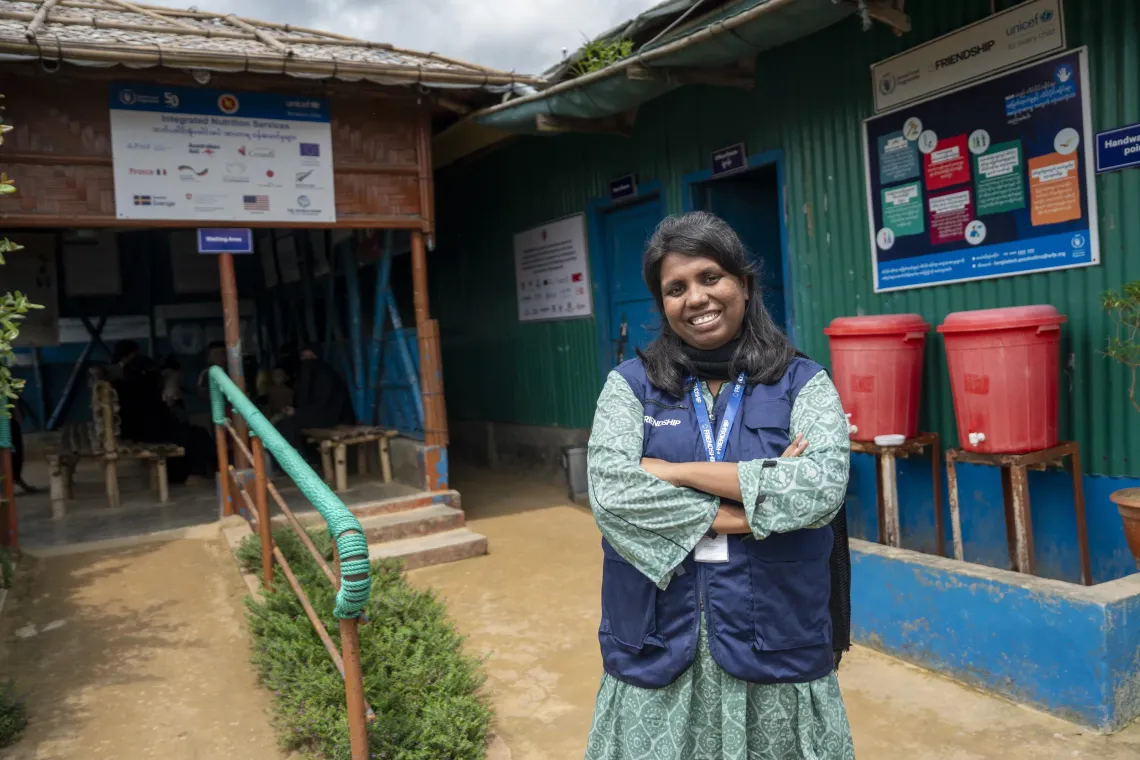
Sadia knows that she cannot reach every family in Kutupalong herself. But every word-of-mouth recommending Sadia, every relieved mother, every harmful practice replaced with a healthier one, and every child who begins to recover creates another ripple of hope.
For the families who step outside their shelters looking for ‘Pusti apa’, Sadia is prepared with practical advice, reassurance, and compassion, ready to save the day, one child at a time.