First-ever certification for volunteer teachers strengthens quality education in the Rohingya Refugee Camps
UNICEF and the Asian University for Women recognize over 1,100 volunteer teachers, advancing quality education by placing trained volunteers at the heart of learning for Rohingya children.
- বাংলা
- English
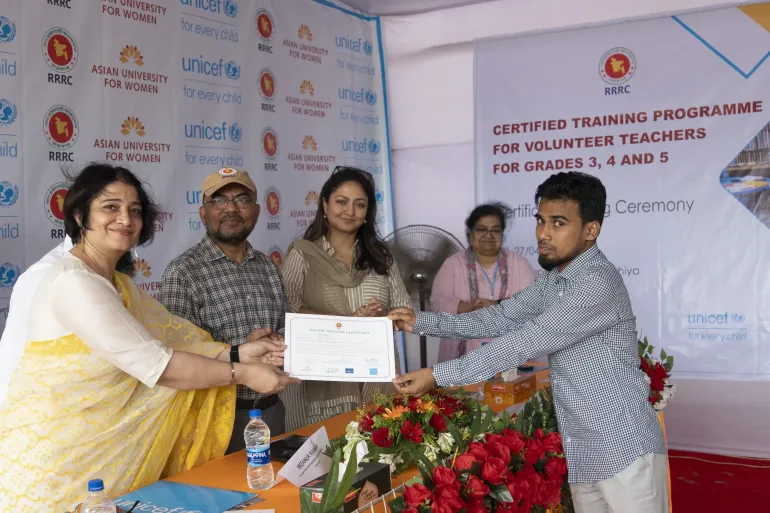
Dhaka, 29 April 2026 – In a major step toward improving education quality for Rohingya children, over 1,100 volunteer teachers in refugee camps are, for the first time, receiving formal training certificates, recognizing their skills and strengthening classroom learning.
The certification was awarded through a joint initiative by UNICEF and the Asian University for Women, in collaboration with the Refugee Relief and Repatriation Commissioner (RRRC) and the Government of Bangladesh.
“This is a remarkable initiative. This is not just a certificate; it is a symbol of empowerment. With this, you will show the path to the next generation; they will build their own future,” said the Refugee Relief and Repatriation Commissioner (RRRC), Mizanur Rahman.
Over the past two years, volunteer teachers and master trainers from both Rohingya and host communities have completed the training programme across Cox’s Bazar and Bhasan Char.
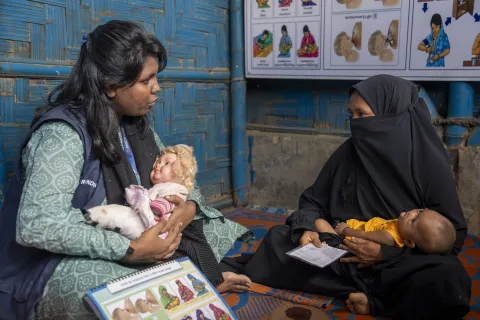
Trained teaching volunteers are the foundation of effective education, particularly in crisis settings. This structured programme, the first of its kind for the Rohingya camps, equips teaching volunteers with the knowledge and practical skills needed to deliver the Myanmar Curriculum more effectively.
“This certification represents a major milestone in our collective efforts to ensure that every Rohingya child has access not just to education, but to quality learning,” said UNICEF Representative a.i, Stanley Gwavuya. “By investing in volunteer teachers, we are investing in the future of an entire generation of children who have already faced immense disruption and loss.”
The three-month programme included 176 hours of training, covering 118 modules aligned with the Myanmar Curriculum, including English, Mathematics, Science, Social Studies, and Burmese. It combined face-to-face learning, peer engagement, and classroom-based practice, with a strong focus on inclusive and gender-sensitive teaching.
“Education is the best defense against oppression and inequality. But not any education can deliver in overcoming these challenges. Education must be effective; it must be compassionate. This training program gives us hope that education within the camps can be improved to recover that sense of hope,” said Kamal Ahmad, Founder of Asian University for Women.
This initiative reflects efforts to improve the quality of education by enhancing the skills of existing volunteer teachers through the support of the donor community. Strengthening teaching volunteers is fundamental to improving educational efforts, enabling more engaging, effective, and inclusive classrooms.
As Rohingya children continue to face an uncertain future, equipping volunteer teachers with skills offers a powerful pathway to restore hope, dignity, and opportunity through education.
###
About UNICEF
UNICEF works in some of the world’s toughest places, to reach the world’s most disadvantaged children. Across 190 countries and territories, we work for every child, everywhere, to build a better world for everyone. For more information about UNICEF and its work for children, visit www.unicef.org/bangladesh/
Follow UNICEF on Twitter, Facebook, Instagram and YouTube
About Asian University for Women (AUW):
Recruiting from over 20 countries in Asia and the Middle East, AUW seeks out high-potential young women from communities with few opportunities for advancement, and provides them with the academic, professional, and financial support required to earn their bachelor’s and master’s degrees and to take on change-making roles. AUW has graduated over 1,800 women across 12 classes and currently enrolls more than 2,000 students. Over 50% of AUW graduates pursue advanced studies at leading global institutions, while others build careers with prominent international organizations, corporations, and public sector institutions.
For more information, please visit: https://asian-university.org/