Free Healthcare Saves Children’s Life in Yemen
provide specialized maternal, newborn, and childcare free of charge to vulnerable families

- English
- العربية
UNICEF seeks to achieve the greatest impact possible for newborns and children suffering from health complications to improve the quality of basic and life-saving healthcare, especially within the first hours of birth.
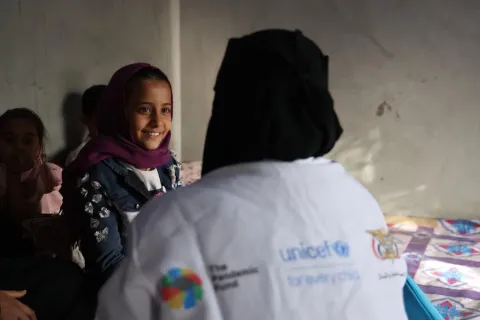
With the conflict in Yemen weighing heavily on the healthcare system, UNICEF works on strengthening service delivery in Yemeni hospitals. UNICEF is working to strengthen service delivery in Yemeni hospitals where the conflict is putting heavy strains on the health system. Al-Sadaqa Hospital in Aden, southern Yemen, is one of the health facilities that were targeted with UNICEF’s interventions; the infant nursery department of the hospital was rehabilitated to provide healthcare for children and mothers during pregnancy and after childbirth.
Free lifesaving services
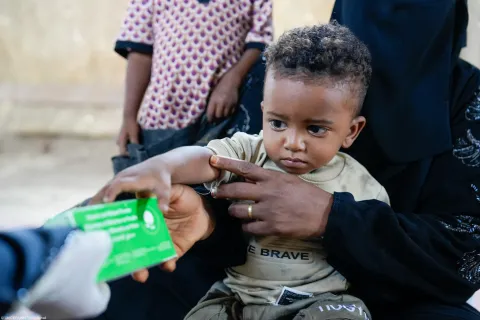
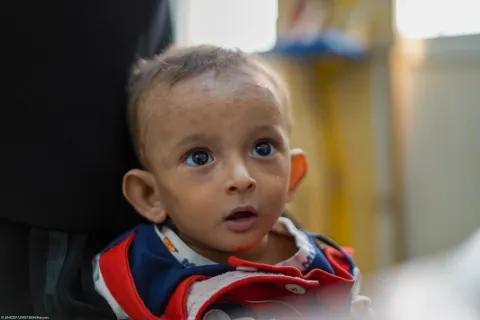
Intisar Mahdi came from Radfan district in Lahj governorate to Al-Sadaqa Hospital in Aden to give birth to her son, Ali. "I received medical attention upon my arrival at the hospital. My baby was born with breathing problems, so he was transferred to the incubator in the pediatric department, where he received the necessary healthcare for free,” she says. "Ali stayed in the incubator for forty days to receive treatment and to be monitored until passing the critical state,” she explains. "The medical care and daily check-ups have saved my child’s life. I was so happy to see my child recovering, and I am glad that he will be discharged from the hospital soon,” Intisar adds.
“Unfortunately, I lost four children before Ali was born; they did not receive these life-saving services, so I am glad my son, Ali, had access to them,” she clarifies and concludes by expressing her gratitude to the infant nursery department staff.
Al-Sadaqa Hospital is specialized referral hospital that receives newborns from Aden and the neighboring governorates.
“Most critical cases come from rural villages and may require up to a month of continuous treatment and care until recovery. We take care of the babies and monitor their health condition daily until they reach full recovery,” says Abdel-Rahman Salem, a 32-year-old nurse at the infant nursery department.
Salem is grateful for the support given to the hospital. “The majority of cases we receive are for premature babies, and they receive the necessary healthcare services free of charge. The medical equipment, incubators, and medicines the department was supported with have enabled us to offer children free life-saving services,” he adds.

Besides providing healthcare services for mothers and newborns, the staff share health education messages with mothers about the importance of exclusive breastfeeding, hygiene, and other health practices. UNICEF’s interventions at Al-Sadaqa Hospital gave mothers and their children access to the most-needed healthcare services.
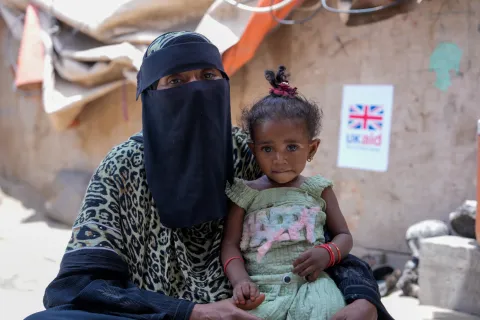
“Our living conditions are tough, and I cannot take my children to private hospitals because they are extremely expensive,” says Nemah Saleh, a resident from Dar Saad, Aden. “I brought my daughter to Al-Sadaqa Hospital after she was born; she was in very poor health, so she was admitted to the incubator at the pediatric department,” she continues. “My daughter is getting free medical care and regular medications, so her health is improving,” she adds. Nemah hopes medications become freely available to families that cannot afford them.
A safe and healthy environment
Maram Yasser, 23, is working as a nurse in the neonatal ward at Al-Sadaqa Hospital. She highlights that the support provided to the ward helps meet the premature babies who are in critical need for incubators and close medical observation. Maram started working in this department in 2022.
“The time I spend with children here is valuable. I feel like they are my children. We observe premature babies until they are their health conditions stabilize,” she says. “I feel relieved whenever a child recovers because I can see how my work brings joy and happiness to their parents,” she adds.

With funding from donors, UNICEF has supported the infant nursery department of Al-Sadaqa Hospital in Aden governorate, southern Yemen, to give children and mothers access to health care services. UNICEF and Kuwait Fund for Arab Economic Development work hand in hand to provide specialized maternal, newborn, and childcare free of charge to vulnerable families.