Bringing play to nutrition therapy
How therapeutic food, play and parental bonding helped Miracle recover from severe acute malnutrition in Sierra Leone.

Fatigued, apathetic and extremely thin.
At just eight months old, Miracle was rushed to Bo Government Hospital in southern Sierra Leone where he was diagnosed with severe acute malnutrition.
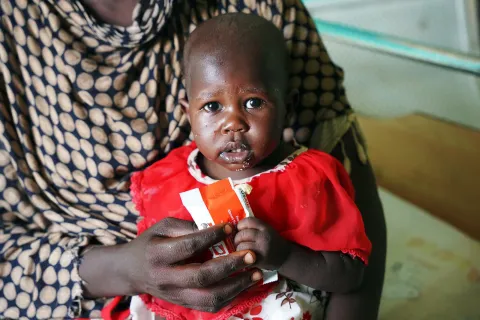
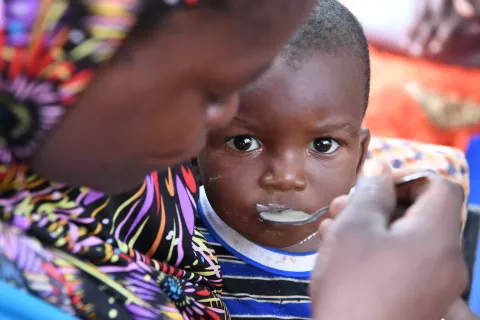
At the health facility, Miracle received immediate treatment, including ready-to-use therapeutic food (RUTF). This life-saving energy-dense paste made from peanuts, sugar, milk powder, oil, vitamins and minerals is specifically designed to treat severe acute malnutrition in young children.
Through consistent treatment and round-the-clock care from his parents, Miracle gradually gained strength, began to sit up, and became more active.
Responding faster to treatment
At the treatment centre, nurses also encouraged Miracle’s parents to gently play with him whenever he was more alert.
“Integrating play into the inpatient facility treatment process is critical in helping malnourished children respond faster to treatment,” explains nurse Hannah, who looked after Miracle when he underwent the treatment.
Play helps malnourished children who are recovering to regain physical strength while also supporting motor skills, cognitive abilities and social-emotional development. In addition, when parents play with their children, the close interaction and bonding help parents tune into their child’s physical and emotional needs. And when understanding their child’s needs, parents are more able to meet them. This is particularly important for parents whose child is recovering from malnutrition.

Recovery continues at home
Thanks to the timely RUTF treatment, Miracle’s condition improved significantly, and he was soon well enough to be discharged from the treatment centre.
But his recovery did not end at the hospital doors. Miracle’s parents received RUTF sachets to support continued treatment at home. In addition to the RUTF, Miracle’s parents also learnt the importance of continuing to play with him at home to prevent relapse and boost his development in short and long term.
“I never thought about playing with him as something important.”
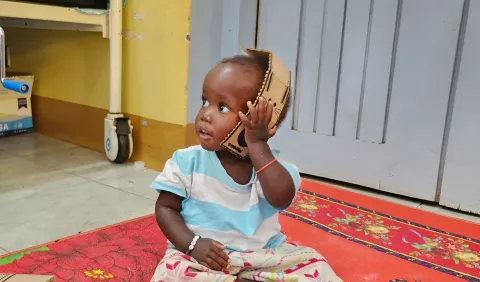
In fact, one of nurse Hannah’s responsibilities is to show parents at the treatment centre how to play with the printed cut-out designs, to repurpose cardboard packaging into toy cars, and to motivate parents to play with their children using these and other toys.
For little Miracle, play had been a luxury. Not only because most store-bought toys are out of reach for families with a meagre income, but also because Miracle’s parents did not know that something as simple as play could support his recovery.
“We saw how much he loved the toy car, so we made more at home. Now he plays with them all the time with his siblings. It has brought play into our home.”
Intrigued by the carton toys at the treatment centre, Miracle’s father began crafting his own-design toy vehicles from carton boxes at home, everything from trucks to tractors. Miracle loved them all, and the process brought the entire family together around creativity and play.
A holistic approach to malnutrition treatment
Adopting a holistic approach to malnutrition treatment, UNICEF integrates cut-out toy designs on its RUTF packaging, and trains treatment facility staff to use these to inspire parents to play with their recovering children. The designs are developed in partnership with design and packaging experts from the LEGO, IKEA and Mondi, as well as early-childhood development, disability and sustainability experts from UNICEF, University College London and Oxford University.
From toy cars and airplanes to balls and rocking teddy bears, these easy-to-assemble carton designs help stimulate children on the road to recovery. In Sierra Leone, play is now transforming the lives of children and their families across communities.
Today Miracle has regained his health, thanks to proper nutrition, parental bonding and active play with his father, mother and siblings. “He likes to play with his father and siblings at home,” says Miracle’s mother. “And that is what I like best.”