COVAX: protecting every country, no matter how remote or small
Meet our experts – Ignacio Gimenez, Procurement Services Specialist with UNICEF Pacific Multi Country Office, on the challenges of delivering COVID-19 vaccines to the small Pacific island countries.

How did you feel when the first COVID-19 vaccine doses landed in Fiji?
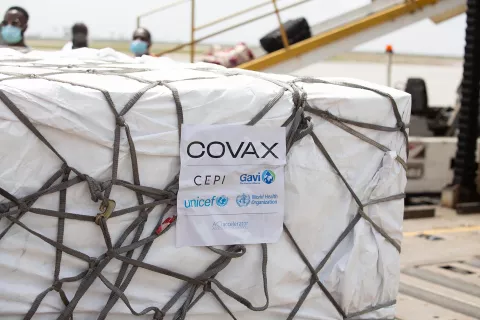
It was a historical moment because it was the first shipment of COVID-19 vaccines under COVAX arriving not only in Fiji but also in all Pacific islands. So, I was very excited and happy. Since the beginning of COVAX, it has been a lot of work for everyone involved. The arrival of the vaccines in the country was the materialization of all our efforts.
For me it was especially emotional because I was lucky enough to be on the airport’s tarmac when the vaccines arrived. Since then (as of 30 June 2021), 278,400 doses have been delivered to eight Pacific island countries through the COVAX Facility and, thanks to these shipments, countries have been able to start vaccinating their populations.
How are you involved in the ongoing roll-out of the COVID-19 vaccines?
I have been working in the coordination of supply and logistics for the delivery of syringes and vaccines, which includes liaising with UNICEF Supply Division, freight forwarders and local governments to make sure everything is OK for the arrival of the vaccines in the countries.

Our team, working hand in hand with colleagues from WHO, is also supporting the countries in their readiness efforts to receive and administer the vaccines. This means assisting them in the development of national vaccine plans, regulatory approvals to get the vaccines in the country and assessment of their cold chain infrastructure.
The readiness efforts are crucial in routine vaccine programmes but are especially important in this case because we are not talking about standard shipments when countries know way in advance when the supplies are being delivered. Vaccines can arrive very quickly, maybe within a couple of days, so countries need to be ready to receive, to clear customs, and to put them in cold storage.
What is the biggest challenge you are facing in rolling out the COVID-19 vaccines?
The biggest challenge is definitely the logistics due to the remoteness of the Pacific islands countries. They are small islands, receive small volumes of vaccines and are hard to reach. In total, they are home to approximately 2.5 million people who live scattered over an area that is equivalent to 15 per cent of the planet’s surface.
When I started working here, I thought it would be easy to travel to these countries, but some are hours and hours away by plane. Usually, it is already challenging to deliver vaccines to them but, during the pandemic, this work has become more complicated because many of the commercial flight routes are not there anymore. Some countries had their borders completely shut down and even now there is still a significant reduction in flights in the Pacific.
These disruptions in air traffic also have a huge impact on routine vaccination programmes, as vaccines need to be transported by air due to cold chain requirements.
“I would like to be told that, because it [COVAX] became a reality, people in developing countries were not forgotten or overlooked and were given access to vaccines.
So, as we knew that business as usual was not going to work, together with the Supply Division and UNICEF’s East Asia and Pacific Regional Office, we adopted a more “out of the box” approach and looked into all options available. For example, when we found out that some countries were organizing repatriation flights to transport their citizens back home, we quickly contacted their governments to use these flights to take vaccines, for example, to Tuvalu. Otherwise there would not be another way of reaching Tuvalu.
And we are fortunately managing to find solutions, also thanks to close coordination with freight forwarders, governments, donors, and partners.
What makes COVAX unique compared to other major missions or projects you have been involved in with UNICEF?
First, the high level of collaboration among all different partners, including governments, development organizations, UN agencies - not only at the headquarters but also at the country level and all the way down to healthcare workers. Everybody is on board trying to do their best to make sure that vaccines are delivered and given to everyone.
Also, the huge magnitude of this supply operation in terms of how many vaccines need to be delivered and how many actors all around the world are working at the same time to get people vaccinated.
This is not the first time we have seen a pandemic, but it is the first time that something like COVAX has come into being.
It is completely different from any other emergency or project I have been involved in. The only situation I could compare it to is the Ebola outbreak in East Africa in 2014, when I was part of UNICEF Supply Division’s medical team. It was also very stressful and a very urgent situation, but it lasted a shorter time and affected a small part of the world. This is affecting absolutely every country and has been a much longer process from the initial planning to getting vaccines delivered.
Still, it is amazing what we are achieving. It makes you feel very proud because otherwise most of these countries would not have a chance to get any vaccines.
In 20 years, how would you like people to tell the story of the COVAX Facility to children and young people?
I would like people tell that COVAX gave the Pacific Region countries a chance to get back on their feet. A few countries here had their borders completely closed and, because of the vaccines’ arrival, they managed to open their borders and are getting their key industries, like tourism, running again.
I would also like it to be remembered that, because COVAX became a reality, people in the developing world were not forgotten or overlooked and that every country, no matter how small or remote, was supported and protected.
I also hope it will be told as a success story of the global effort that played a big role in ending the pandemic; that it was a lesson learnt of how, when everyone works together, anything is possible, even beating a pandemic.
This is not the first time we have seen a pandemic, but it is the first time that something like COVAX has come into being. My hope is that COVAX will leave a legacy of strong relationships and collaborative approaches that we can rely on in case of another pandemic.