Equipping children with future-ready skills
UNICEF, Chery Automobile and the Austrian Development Agency collaborate to transform education for South Africa’s young people.

Sebokeng - Fourteen-year-old Lesedi dreams of showcasing African-inspired fashion designs on global runways.
While her school’s Grade 9 curriculum focuses on traditional academic subjects, she’s gaining something equally vital: the transferable skills to turn her ambition into reality.
In today’s rapidly evolving job market, 21st-century competencies like collaboration, creativity and critical thinking are as essential as academic knowledge. Yet measuring these skills remains a global challenge.
“Hard skills are easily quantifiable, but soft skills have historically been difficult to assess,” explains Hana Yoshimoto, Chief of Education at UNICEF South Africa.
“UNIICEF is supporting the South African Department of Basic Education to strengthen the national system to measure soft skills,” Yoshimoto says. “Through our partnership with Chery Automobile South Africa and the Austrian Development Agency, we’re pioneering new solutions to this systemic gap.”
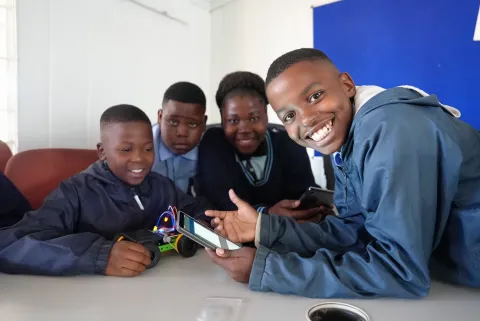
At Kgokare Secondary School in Gauteng, UNICEF is piloting an innovative artificial intelligence (AI) measurement tool developed by implementing partner ThinkShift.

The technology analyses complex datasets to track skill development, supporting South Africa’s Department of Basic Education to strengthen national assessment systems.
“The traditional classroom is about working individually on memorization and recollection. As a result of the Fourth Industrial Revolution, that has to fundamentally change,” says ThinkShift co-founder Busi Mkhumbuzi-Pooe.
In response, the ThinkShift approach simulates real workplace environments through project-based learning, helping students bridge the classroom-career divide.

The impact of this progam is already visible:
- Lesedi applies creative thinking to fashion design concepts
- Aspiring gynaecologist Khensani (14) gains critical analysis skills
- Amogelang (16), who has autism, has gained confidence through communication exercises
For Amogelang, the programme has transformed the way he expresses himself. “Look at me now,” he says. “People engage with me and like what I have to say, which is a first for me because I used to be a loner.”

Teachers report academic improvements too. “There is a huge improvement,” says educator Anna Mafojane, describing her students. “They challenge me to engage them more and we always discuss things more in-depth than how we did before.”
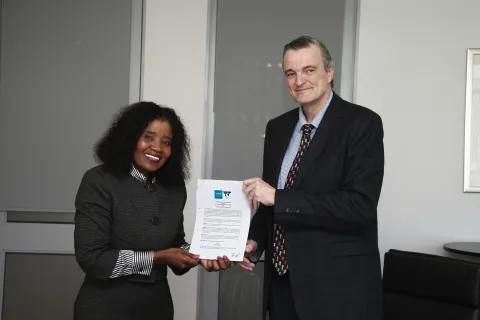
“Chery is dedicated to providing children with an enhanced learning environment to empower them with skills for their future careers,” says Tony Liu, Executive Deputy General Manager at Chery Automobile South Africa.
As the pilot progresses, UNICEF remains committed to scaling solutions that prepare every child to thrive in tomorrow’s economy.
UNICEF does not endorse any company brand, product or service.