When We Learn Together, Schools Flourish
The Power of Inclusion

- Srpski
- English

Svilajnac, December 2024 – When Zaza, who came to Serbia from China, joined the 6th-grade class at Jovan Jovanovic Zmaj Primary School in Svilajnac at the start of the school year, it became clear that the language barrier was not an insurmountable obstacle for the new student, her classmates, or the teachers. Welcoming Zaza into the classroom became both an inspiration and a challenge that enriched everyone involved.
Zaza is a cheerful and resourceful girl. Her favourite subjects are physics and math, where she excels, and in Svilajnac, she has also come to love learning Serbian.
“My teachers help me, as do my classmates, and they play with me,” says Zaza. “I’ve made progress in many subjects, and I’m getting better and better at Serbian.”
Teacher Stevica Maksimovic explains that peer support is crucial because a new student spends most of their time with their peers. Therefore, it’s essential that teachers encourage students to assist in the adaptation process.
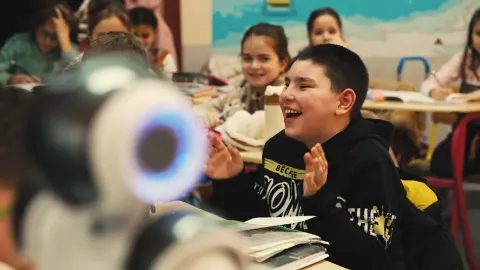
The students quickly found creative solutions to help Zaza learn Serbian and follow the lessons. She made friends, and in the process, the students from Svilajnac also broadened their knowledge and experiences.
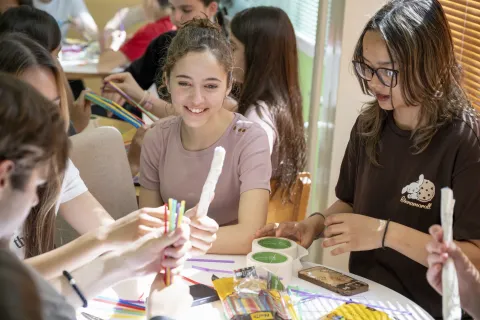
Zaza’s classmates, Teodora and Andrea, devised innovative ways to help her with her education. Teodora created flashcards to assist Zaza in learning Serbian. During breaks, the cards are carefully arranged on the desk, each one representing a gateway to a new world. One side of the card displays a Serbian word, while the other side shows its Chinese counterpart.
“Since then, Zaza has been learning more and more Serbian words, I’ve picked up some Chinese words, and we’ve both improved our English,” says Teodora. “Soon, Zaza began helping me with physics and math because she’s so good with numbers.”
“For teachers, providing lessons to a student unfamiliar with the language was a challenge, but together with the students, we managed to mobilize the entire class for a beautiful goal: learning and friendship,” explains teacher Stevica Maksimovic.


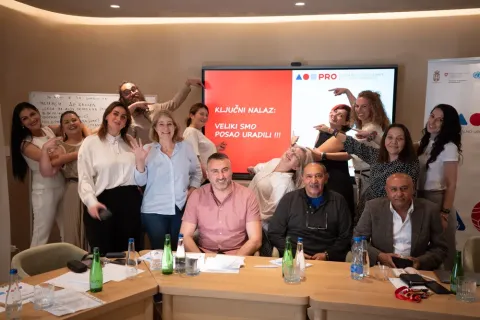
Maksimovic points out that for more than two years, the “We Learn Together” project, implemented by the Ministry of Education in collaboration with UNICEF and the European Union, has successfully incorporated the principles of inclusion, digital technology, and the green agenda.
“In today’s world, inclusion is an essential part of daily practice. We are on the right path to making inclusion a reality in our school. It’s vital to instil the concept of inclusion in children’s minds so that as they grow, they continue to embrace it and spread it to others,” says Stevica.
Teacher training has been crucial in enhancing their competencies. Through the “We Learn Together” project, they became more aware of the challenges they face and how to address them.
“We’ve identified our weaknesses and started working on them with the help of the Ministry of Education, UNICEF, the EU. The focus is always on the student, and the essence lies in improving communication between teachers, students, and parents,” says the English teacher, one of the 4,500 educators in Serbia who have been empowered by the project to enhance their skills for inclusive education.
One significant challenge the school recognized was helping students from rural schools adapt to the environment of their main urban school after 4th grade.
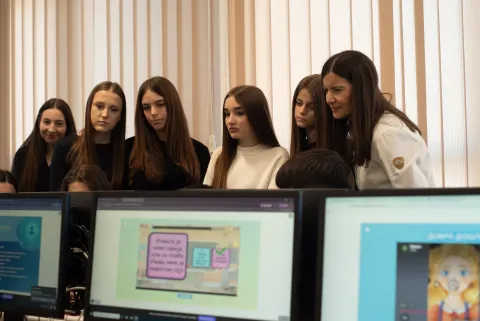
“In that transition period, students often feel out of place, and their academic performance drops significantly. Thanks to this project, we’ve raised awareness of these challenges. The focus on this transition has expanded to include all types of transitions—from preschool to primary school, from primary to secondary school, and now, helping foreign students who don’t speak Serbian adjust. We’ve also integrated digital tools to ensure online safety for children. For us, it’s vital to use education to spread awareness about the importance of inclusion,” explains Maksimovic.

Another key aspect of the “We Learn Together" project is horizontal learning, where teachers across Serbia share knowledge and experiences and participate in international exchanges to further improve their competencies.
Mentors like Otilia Velisek Brasko, an expert in quality education for every child, have played a crucial role in this process.
“Inclusive education has highlighted the need for further empowering practitioners to ensure every child can participate in learning. The support provided to teachers through the ‘We Learn Together' project has instilled a strong awareness among students and parents of the importance of embracing diversity as a great source of inspiration,” says Velisek Brasko.
For instance, the Petro Kuzmjak school in Ruski Krstur, which combines primary and secondary education along with a student dormitory, demonstrated the value of project-based learning. Teachers, students, parents, and the local community participated in an environmental initiative that inspired everyone involved and fostered the sharing of knowledge with other schools across Serbia.
“Thanks to this project, schools have flourished because they embraced the lasting value of differentiation and participation, driving our collective progress,” concludes Otilia Velisek Brasko.