Staying vigilant to impede a pandemic outbreak
Read on to learn more about how UNICEF Rwanda is supporting the Ministry of Health in Rwanda and the Rwanda Biomedical Center to conduct active case finding for early tracing of mpox cases at the household level.

It’s a warm and humid Sunday morning in a remote village in Kamonyi district, Southern Rwanda, as Saverina Mukamusoni, a long-serving Community Health Worker (CHW) trudges up a small hill to the doorstep of one of her neighbours and calls out the customary “muraho” greeting in the local language, Kinyarwanda (loosely translates to how are you).
After initially not getting a response from the dwellers of that home, a second – and slightly more audible – muraho! prompts a child to timidly venture out to see who has come calling. The child, whom I later learn is called Thabita, breaks out a huge grin as she recognizes Saverina and rushes forward to greet her.
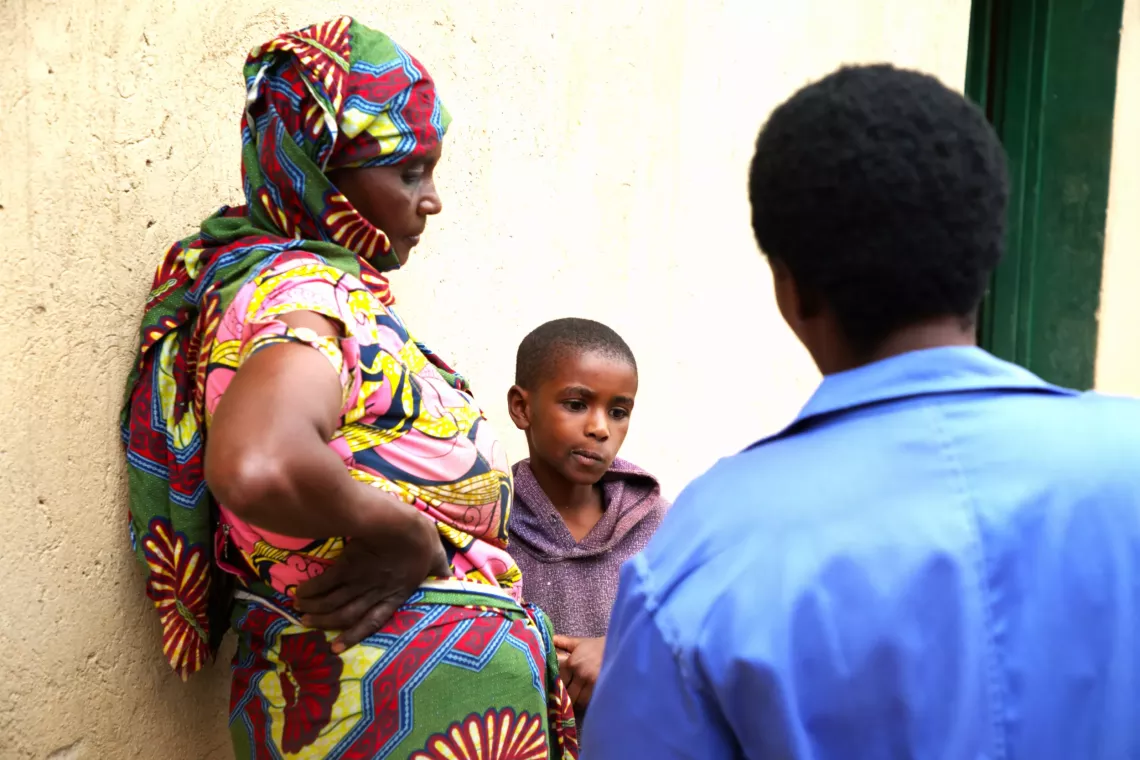
Saverina asks Thabita to inform her mother to come out of the house to see her, and a conversation amongst friends ensues. You can tell from the way that Saverina engages with Therese (Thabitha’s mother) that she is very skilled at community engagement – a skill honed over the course of almost three decades serving as a CHW in her village.
Severina painstakingly explains everything that she knows about mpox – its origin, how it is spread, symptoms to look out for, and other details – all while engaging Therese about how hot it has been of late, how Thabitha is faring in school, and other chitchat.
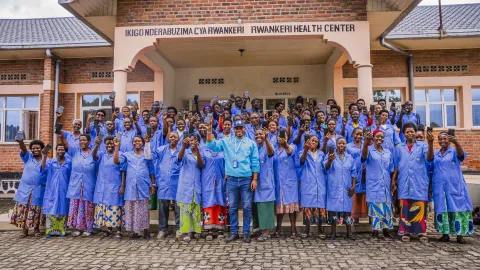
There is a strong cadre of 1,263 CHWs in Kamonyi district with whom UNICEF – through the Rwanda Biomedical Center – is working on the mpox response. The CHWs conduct active case finding by going door-to-door amongst households in the 12 sectors that make up Kamonyi district reaching almost 235,000 residents of the district with life-saving messages on mpox identification and prevention.
This crucial work is not being done in Kamonyi district alone. The mpox active case finding approach within eight districts identified to be at highest risk of being affected is a critical intervention to promptly identify and manage mpox cases.
"It is a great opportunity to sustain and strengthen community engagement which has been ongoing since the start of the outbreak and enhance the overall effectiveness of the Mpox outbreak response," said UNICEF's Health and Nutrition in Public Health Emergencies, Dr Thierry Ineza.
With financial support from the Mastercard Foundation, UNICEF has been able to reach almost 3 million people in 15 districts countrywide with life-saving messages related to mpox prevention, better equipping the community to proactively identify and – with support from the CHWs and local health post – diagnose potential mpox cases within the community.
UNICEF has been able to reach almost 3 million people in 15 districts countrywide with life-saving messages related to mpox prevention.

Saverina and Therese conclude a long-winding conversation with assurances from the latter that she will make sure that all members her household are fully informed about mpox – its origin and symptoms. Most importantly, she will inform of the prevention measures: regularly washing hands with soap and clean water, desisting from touching someone who has shown symptoms of the disease, and immediately isolating a suspected case.
When I ask Saverina how she is able to do such important work so effortlessly, her response is priceless.
“I consider this to be more than just work; this is my way of serving my community. I’m proud that my efforts – however miniscule – are contributing to our national efforts to contain the outbreak of mpox in Rwanda!” she exclaimed.
While a new variant of mpox that may be better adapted to spread between people has recently been identified in the Democratic Republic of Congo, these efforts have helped protect the public and thus far kept the mpox virus at bay.
On 14 August 2024, the World Health Organization (WHO) declared mpox a public health emergency of international concern (PHEIC), following the Africa CDC’s declaration on the day before, which recognized the mpox outbreak as a Public Health Emergency of Continental Security (PHECS). Rwanda confirmed its first mpox case on 24 July 2024, shortly after cases were reported in neighboring countries.
Since the onset of mpox in Rwanda, the country has reported 105 confirmed cases. Cases were confirmed after significant efforts were made to identify and isolate them in primary healthcare centers, collect samples, and transfer them to the national reference laboratory in Kigali for confirmation before ruling out some cases.
Rwanda has implemented comprehensive measures to address the mpox outbreak, including bi-monthly door-to-door active case finding (ACF) for early case detection, heightened screening and surveillance in schools and public areas, screening at points of entry (POE), ring vaccination, and public awareness campaigns. UNICEF also supported the development of national guidelines.
The end-result remains clear, as does the steadfast commitment from the Government of Rwanda and its partners: to prevent an outbreak of mpox in the country, and in the event an outbreak does occur, seamlessly and effectively contain its spread.