Beyond Silence: Fatuma’s New World of Sound
How digital hearing aids gave a young girl in Rwanda her voice, her confidence, and her future.

In Muganura village, Rwamagana District, Eastern Rwanda, lives Fatuma Mbabazi, 16 years, with her parents and two siblings.
From the age of four, she lived in silence, struggling with hearing and speech difficulties. She could not follow lessons at school, play with other children like the other girls of her age, or communicate with her family. “Life before hearing aids was very difficult,” she recalls. “I often felt alone, even when I was with others.”
Her parents, Selemani Mugabo and Mary Mukamurenzi remember those painful years. They tried to support Fatuma with everything they could, even managing to buy her a pair of analog hearing aids. But the devices were not digital and offered little or no help at all. The hearing aids were later lost at school, and the family could not replace them. “It was a big blow for us,” Selemani says. “We thought our daughter might never have a chance to live like other children.”
Mary adds softly, “I used to look at her and cry, because she could not respond. Seeing my child sitting silently at home was not a happy thing at all. When she finally spoke to me for the first time, I cried again, but this time with joy.”

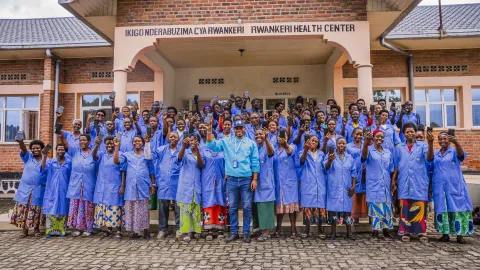
That joy came when Fatuma was identified through the Winsiga Ndumva programme, a partnership of the Rwanda Biomedical Centre, UNICEF, ATscale and implemented by the Umbrella of Organizations of Persons with Disabilities in the Fight against HIV/AIDS and for Health Promotion (UPHLS). The programme was launched in 2023 to tackle the huge unmet need for ear and hearing care in Rwanda, where hearing aids were often unaffordable, unavailable through health insurance, and only accessed by traveling long distances to specialist hospitals at extremely high costs. Stigma and lack of awareness meant many children, families, and other members of the surrounding community, went undiagnosed or unsupported.
With an investment of US$1.2 million over three years, the programme is scaling up disability-inclusive primary health care to eight districts, Nyagatare, Nyarugenge, Huye, Nyabihu, Musanze, Rwamagana, Rusizi, and Muhanga. It aims to fully integrate ear and hearing care services in the routine screening for over 9,400 children and provide at least 1,200 with digital hearing aids, while also training health workers, supporting teachers, and raising awareness in communities.

During an outreach clinic at Institut Filipo Smaldone, Fatuma was fitted with digital hearing aids that transformed her life.
"The first time I put them on; I heard my mother’s voice clearly. It felt like I had entered a new world,"
Her world has since expanded in remarkable ways. When she is at home during school holidays, Fatuma puts on her digital hearing aids every morning before helping her mother with different chores. She sweeps, organizes the house, and enjoys reading stories in the afternoon. Sometimes her mother sends her to the nearby shop to buy salt or soap. Fatuma proudly pays, receives the correct change, and returns home with confidence. “Now she is independent, like any other girl,” her father says.


At school, the difference is clearly seen. Before receiving her digital hearing aids, Fatuma relied exclusively on sign language, which only a few teachers and classmates understood. She repeated lessons, often felt isolated, and missed catching up on her education compared to her peers. Now, she follows lessons closely, participates and answers questions in class, and interacts freely with her peers. In 2025, she proudly completed Primary Six National Examination at Rwamagana Adventist Primary School, a milestone she once thought was impossible.

Her mother sees the change every day. “Before, Fatuma’s learning was always a struggle. Now she is cheerful, sociable, and unafraid of interacting with others. Seeing her smile gives us so much hope.”
Her confidence shines not only in school but also in her community. Fatuma has joined a local traditional dance troupe, where she follows the beat of the drums, moves with the other dancers, and performs with joy. “She is still learning some words, but she is far ahead compared to before. Watching her dance makes me believe in her future,” her father says proudly.

Fatuma now dreams big. “I want to become a doctor in the future. I want to continue my education and one day advocate for other children with disabilities. I want them to know they can also succeed.”

Her story is a reminder of what strong partnerships can achieve. The Winsiga Ndumva programme is not only giving Fatuma the chance to hear, learn, and thrive, it is also showing what is possible when governments, development partners, and communities come together.
Selemani offers a final reflection: “Through this programme, my daughter’s life was saved. If it could reach more children like Fatuma, many families would be free from the pain we lived for years. A strong partnership like this can save a lot.”

But there is still more to do. Thousands of children across Rwanda are still waiting in silence, unable to access the hearing care they desperately need. Expanding access to digital hearing aids, ensuring batteries and services are available close to home, training more teachers, and raising awareness are essential next steps. Stronger investment, advocacy, and collaboration can ensure that no child is left behind because of hearing loss.