From Piles of Registers to Digital Care: Community Health Workers in Rwanda Adopt Digital Health Rec
Community Health Workers across Rwanda are replacing paper registers with the Community Electronic Medical Records (cEMR) system, strengthening digital health services for mothers and children.

In villages across Rwanda, Community Health Workers (CHWs) are often the first point of care for mothers and children. Every day, they walk from one household to the other checking on pregnant women, monitoring children’s health and supporting families with knowledge on nutrition, disease prevention and referrals to health centres.
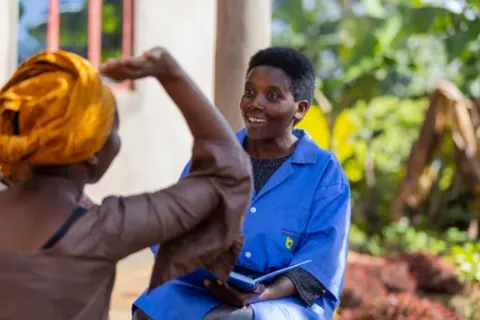
“During these home visits, we used to carry several registers,” explains Nyirandikubwimana Pauline, a CHW during the cascade training in Rwankeri Health Center. “Sometimes to find one family’s record, we had to turn many pages. Now the phone helps us to organise the information and reminds us of the follow-ups when needed.”


With funding from the Republic of Korea and UNICEF technical oversight, the Ministry of Health and the Rwanda Biomedical Centre (RBC) launched a cEMR pilot, strengthening leadership, training, mentorship and supportive supervision. Smartphones were provided to 600 CHWs in five districts; 3,153 CHWs then modeled implementation in five more districts, and UNICEF supported scale-up in four additional districts reaching 7,268 CHWs. Results spurred government and partners to expand cEMR to 17 districts (31,094 CHWs) and nationwide to 30 districts (58,567 CHWs) by end-2026, improving real-time data use, decision-making, and quality and continuity of maternal, newborn and child health (MNCH) care.


For years, much of the CHWs work was relying on paper registers.
Each service had its own register, one for pregnancies, one for newborn follow-ups, another for childhood illnesses, and others for nutrition monitoring and referrals. During household visits, CHWs often carried several registers to record data.
As registers accumulated, finding past information during follow-up visits took time. Monthly reporting meant manually counting and summarizing entries across multiple books. The health-centre supervisors often waited for paper reports before they could review community health data, so the Government of Rwanda introduced the Community Electronic Medical Records (cEMR) system to improve how community health information is recorded, shared and used.

Through cEMR, CHWs can now record services directly on smartphones. Instead of using multiple paper registers, information on pregnancies, child illnesses, nutrition and follow-ups can be entered into one digital system.
The mobile application allows CHWs to register households, record services and retrieve information during follow-up visits, helping them to manage their workload more efficiently.
The system is designed to reduce the administrative burden faced by CHWs while improving the quality and timeliness of health data. It also enables supervisors at health centres to review information earlier and provide targeted support when needed.
For families, this means better follow-up during pregnancy, improved monitoring of children’s health and faster response when support is needed.
For CHWs who have spent years working with stacks of notebooks, the change is significant.

“What used to take many registers,” Cyubahiro Innocent, a CHW, says with a smile, “can now be done on one phone.”
To prepare for the rollout of cEMR, the Ministry of Health through RBC, in collaboration with UNICEF and with financial support from the Republic of Korea, organized Training of Trainers (ToT) sessions for health facility staff who will guide CHWs in adopting the digital system.
Participants included community environmental health officers, data managers, store managers, CHW supervisors and IT officers from district hospitals and health centres.

The trainings focused on building technical skills and preparing facility staff to support CHWs during the transition from paper registers to digital tools.
“This cEMR training, combined with mentorship and supportive supervision, is critical to strengthening Rwanda’s community health programme,” says Emery Hezagira, Director of the Community Health Programme at the RBC. “By equipping CHWs with smartphones and digital tools, the system supports accurate records, decision support and real-time data for better health services across districts.”
The rollout follows a structured approach. Health facility staff are trained first before supporting CHWs through cascade trainings at health centre level.
Following the ToT sessions, participants returned to their health centres to begin cascade trainings for CHWs.
During these sessions, CHWs practise using the application, learn to enter service data, and see how the system supports follow-ups and generates reports more efficiently.
Field visits during the training process also allow supervisors and partners to observe how the system is being used and identify areas where additional support may be needed.
“UNICEF and the Government of Rwanda have built a strong, results-driven partnership to advance maternal, newborn, child and adolescent health (MNCAH) outcomes, especially for underserved communities,” says Dr. Manzi Emmanuel, Health Specialist at UNICEF Rwanda. “By scaling digital tools from Rapid SMS and RapidPro to District Health Information System -2(DHIS2), data visibility, real-time decision-making, accountability and equitable service delivery are strengthened across the health system.”
CHWs say the digital system is making their work easier and helping them support families more effectively.
“Now we can record services immediately during home visits,” one CHW explains. “The phone helps us keep track of mothers and children and make sure no one is missed during follow-ups.”

The rollout of cEMR is part of Rwanda’s broader effort to strengthen digital health systems and improve the way community health data supports decision-making and service delivery.
Across Rwanda, digital tools like cEMR are helping ensure that CHWs have the tools required to reach every mother, every child and every family served.
For community health workers who spend their days walking between households, cEMR is a meaningful shift: less time managing stacks of registers, more time supporting the families who rely on them. Continued investment in digital tools, training and connectivity will help CHWs work more efficiently, improve health data quality, and strengthen follow-up and care for mothers and children across Rwanda.