Refuge, friends, new dreams
An 18-year-old Ukrainian refugee builds a future in Romania while carrying the weight of war

- English
- Română
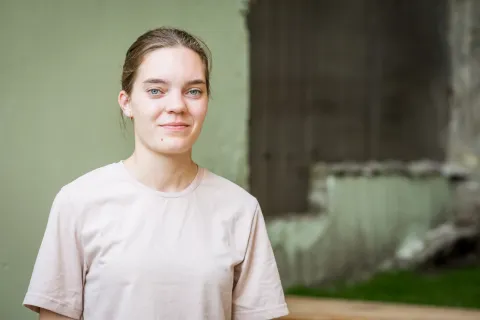
The first nights in Timișoara were the hardest. Denys would jolt awake to the sudden sounds of sirens from the fire station near his new apartment, heart beating fast, unsure if the sound meant bombs were falling.
In the first days of the war, his family knew their hometown of Lutsk, Ukraine, near the Belarusian border, might be attacked next. His father packed their bags, ready to leave together, until the news came that men between 18 and 60 years old were not allowed to leave the country. “At first we wanted to go with dad,” Denys remembers, “but just as we packed everything and decided to leave, they announced men couldn’t go.” Instead, his father turned to his teenage son and said: “Take care of your mother.”
This is how Denys and his mother began the long journey to the south, crossing into Romania to reach his older sister, who was already living and working in Timișoara. Denys remembers feeling unexpectedly in control, translating from English, asking for directions, handling delays with trains and buses, because his father’s words were still in his mind and taking care of his mother was all that mattered.
Leaving Lutsk meant letting go of the small routines that he loved about his daily life, like playing football with his friends after school, stopping for ice cream on the way home and spending time with his dad. “Those are the things I still miss the most,” Denys says. It meant unmooring himself from the place he thought would always define “home”, and rebuilding it around people instead: his mother and sister in Romania, and his father waiting back in Ukraine.

Still, some ties and memories hold across time and space. Fishing has been part of Denys’ life since he was four years old, when his father gave him his first fishing rod, and the ritual has stayed with him. Even in Romania, he finds quiet places by the water, where he casts a fishing line as a means of meditation, a way to reconnect to himself, to feel close to his father across the distance, or to share calm moments with his friends.


Even now, four years later, the war has not loosened its grip on Denys. Whenever he wakes up to news of new bombings in his hometown, his first reflex is to call his father. “One night, I woke up to loud noises from a massive rocket bombardment in Lutsk,” he recalls. “I grabbed my phone right away to make sure dad was okay.” What weighs on him most is the feeling that the world is moving on. “I noticed recently that most of the people here in Europe… It’s almost like they forgot, like the war has finished, like nothing is happening in Ukraine. But there are still people dying over there, children dying.”
When the conversation shifts to the future, Denys balances the pragmatism of someone who has grown up quickly with the optimism of a teenager who still allows himself to dream. He plans to learn Romanian better and to study computer science at university in Timișoara this year. At the same time, he talks about giving back in the future, through volunteering and supporting children who carry trauma as he once did.
“I know how important it is to have someone there, someone who understands,” he says.“One day, I want to be that person for others.”
But he hasn’t let go of his childhood passions, either. His smile lights up his face when he describes his love for cars: “Since childhood, I’ve dreamed of being a racing driver. I go to car events and photograph cars, it’s my passion” he grins.
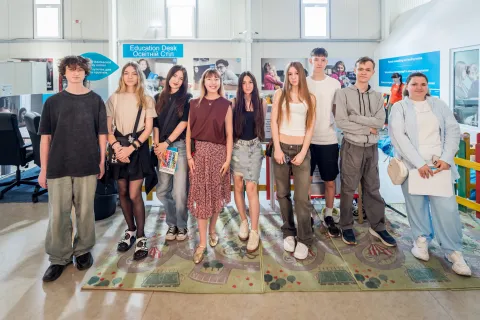
However, more than any hobby or passion, it is human connection that has helped Denys really flourish in Romania. When Denys first arrived in Timișoara, he was shy and kept mostly to himself, but that changed after he discovered the Ukrainian Youth Hub, a place where he could meet other young people, join different activities, and slowly begin to open up. Looking back, Denys says the hub gave him the space to start expressing himself, to trust people, and to feel confident about a new beginning in Romania. “Without it, I don’t think I would have found my way,” he reflects. “It helped me understand myself better, find people I could trust, and learn how to live.”

The Ukrainian Youth Hub in Timișoara has become that kind of space for many other young people who, like Denys, were displaced by the war in Ukraine. Created by FITT - the County Youth Foundation, with support from UNICEF, the hub offers activities, learning opportunities, and a place to form connections, to feel welcomed and understood.
Since the start of the war, UNICEF has been supporting similar initiatives across Romania, helping children and their families adapt, reconnect to a community, and begin to regain their sense of stability and belonging. This has been made possible thanks to the support of partners such as the U.S. Department of State’s Bureau of Population, Refugees, and Migration, which plays a key role in promoting the protection and integration of Ukrainian refugee children in Romania.
Denys’ hope is to one day return home to Ukraine. Until then, he wishes adults would remember that children and teenagers displaced by war carry a great deal of pain. “I think adults should understand what this feels like. It’s very painful. They need to know that the war is not over for us and to understand how it still feels.”