Polina’s Path
A young Ukrainian refugee’s journey to a new life with purpose

- English
- Română
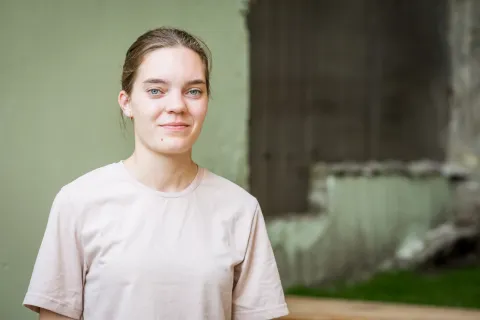
Polina answers questions like she’s solving an algebra equation: She listens intently, she crafts sentences deliberately and delivers answers that land with quiet precision. She places each word with the care of someone building something solid out of the silence around her. “Algebra is something you can feel is right,” she says, her eyes steady. Equations follow rules, they offer structure even when the rest of life doesn’t.
But ask her about her godparents, who are still back home in Bucha, Ukraine, far from the safety she’s found in Romania, and her voice breaks slightly while her eyes fill with tears. In that fraction of a second, the illusion lifts, and you can briefly glimpse the girl underneath: vulnerable, fiercely loving and with a strong armour threatening to crack under the weight of missing everything she had to leave behind.

Polina moves between two worlds, as she is equal parts analyst and artist, grounded but deeply sentimental. In one breath, she speaks about valuing structure and finding calm in rules, patterns and in knowing exactly what to expect. In the next, she talks about the way music settles her nerves, or how drawing flowers helps her reconnect with herself on days when the world feels out of balance.
Polina arrived in Timișoara when she was just ten, a child old enough to understand the terror of war, but still young enough to look for safety in the faces of the adults around her. What she remembers most from those early days isn’t the fear, though there was plenty, but the unexpected warmth she found in other people. “When I first came to Romania, the first thing I noticed was that there were so many people who genuinely offered help,” Polina says.

For now, Polina attends school mostly behind a screen, as she is enrolled in an online Ukrainian program designed for students displaced by the war, which allows her to stay connected to her language and curriculum. She misses subjects like art and music, but has found meaning in others. “English is useful. It helps me communicate with people from different cultures,” she explains. Over time, she has also learned some Romanian language, enough to manage simple conversations and feel more at ease in her new country. And algebra, of course, is still one of her favourites, as it’s a subject where things add up and where problems have answers.
Romania has started to feel like home for a while, a place where she feels safe and supported, and online school gives her a sense of routine, but it’s her plan for what comes next that keeps Polina going. She already seems to see her future with clarity: a life rooted in service, in giving back, in helping others feel seen and supported, just like she was. As she talks about her future, Polina speaks with a steady focus, like putting one foot in front of the other on a neat path she’s already laid out for herself. “My dream for the future is to volunteer, to sing, and to become a teacher for kindergarten or primary school children,” she says. Helping others doesn’t feel like a fantasy, but a clear direction traced by what she’s lived through and what she values most: empathy, connection and respect for others.

And then, just under the surface of her mature composure, Polina’s fierce longing to return home flares. “If I were 18, I’d go back to Ukraine right this second,” she says, without hesitation. But even when her teenage heart pulls in the direction of home, Polina keeps moving forward. She adapts, she learns, she plans. When asked what advice she’d give to other children starting over in a new country, she answers quickly: “Be brave. Don’t be afraid to try something new and to communicate with people.” Her advice reflects the way Polina moves through the world: with determination and an unshakable sense of who she is and who she wants to become.
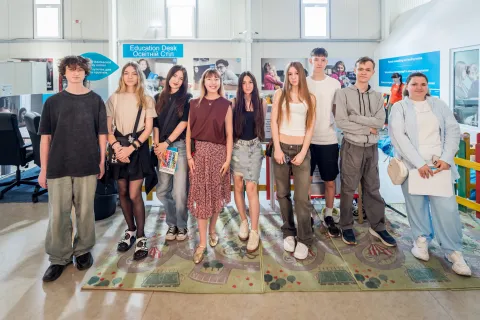
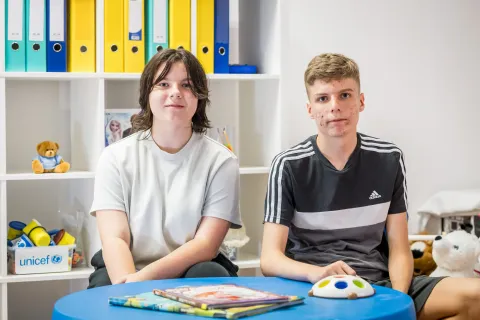
As she follows her plan for the future, Polina has found support within her family and through school, but also in the community around her. One place that has made a difference for her is the Ukrainian Youth Hub in Timișoara, a space where many children like her go to feel understood, to learn, and to connect. Set up by FITT - the County Youth Foundation, the centre offers, with support from UNICEF, activities, learning opportunities, and a place to feel welcomed and understood. This youth hub has played an important part in helping Polina find her place in her new community, giving her the chance to meet other teenagers from Ukraine, Hungary, and Romania, and to share experiences through activities like theatre workshops that sparked creativity and new friendships.
Since the start of the war, UNICEF has been supporting similar initiatives across Romania, helping children and their families adapt, reconnect to a community, and begin to regain their sense of stability and belonging. UNICEF has benefitted from the support of the United States Department of State’s Bureau of Population, Refugees, and Migration, a key partner in protecting and promoting the integration of Ukrainian refugee children in Romania.