A Place to Play, A Place to Belong in Bacău
How Bacău’s Inclusive Playground is Changing a Community

- English
- Română
Every parent knows the joy of watching their child making a new friend at the playground: the moment of hesitation before a shy game turns into laughter, the effortless way that barriers fade and strangers become friends when children run, climb, and play together. This is why playgrounds are places where communities take root, where children learn how the world works, and where differences often matter less than the joy of play.
But for too many children, especially those who are living with disabilities, these moments of connection are not as common or as easy to experience. Many playgrounds are not designed with all children in mind, leaving some of them watching from the sidelines instead of taking part in the games that all children share. Without opportunities to interact with their peers, many children grow up feeling excluded, not because they lack the ability to join in, but because the world around them isn’t built to include them.
Bacău’s inclusive playground was built to address this gap. More than just a space for children to play and have fun in, it is a place where inclusion can be lived and learned, where friendships between children with diverse abilities can be formed organically, and where a community can grow stronger, through each shared game at a time.

"Over time, I realized that this project means so much more for the Municipality of Bacău than just a space where children have a place to have fun," says Daniela Pozînărea, Head of the Social Assistance Directorate of Bacău Municipality. "Every day, children are learning about diversity and acceptance. The fact that they interact daily, that they collaborate and form playgroups, significantly reduces discrimination and changes the way they see children with disabilities."

Thanks to the financial contribution of the Austrian people offered through the Austrian National Committee for UNICEF, this playground is contributing to reshaping the way children, together with their community, understand inclusion.
Play is essential for every child, and for children with disabilities, it is also a rare opportunity to connect, to develop physically, and to feel like they truly belong in places where other children can thrive. "Play is important for all children, but especially for children with disabilities," says Carmen Fifirig, Head of the Integrated Community Service at the Social Assistance Directorate of Bacău Municipality and coordinator of the Integrated Community Center in Bacău. "It allows them to interact, to experience joy, to be outdoors. When they engage with other children, it brings happiness to everyone."

Unlike traditional playgrounds, where many activities are inaccessible to some children, this one has been built with equipment that invites all children to explore, engage, and challenge themselves at their own pace. This is why, for many children with disabilities living in Bacău, this playground is their first real chance to experience movement, to explore freely, and to play alongside other children without barriers. The playground elements built in a thoughtful way give these children opportunities to live in the moment, to feel less self-conscious about differences to typical children, and to feel seen and included in collective games.
"Some of the most loved play areas are the ones where they develop fine motor skills," explains Ms. Carmen Fifirig. "We have the musical piano panel where they can practice coordination, as well as different interactive play structures: circles they need to manoeuvre, a caterpillar to interact with, and all children truly enjoy these activities."
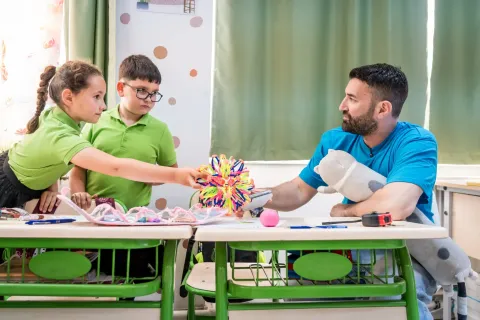
For children with disabilities, these activities and toys are also excellent tools for physical development and growth. The movements of gripping, pulling, and pressing help improve coordination, reaction speed, and motor skills in a way that feels natural and enjoyable. When playing in a group, children can often push their physical limits and build strength and new skills without even realizing their progress.

Perhaps just as importantly, bringing children together in an accessible space is influencing the way they see the world and their place in it. For children with disabilities, the playground encourages independence and builds confidence in their skills and power, so that they contribute to creating a better world, with their ideas and their knowledge. For typical children playing together with them is doing something just as powerful: teaching them, from an early age, that disability does not define a person. And this is how they build friendships and create memories.
"The fact that our city now has an inclusive playground means that our community will become more tolerant. We are creating a more equitable society, one where inclusion is not just a concept, but something that is experienced every day," Ms. Pozînărea explains. "Through this playground, we have created an opportunity for children to grow up in an environment that promotes inclusion and the acceptance of differences. This means we are laying the foundation for them to become responsible, empathetic adults. I believe this project will have long-term benefits for our community," she says proudly.

Access to safe, inclusive spaces is something many children take for granted, but for children with disabilities, such spaces are rare in Romania. Without inclusive spaces, many children remain on the sidelines, unable to fully participate in their communities.
UNICEF has been working with the Romanian authorities to change this. In one of the latest initiatives, “Romania for every child”, five Integrated Community Centers (ICCs) were established in urban and rural areas in Central and Eastern Romania, in Bacău, Brașov, Colonești, Corbasca and Moinești. These centers serve around 20 communities, providing children and their families with health care, education, and social services. In Bacău county alone, over 7,200 vulnerable children and their families have received support, children with disabilities having had free access to kinesitherapy, speech therapy, and psychological counseling.
With continued commitment and investment in child-friendly and inclusive infrastructure, services and community programs, UNICEF is helping to build a future where every child can play, grow, and belong without barriers or exclusion.