CNASR-UNICEF study: Shortage of social workers in rural areas and ageing-threatened workforce
The research shows a significant labour shortage in the sector in the coming years, as the number of beneficiaries increases
- English
- Română
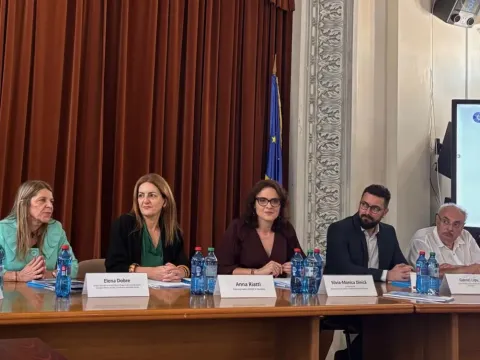
Bucharest, 27 June 2023. The social services workforce is threatened by ageing and is under-represented in rural areas, where only a third of social services employees work, according to the Census of the Social Services Workforce in Romania, conducted by the National College of Social Workers in Romania (CNASR) with support from UNICEF. This situation requires a strategic and immediate approach, given the statistical data showing that Romania has the highest rate of risk of poverty and social exclusion in the European Union1, pronounced rural-urban disparities and a marked ageing of the population.
More than half (56%) of the nearly 21,000 survey respondents are over 46 years old, while only 13% of survey participants are under 36 years old, according to data collected from April to October 2022. In the absence of a policy aimed at attracting young people into social services professions, the situation will worsen and lead to a severe labour shortage in the sector, as the number of beneficiaries increases, the study's authors say. One solution could be to increase the number of entry-level posts open for applications, but also to offer installation packages and benefits packages for those who take up work in rural areas, or scholarships for students from rural or disadvantaged areas to work in rural areas after graduation.
Another problem identified in the Social Services Labour Force Census is the low representation of social service employees in rural areas (only one third of them work in villages and communes), a conclusion that also applies to the segment of social workers. In more than 50% of localities the ratio of social workers is below the optimal threshold of one social worker per 3,000 inhabitants. Of these, 70% are in rural areas. The study also highlights a shortage of specialists and limited capacity to provide social services, especially for certain categories of beneficiaries, such as children and adults with disabilities, the terminally ill, victims of domestic violence and victims of human trafficking.
Diana Cristea, President of the National College of Social Workers in Romania (CNASR), says: "Research and data on the social services workforce are essential to determine employment trends, address training needs, identify barriers to the provision of quality social services and develop policies to plan, develop and support them. A planned, developed and supported workforce is important for families and communities to deliver programmes that aim to counteract poverty and social exclusion. A strong workforce can better protect citizens and help people tackle the challenges in their daily lives. Given the dynamics of the workforce, it is desirable that such census exercises are carried out regularly so that timely action can be taken to reduce the negative effects of a significant number of professionals leaving the field."
"The results of the social services workforce census - a unique exercise in the Europe and Central Asia region - urge us to take a strategic approach by using this evidence in developing policies for planning, distributing, attracting, recruiting and retaining the social services workforce. This includes the allocation of adequate resources to strengthen and support the social services workforce, particularly in rural, marginalised areas, for the establishment, development and implementation of social services that respond to the needs identified by the social diagnosis of each community. At the same time, support must be provided for adequate and continued training of professionals, with priority for those already working in the field, so that quality social services are available for children and their families, adults with disabilities, the elderly and all categories of vulnerable population", said Anna Riatti, UNICEF Representative in Romania.
The study, available in advanced draft and to be made public by mid-July 2023, mainly aimed to objectively assess, in terms of coverage and distribution, the available social workforce. The census-type research was conducted among professionals employed in the social services sector in Romania in 2022 by the National College of Social Workers in Romania (CNASR), with the support of UNICEF, and through Metro Media Transilvania. The research was conducted through a questionnaire-based sociological survey, resulting in a total of 20,999 valid responses.
1 Romania AROPE 2022: 34.4% (vs. 21.6% EU average), Statistics | Eurostat (europa.eu)
Media contacts
About CNASR
The National College of Social Workers represents the interests of the social work profession and acts by all means conferred by law for its development and to raise its prestige in social life. As a professional authority in the field, CNASR participates, according to art.26 of the Law 466/04.11.2004, in the elaboration of norms and legislation regulating the field of social assistance, fulfilling the attributions conferred by the Law 466/04.11.2004. As a professional organization, the CNASR represents, defends and promotes the rights and interests of its members at local, national and international level, defends the honor, freedom and professional independence of the social worker in the exercise of the profession, ensures that social workers comply with their obligations towards beneficiaries, institutions and society, in accordance with the deontological rules of the profession.
Follow CNASR on www.cnasr.ro and www.facebook.com/ColegiulNationalalAsistentilorSociali.
About UNICEF
UNICEF is present in Romania and 190 other countries and territories to promote the survival and development of children from early childhood through adolescence. In Romania, UNICEF works with key actors such as government, parliament, local authorities, civil society, the private sector, national and international partners and the media to ensure access for all children to quality early education and schooling, to protect adolescents and monitor children's rights, to provide social protection and to mobilize resources for children. For more information about UNICEF and its work, visit https://www.unicef.org/romania/ro.
Follow UNICEF in Romania on Facebook and Instagram.