The quest for clean air in North Macedonia
Youth activists empowered to take action

- English
- Македонски
- Shqip
“Many of the green initiatives are tokenistic and they don’t work,” says 19-year-old Desanka, an environmental activist in Skopje, North Macedonia. Desanka has been working with other young people on a petition to the government, calling for higher fines for factories that do not take adequate protection measures on air quality.
“Stopping air pollution at the source is the most important thing we must do. Factories need to face fines if they do not use appropriate filters,” explains Desanka who has experienced the effects of air pollution herself. “I used to live in a village, and I came to Skopje last year to study medicine. I feel like I am a smoker now: I have a constant cough, but I do not smoke.”
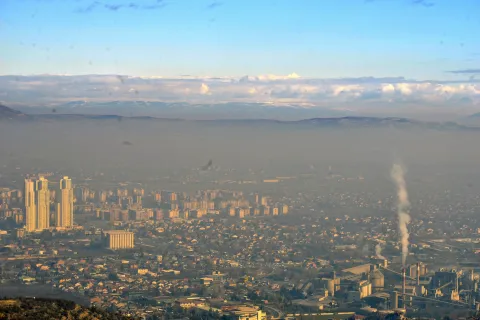
Across Skopje, North Macedonia, levels of PM2.5 – particles measuring less than 2.5 micrometers in diameter - far exceed the levels considered safe for health by the World Health Organization (WHO). These toxic particles are easily absorbed into the bloodstream and are most harmful for children as they wreak havoc on their developing lungs, hearts, and brains.
According to the Ministry of Environment and Physical Planning, a significant portion of the country’s air pollution (45 per cent) stems from the heating systems used in households and public institutions. This is further compounded by heavy traffic and industry.
UNICEF’s Youth4CleanAir initiative supports young people like Desanka from across the country to gain the skills and knowledge they need to advocate to their local authorities and the wider public for better air quality.
The initiative has not only supported young people to learn about air quality and advocate for policies to address air pollution, but it has also enabled them to grow and develop personally. “It has given me a lot of confidence, passion and a purpose,” says Enis, 19. “I have learnt a lot, about air quality but also about myself.”
While there is still a long way to go, these young people feel empowered by the response from the local authorities. “They have taken us seriously. We sit with them at the table and discuss a way towards cleaner air,” says Desanka.
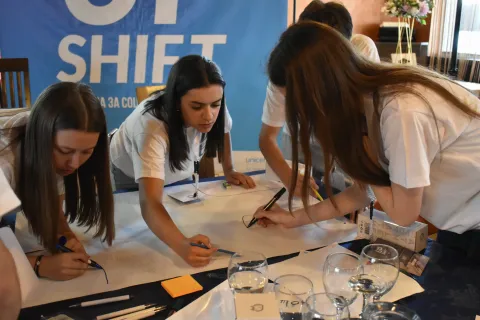
To amplify the voices of children and young people and support their inclusion in decision-making on air quality and environmental policies, in 2024 UNICEF held a series of 15 workshops for youth on air quality in five municipalities heavily affected by air pollution. These provided an opportunity for young people to raise their voices, advocate in their communities, develop initiatives and contribute to decision-making via different mechanisms, including through influencing the municipal air quality plans, to ensure that they address the specific needs of children and young people.
Young people submitted a range of specific asks to local and national institutions such as replacing polluting heating systems in schools and preschools, introducing low emission zones around schools, reliable and sustainable public transport, strengthened inspections for industrial facilities and subsidies for households to replace polluting heating and cooking systems.
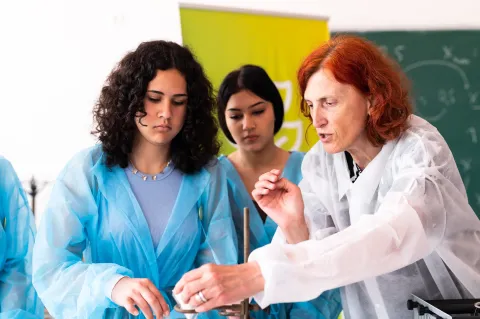
UNICEF also works to engage younger children in environmental topics including air pollution. Last year, the Bureau for the Development of Education and UNICEF launched the Experiential Learning Network to bring science and environment closer to children, including learning about air pollution. The network, which includes the Macedonian Ecological Society, Botanical Garden – Skopje, Hydrobiological Institute – Ohrid, Educational Centre – Negrevo, Narodna Tehnika, and the National Park – Galichica, developed and now runs an extracurricular education programme reaching children and adolescents in primary and secondary education. To date, over 3,000 students from across North Macedonia have participated in its workshops.
Angela Ivanova, 26, from Skopje is one of the mentors at the Institute of Biology at the Faculty of Natural Sciences and Mathematics. She has been actively involved in the development and implementation of the Experiential Learning Network since the beginning and she is also involved in other educational programmes of the Botanical Garden and in organizing national competitions in biology for primary and secondary school students.
“Usually, children do not have microscopes in their own schools. When they come here, we show them what plants look like on the inside using a microscope and you immediately see the amazement on their faces. They are delighted. Everyone interprets it in a different way,” explains Angela. “We always make the link between plants and air quality because they are critical to human health and the area.”
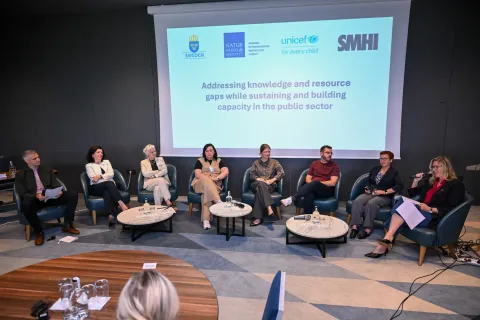
UNICEF works across the Western Balkans in partnership with governments, the private sector, civil society and the Swedish Environment Protection Agency to tackle levels of air pollution that are among the worst in Europe. Our work includes improving environmental education in schools, supporting education programmes for green skills, raising awareness about the causes and health impacts of air pollution among communities, and engaging children and young people in air quality data and management.